The Federal Reserve has initiated its long-anticipated easing cycle, potentially setting the stage for a bullish trend in risk assets, including Bitcoin (CRYPTO: BTC) and other cryptocurrencies, according to industry experts.
What Happened: Economist and crypto analyst Alex Krüger took to his X account to highlight the Fed’s decision to implement a 50-basis point cut while projecting an additional 50 basis points of cuts for 2024.
This balanced approach, Krüger suggests, has struck a “sweet spot” by addressing concerns about the Fed falling behind the curve while simultaneously demonstrating control rather than reactionary measures.
For cryptocurrency enthusiasts, Krüger sees a bullish outlook for Bitcoin, though he cautions that its trajectory may be heavily influenced by the upcoming U.S. election results.
He even suggested a bold strategy for altcoins: “For altcoins, go max long early in Election Night if Trump is coming up ahead in the counts. That’s my plan.”
Krüger emphasized the robust state of the U.S. economy, a factor he considers crucial for risk assets. He pointed out a historical trend: “Historically when the Fed begins its easing cycle with no recession, equities have rallied 10% in six months, while if the Fed begins the cycle in a recession, equities have fallen by 12%.”
Why It Matters: Economic strength was echoed in Fed Chair Jerome Powell’s statement: “I don’t see anything in the economy that suggests the likelihood of a downturn is elevated. You see growth at a solid rate, you see inflation coming down, you see a labor market that’s still at very solid levels.”
However, Krüger also tempered expectations, noting that U.S. equities are not cheap and that a return to a real negative rates environment is unlikely in the near future. He observed a significant divergence between market expectations and Fed projections for 2025, with the market pricing in a 25% probability of a hard landing.
In conclusion, Krüger’s analysis suggests that while the Fed’s easing cycle could boost risk assets, including cryptocurrencies, investors should remain vigilant of economic indicators and political developments that could shape market trends in the coming months.
Ford Motor Company (NYSE:F) shares are trading higher on Wednesday. Ford, Bayerische Motoren Werke AG (OTC:BMWYY) and, Honda Motor Company, Ltd. (NYSE:HMC) launched operations for the joint venture, ChargeScape, that was announced last year.
ChargeScape, the vehicle-grid integration joint venture, is a software platform that connects electric vehicles (EVs) to the power grid, helping to stabilize the grid and reduce charging costs for drivers.
The companies disclosed the appointment of Joseph Vellone as ChargeScape’s first CEO and Kalidindi Raju as its Chief Technology Officer (CTO).
Vellone said, “The U.S. has set ambitious targets for renewable energy deployment and EV adoption, and ChargeScape is here to bridge that gap between supply and demand of electricity.”
“We want to transform EVs from a liability into an asset for the power grid and help deliver a clean transportation future for our country.”
Raju said, “Although the vehicle-grid integration market is expected to be highly competitive, our partnerships with the world’s largest automakers gives us a significant edge. With direct access to the vehicles, we enable utilities to optimize EV charging securely and reliably.”
ChargeScape’s technology wirelessly connects to electric vehicles and collaborates with utilities to manage energy flow based on real-time grid conditions.
EV drivers can be financially rewarded for their flexibility, while ensuring their vehicles are charged by the specified time.
This month, Ford sold 8,944 electric vehicles in August in the U.S., marking a jump of 29% from the corresponding month last year.
This week, the company said that it is looking to start production of a high-performance race car variant of the Mustang for street use as early as this year.
Investors can gain exposure to the stock via First Trust Nasdaq Transportation ETF (NASDAQ:FTXR) and Invesco Exchange-Traded Fund Trust II Invesco S&P Ultra Dividend Revenue ETF (NYSE:RDIV).
Price Action: F shares are trading higher by 1.01% at $11.01 at the last check Wednesday.
During times of turbulence and uncertainty in the markets, many investors turn to dividend-yielding stocks. These are often companies that have high free cash flows and reward shareholders with a high dividend payout.
Benzinga readers can review the latest analyst takes on their favorite stocks by visiting Analyst Stock Ratings page. Traders can sort through Benzinga’s extensive database of analyst ratings, including by analyst accuracy.
Below are the ratings of the most accurate analysts for three high-yielding stocks in the energy sector.
JP Morgan analyst Phil Gresh maintained an Underweight rating and slashed the price target from $30 to $26 on July 2. This analyst has an accuracy rate of 60%.
Goldman Sachs analyst Neil Mehta maintained a Sell rating and increased the price target from $28 to $31 on Sept. 1, 2023. This analyst has an accuracy rate of 68%.
Recent News: On July 29, CVR Energy posted a profit for the second quarter.
RBC Capital analyst Scott Hanold reiterated an Outperform rating with a price target of $200 on Sept. 5. This analyst has an accuracy rate of 67%
Piper Sandler analyst Mark Lear maintained an Overweight rating and cut the price target from $234 to $206 on Aug. 15. This analyst has an accuracy rate of 62%.
Recent News: On Aug. 7, Chord Energy posted downbeat quarterly earnings.
In a recent discussion, Morgane Delledonne, head of investment strategy at Global X ETFs, shed light on the Federal Reserve’s interest rate policy and its effect on the markets.
What Happened: Delledonne, in an interview with CNBC on Monday, highlighted the gap between the Federal Reserve’s goals and the expectations of the market.
“What the Fed wants and what the market wants are two different things,” she explained.
She pointed out that the Federal Reserve heavily depends on economic data, which currently suggests a robust economy despite some weakening in the job market. However, Delledonne emphasized that core inflation continues to remain high.
Delledonne opined that the Fed is unlikely to risk the downward inflation trend by being overly aggressive.
“I don’t see the balance of risks pointing to a 50 basis points cut,” she said. She also suggested that such a move by the Fed could signal to the market that a recession risk is imminent.
Why It Matters: The Federal Reserve’s interest rate policy significantly influences the financial markets. The Federal Reserve was set to cut the federal funds rate for the first time in over four years. The market participants were leaning towards a larger 50-basis-point cut, with a 65% probability.
Furthermore, the performance of the S&P 500 following the Federal Reserve’s rate cuts largely depends on whether the economy is in a recession or not. The stock markets typically experienced significant declines after the Fed’s initial rate cut during recessionary periods.
Yelp Inc (NYSE:YELP) filed an antitrust lawsuit againstAlphabet Inc‘s (NASDAQ:GOOG) (NASDAQ:GOOGL) subsidiary Google in August. According to BofA Securities, growing competition from online food delivery platforms is expected to keep putting pressure on Yelp’s growth.
Analyst Nitin Bansal initiated coverage of Yelp with an Underperform rating and a price target of $30.
The Yelp Thesis: Yelp’s usage is declining, as is evident from the platform’s shrinking user base, Bansal said in the initiation note.
According to Sensor Tower, Yelp mobile MAUs (monthly active users) have contracted by 70% since 2018 and are down 5% year to date, with the BrightLocal survey suggesting that alternate review platforms like Instagram and TikTok are becoming more popular, he added.
“The company also faces strong competition from Google that creates challenges in growing review share,” the analyst wrote. He further stated that increasing competition in the Restaurant, Retail & Other segment, which accounts for roughly a third of the company’s total revenues, will continue to impact the platform’s growth outlook.
“We see downside risk to Street’s 2025/26 estimates and expect downward revisions to pressure multiple,” Bansal said.
YELP Price Action: Shares of Yelpwere down 3.1% to $33.35 at the time of publication on Monday.
As the digital asset market faces uncertainty, tech leaders are finding new ways to stay ahead. Markus Kuhnert, founder, and CEO of BRANDGUARDIAN and upcoming speaker at the Benzinga Future of Digital Asserts event, believes that decentralization could be the answer.
With over 27 years of experience working with major global companies, Kuhnert’s focus has shifted to Web 3.0 technologies, aiming to navigate the potential shifts in how digital assets will be managed.
Preparing for Shifting Policies
Kuhnert’s forward-thinking approach stems from his belief that decentralization will help companies remain adaptable, even in the face of changing policies. Speaking about his company’s future, he highlighted the transition of 1io into a decentralized autonomous organization (DAO).
“We are transitioning 1io into a DAO, which means we operate beyond traditional regulatory frameworks,” Kuhnert said. “Governments are struggling to regulate blockchain because it’s disruptive and doesn’t align with old economic models.”
This move reflects a growing sentiment in the tech industry that traditional systems may not be able to keep up with the rapid pace of innovation in digital assets.
Building Trust Through Blockchain
While significant investment has been made in the cryptocurrency market, many consumer-facing applications have struggled to gain widespread trust. For Kuhnert, blockchain solves this challenge by ensuring users maintain control over their data and identity.
“At 1io, we use blockchain to create verifiable identities and ensure data ownership,” he explained. “This eliminates middlemen, giving users confidence in who they interact with and control over their data.”
Kuhnert’s focus on consumer trust sets the tone for what many in the industry believe is necessary for digital assets to reach their full potential.
Volatility in the Crypto Market
Amid discussions about market volatility, Kuhnert remains confident that decentralized technologies can create real value. He acknowledges that while the market is still young, long-term strategies built around user control and decentralization will provide more stability.
“We’re still at the early stages of the crypto market,” Kuhnert said. “Technologies that provide real value, like 1io, are less vulnerable to volatility than speculative assets.”
With leaders like Kuhnert set to speak at the Benzinga Future of Digital Assets event, discussions around decentralization, trust, and market resilience will undoubtedly play a key role in shaping the industry’s future.
Nvidia Corp’s (NASDAQ:NVDA) advanced artificial intelligence chips could soon make way to Saudi Arabia as the U.S. contemplates its advanced semiconductor sanctions on the country it had imposed in 2024.
The Saudi government is eying Nvidia’s H200 chips, Reuters cites U.S. and Saudi officials at Saudi Arabia’s Global AI Summit (GAIN).
The U.S. initially imposed advanced semiconductor sanctions on China in 2023, citing national security concerns.
In 2024, the embargo on Saudi Arabia followed for its alleged proximity to China. Interestingly, Nvidia AI chips continue to enter China via smuggling and other channels.
Saudi Arabia’s engagement in the AI sector has increased, as evidenced by its participation in AI-driven initiatives and partnerships to reduce its reliance on Chinese firms. This has prompted the U.S. to reevaluate its embargo on the country.
Analysts, including Wedbush Securities analyst Matt Bryson and Oppenheimer analyst Rick Schafer, maintain Nvidia as the critical AI play as Big Techs, including Microsoft Corp (NASDAQ:MSFT), Amazon.Com Inc (NASDAQ:AMZN), and Alphabet Inc (NASDAQ:GOOG) (NASDAQ:GOOGL), splurge on their AI ambitions.
Nvidia Stock Prediction For 2024
Equity research can be a valuable source of information for learning about a company’s fundamentals. Analysts create financial models based on the fundamentals and expected future earnings of a company to arrive at a price target and recommendation for the stock.
Shares of NVIDIA have an average 1-year price target of $154.27, representing an expected upside of 31.63%.
Because of differences in assumptions, analysts can arrive at very different price targets and recommendations. No analysts have bearish recommendations on NVIDIA, while 42 analysts have bullish ratings. The street high price target from Rosenblatt is $200.0, while the street low from DA Davidson is $90.0.
Nvidia stock has risen 161% in the last 12 months. Investors can gain exposure to the stock through the SPDR S&P 500 (NYSE:SPY) and the Vanguard S&P 500 ETF (NYSE:VOO).
Price Action: NVDA stock is up 1.20% at $118.31 at the last check on Thursday.
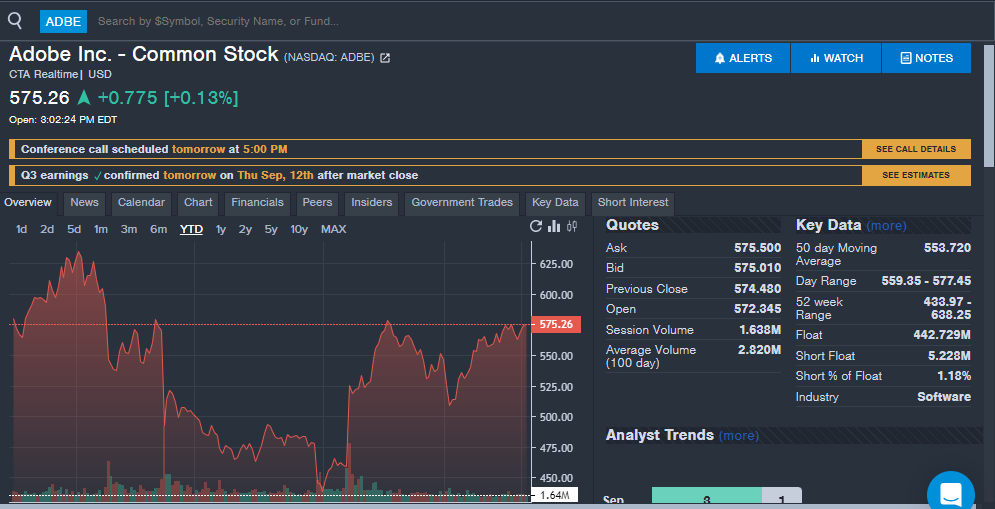
Software company Adobe Inc (NASDAQ:ADBE) could provide another example of a company utilizing artificial intelligence for new products and financial growth when the company reports third-quarter financial results after market close Thursday.
Earnings Estimates: Analysts expect Adobe to report third-quarter revenue of $5.37 billion. That’s up from $4.89 billion in last year’s third quarter, according to data from Benzinga Pro.
The company has beaten analyst revenue estimates for six straight quarters and nine of the last 10 quarters, overall.
Analysts expect Adobe to report third-quarter earnings per share of $4.53, up from $4.09 in the comparable period. The company has beaten analyst estimates for earnings per share in 10 straight quarters.
Guidance from the company calls for third-quarter revenue to be in a range of $5.33 billion to $5.38 billion. The company expects earnings per share will be in a range of $4.50 to $4.55 for the third quarter.
Adobe stock is down 0.7% year-to-date in 2024 as seen on the Benzinga Pro chart below.
What Analysts Are Saying: JPMorgan analyst Mark Murphy sees a positive setup for Adobe in the second half of 2024 as Generative AI monetization and pricing tailwinds factor in.
The analyst currently has an Overweight rating and $580 price target. He previously upgraded Adobe shares in June and added the stock to the analyst focus list in September.
“We reaffirm our positive fundamental bias on the setup for the 2H of the year, while we continue to see upside from current levels despite ADBE shares having traded up in the past several months,” Murphy said.
The analyst said Adobe shares could remain volatile after earnings and with variance in demand, but the view looks positive with the potential for “differentiated performance” in the third quarter.
“We continue to highlight an important potential trend change for a key metric in Adobe’s Creative Cloud Net New ARR, for which the company has outlined expectations for y/y growth in Q3 and Q4, following three consecutive quarters of y/y decline.”
Ongoing traction of Adobe’s GenAI portfolio is expected from the company in the third quarter by the analyst.
Citigroup: Maintained Neutral rating, raised price target from $550 to $621
Stifel: Maintained Buy rating, raised price target from $600 to $650
Oppenheimer: Reiterated Outperform rating, raised price target from $580 to $625
Barclays: Maintained Overweight rating, raised price target from $650 to $675
Key Items to Watch: Adobe’s earnings report comes one day after the company unveiled its AI video capabilities with the Adobe Firefly Video Model.
On Wednesday, Adobe showed off the new model that will extend what Adobe Firefly is capable of. Users will be able to generate video from text prompts and make adjustments to the images.
“Building upon our foundations Firefly models for imaging, design and vector creation, our Firefly foundation video model is designed to help the professional video community unlock new possibilities, streamline workflows and support their creative ideation,” Ashley Still, senior vice president, Creative Product Group at Adobe, said.
The new features will be available later this year.
Adobe could highlight the new video capabilities during its earnings report or on its conference call as another pillar of growth from AI.
The company highlighted “strong growth” from its cloud segments of Creative Cloud, Document Cloud and Experience Cloud in the second quarter and investors and analysts could be looking for a continuation of this growth.
Artificial intelligence will remain the major topic analysts and investors are looking for in Adobe’s third-quarter report.
“Our highly differentiated approach to AI and innovative product delivery are attracting an expanding universe of customers and providing more value to existing users,” Adobe CEO Shantanu Narayen said after second-quarter results.
ADBE Price Action: Adobe stock trades at $576.25 versus a 52-week trading range of $433.98 to $638.25.
On CNBC’s “Mad Money Lightning Round,” Jim Cramer was asked about Advance Auto Parts (NYSE:AAP). He said, “You’re going to hold it… That company is not a great operator.”
On Aug. 22, the company reported quarterly earnings per share of 75 cents, missing the street view of $1.07. Quarterly sales of $2.683 billion beat the street view of $2.679 billion.
Cramer said “no to Citigroup Inc (NYSE:C), yes to JPMorgan Chase & Co (NYSE:JPM).”
On July 30, Morgan Stanley analyst Betsy Graseck maintained Citigroup with an Overweight rating and raised the price target from $66 to $79.
When asked about IES Holdings, Inc. (NASDAQ:IES), he said, “I know the company, and it’s the right spot.”
On Aug. 2, IES Holding reported a year-over-year increase in third-quarter financial results. Also, the company authorized a $200 million share repurchase program.
IBM (NYSE:IBM) is “doing quite well,” Cramer said. “Arvind Krishna [CEO of IBM] has really reinvented the company, he’s doing a terrific job.”
On Sept. 9, IBM announced its intent to acquire Accelalpha, a global Oracle services provider.
“This is not the moment to own oil,” Cramer said, when asked about Exxon Mobil Corporation (NYSE:XOM).
WTI crude oil prices fell sharply on Tuesday as OPEC cuts its demand forecast.
Price Action:
Citigroup shares fell 2.7% to settle at $57.95 on Tuesday.
IES shares rose 2.4% to close at $148.46 during Tuesday’s session.
IBM shares gained 0.9% to close at $205.32 during Tuesday’s session.
Advance Auto Parts fell 0.5% to settle at $38.53 during the session.
Exxon Mobil shares fell 3.6% to close at $110.82 on Tuesday.
The S&P 500 index has started September on a sour note, dropping 2.8% in the first 10 days of the month.
This marks the fifth-worst start for September in the last 25 years, trailing only 2020 (-5.31%), 2011 (-4.15%), 2008 (-3.34%), and 2001 (-2.97%).
While the initial month weakness is already notable, historical seasonality suggests that the worst may still be ahead.
A Historically Weak Start
Historically, September is one of the worst-performing months for the S&P 500, and the early days of the month typically set the tone for the rest of the month.
A Benzinga analysis, powered by the AI tool “seasonality.ai,” reveals that over the past 25 years, the SPDR S&P 500 ETF Trust (NYSE:SPY) has posted negative returns in the first 10 days of September on 14 occasions, with a slightly negative average return (-0.14%).
Yet, not all September starts are doom and gloom, though. In 2009, for example, the index rallied 4.58% in the first 10 days, representing the best start in the dataset.
The worst starts occurred in 2020, when the S&P 500 plummeted 5.31% in the 10 opening days of the month, followed by 2011 (-4.15%) and 2008 (-3.34%).
SPDR S&P 500 ETF Trust
From Sept. 1 to Sept. 10 (Last 25 Years)
Avg. Return
-0.14%
% Gain Hit Ratio
40%
% Max Return
4.58%
% Max Year
2009
% Min Return
-5.31%
% Min Year
2020
Data: Seasonality.ai
First 10 Days Of September: S&P 500 Performance (2000-2024)
Year
Performance (%)
2000
-1.69
2001
-2.97
2002
3.87
2003
-0.82
2004
1.56
2005
1.72
2006
-0.87
2007
-2.21
2008
-3.34
2009
4.58
2010
2.78
2011
-4.15
2012
1.76
2013
2.73
2014
-0.27
2015
2.13
2016
-1.89
2017
-0.51
2018
-0.59
2019
2.54
2020
-5.31
2021
-1.41
2022
2.57
2023
-1.26
2024
-2.82
Data: Seasonality.ai
Last 20 Days Of September: Even More Pain?
Unfortunately, the seasonality picture only deteriorates as the month progresses. Historical data shows that from Sept. 11 through Sept. 30, the S&P 500 tends to suffer even more.
Over the past 25 years, the index has declined an average of 1.69% during these remaining 20 days, suggesting that the second half of the month often compounds early losses.
The back end of September has been negative 16 times in the last 25 years—more than two-thirds of the time. Some years have seen catastrophic declines during this period.
In 2022, the S&P 500 plunged by 13.09% during the last 20 days of September, marking its worst late-September performance in recent history.
This sharp decline was largely driven by investor anxiety following the September 2022 FOMC meeting, where the Federal Reserve delivered its third consecutive 75-basis-point rate hike, pushing the federal funds rate to a range of 3.00% to 3.25%. The aggressive tightening was aimed at combating inflation, which was hovering at around 8-9% at the time.
On the day of the rate decision, the S&P 500 dropped 1.7% as Fed Chair Jerome Powell signaled that the central bank would continue raising rates “until the job is done,” heightening fears of a prolonged tightening cycle and its potential impact on the economy.
Other severe drops include 2002, when the index lost 10.25%, and 2008, with a 7.59% fall.
The trend of weak late-September performance isn’t limited to bear markets. Even in traditional bullish years, the S&P 500 often stumbles. In 2023, the index lost 4.68% in the last 20 days of the month, while 2019 saw a 1.2% decline.
However, not every bullish year is negative—2007 and 2006 both saw gains of 3.45% and 2.43%, respectively, but these instances represent the exception rather than the rule.
SPDR S&P 500 ETF Trust
From Sept. 11 to Sept. 30 (Last 25 Years)
Avg. Return
-0.69%
% Gain Hit Ratio
33%
% Max Return
3.45%
% Max Year
2007
% Min Return
-13.1%
% Min Year
2022
Data: Seasonality.ai
Last 20 Days Of September: S&P 500 Performance (1999-2023)