Advanced Micro Devices, Inc. (NASDAQ:AMD) is shifting its focus to the gaming GPU market, prioritizing a strategy to gain a larger market share.
This approach marks a significant shift away from competing directly with Nvidia Corp’s (NASDAQ:NVDA) highest-end gaming GPUs, at least for now, Tom’s Hardware cites Jack Huynh, AMD’s Senior Vice President and General Manager.
In an interview during IFA 2024, Huynh emphasized that AMD aims to capture 40%-50% of the total addressable market by focusing on mainstream and mid-range GPUs.
Nvidia currently holds 88% of the discrete GPU market, leaving AMD with just 12%, compelling the latter to focus on building scale.
AMD remains engaged in many activities to boost shareholder value as analysts continue to claim Nvidia as the key AI beneficiary.
Recently, AMD tapped Nvidia’s Keith Strier, who was responsible for boosting Nvidia’s commercial engagements with foreign governments. AMD also shared plans to snap AI server company ZT Systems for $4.9 billion as its Ryzen 9000 series failed to gain traction.
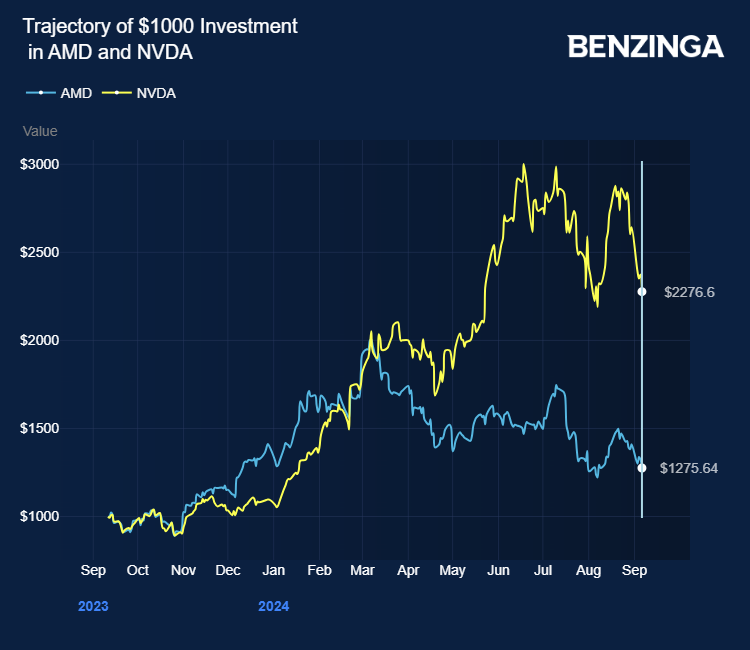
AMD has been up 28% in the last 12 months versus Nvidia, which has gained 128%.
Semiconductor and AI-linked stocks, including Nvidia and AMD, faced a continued selloff despite strong quarterly results from Nvidia and Broadcom Inc (NASDAQ:AVGO). VanEck Semiconductor ETF (NASDAQ:SMH) and iShares Semiconductor ETF (NASDAQ:SOXX) dropped over 12% in the past five days.
Price Actions: AMD stock is up 1.37% at $136.20 at the last check on Monday. NVDA is up 1.22% at $104.05.
Disclaimer: This content was partially produced with the help of AI tools and was reviewed and published by Benzinga editors.
As of Sept. 6, 2024, four stocks in the financials sector could be flashing a real warning to investors who value momentum as a key criteria in their trading decisions.
The RSI is a momentum indicator, which compares a stock’s strength on days when prices go up to its strength on days when prices go down. When compared to a stock’s price action, it can give traders a better sense of how a stock may perform in the short term. An asset is typically considered overbought when the RSI is above 70, according to Benzinga Pro.
Here’s the latest list of major overbought players in this sector.
On July 18, Virtu Financial reported better-than-expected second-quarter financial results. Virtu’s board of directors declared a quarterly cash dividend of 24 cents per share. This dividend is payable on Sept. 15 to shareholders of record as of Sept. 1. The company’s stock gained around 14% over the past month and has a 52-week high of $31.75.
RSI Value: 83.52
VIRT Price Action: Shares of Virtu Financial gained 0.8% to close at $31.44 on Thursday.
On July 22, KKR Real Estate Finance posted upbeat quarterly results. The company’s stock gained around 15% over the past month and has a 52-week high of $14.12.
RSI Value: 70.54
KREF Price Action: Shares of KKR Real Estate Finance Trust surged 5.7% to close at $12.24 on Thursday.
On Aug. 6, Heritage Insurance posted upbeat quarterly earnings. “First, on behalf of the entire Heritage family, we wish a swift and complete recovery to all of those impacted by Hurricane Debby. Our team has been responding to policyholder needs and remains ready to provide outstanding claim service. With regard to the second quarter, our strong results demonstrate the continued execution of our underwriting and rate adequacy initiatives over the last three years,” remarked Ernie Garateix, CEO at Heritage. The company’s stock gained around 124% over the past month and has a 52-week high of $16.90.
RSI Value: 75.73
HRTG Price Action: Shares of Heritage Insurance fell 2.3% to close at $16.27 on Thursday.
On July 25, First Northwest Bancorp posted better-than-expected quarterly sales. “In spite of challenging times for the entire industry as a result of the rate environment, First Northwest executed on a balance sheet restructure strategy. The restructure included a sale-leaseback transaction for six of our branches, a restructure of our bank-owned life insurance policies, two securities loss sale transactions, two balance sheet hedges against fixed rate loans and municipal bonds and the sale of our Visa B shares,” commented Matthew P. Deines, President and CEO. The company’s stock jumped around 17% over the past month and has a 52-week high is $16.12.
RSI Value: 72.83
FNWB Price Action: Shares of First Northwest BanCorp fell 1% to close at $11.57 on Thursday.
The company’s latest patent is for an advertising system that could be used in future Ford vehicles. It would target advertisements based on s driver’s ending destination and/or the conversation held with the passenger.
As reported by Ford Authority, Ford filed the patent in February 2023 and had the patent published on Aug. 29, 2024.
The patent takes into account items like the driver’s GPS, current location and speed of the vehicle to select which ads to show inside the vehicle.
Ford could also select a number of ads to display each drive based on user preference and past history of interaction with ads, the patent says.
The patent shows that the audio signals inside the vehicle could also be used. That could mean more ads being displayed if the driver and passenger aren’t carrying on lengthy conversations.
Why It’s Important: Ford previously filed a patent for its in-vehicle advertising that could use the vehicle’s cameras to scan nearby billboards and display ads related to the subject matter of the billboards inside the vehicle.
A similar patent was also filed for potential advertisements and images to be displayed on windows inside the vehicle.
Being exposed to advertisements isn’t new for drivers or passengers. After all, vehicles are targeted by billboards and radio ads.
Just because Ford filed the patent doesn’t mean that the new advertisement method will come to fruition.
Software company Docusign Inc (NASDAQ:DOCU) could share more on its goal of improving profitability and recent company expansions when the company announces second-quarter financial results after market close Thursday.
Earnings Estimates: Analysts expect Docusign to report second-quarter revenue of $727.36 million according to data from Benzinga Pro.
The company reported revenue of $687.69 million in last year’s second quarter. Docusign has beaten analyst estimates for revenue in more than 20 straight quarters, according to Benzinga Pro.
Analysts expect the company to report earnings of 80 cents per share for the second quarter. That’s up from 72 cents in last year’s second quarter. The company has beaten earnings estimates from analysts in eight straight quarters and 9 of the last 10 quarters overall.
Guidance from Docusign calls for second-quarter revenue to be in a range of $725 million to $729 million.
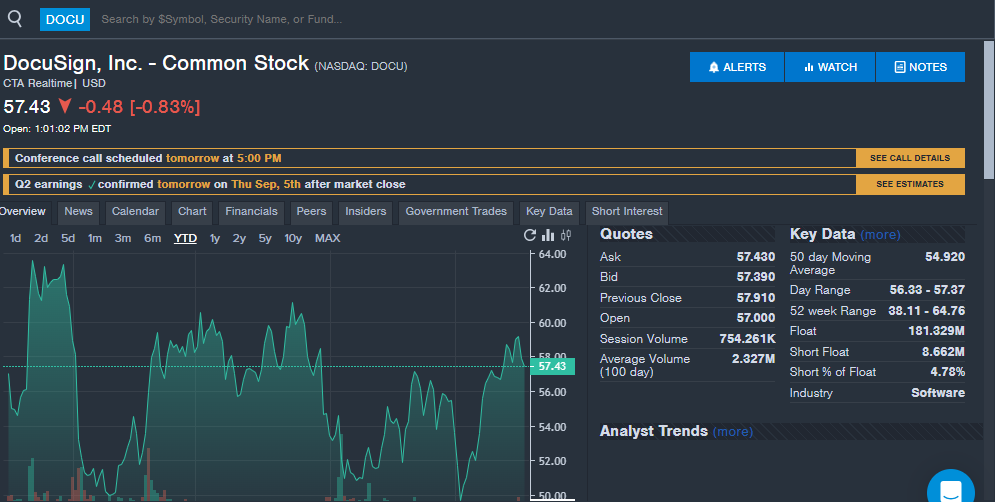
The second-quarter earnings report comes with Docusign shares trading nearly flat year-to-date in 2024. See the Benzinga Pro chart below.
What Analysts Are Saying: Docusign was one of several software companies highlighted in a recent note from RBC Capital with a Sector Perform rating.
RBC Capital said the software sector could benefit from investments in generative AI as spending on seat-based models from the COVID-19 pandemic era is minimizing.
“Software companies themselves saw significant margin expansion during COVID but now as they reinvest for GenAI including higher CapEx, margins are likely flat to up slightly in a best-case scenario, but in some cases going down,” RBC Capital said.
The software sector could be ripe for M&A momentum. Analysts say Docusign is one of several stocks that could be a private equity takeout consideration.
“Overall we continue to believe software M&A activity could accelerate and remain in the headlines following a busy start to the year with several potential deals in the press.”
Key Items to Watch: The company said the first quarter showed a strong start to the fiscal year and the launch of the Docusign Intelligent Agreement Management platform.
Investors and analysts will be looking for an update on this platform and how it is performing.
With many investors having their attention on artificial intelligence, an update on the AI opportunity for Docusign and how it is integrating AI tools and platforms for its customers could be a key item to watch in the earnings report.
The company also said the first quarter showed a focus on stabilizing the business and improving profitability. These two items could be keys for investors and analysts for the software company going forward.
DOCU Price Action: Docusign shares trade at $57.41 on Wednesday versus a 52-week trading range of $38.11 to $64.76.
Elon Musk’s ongoing dispute with Brazil over the ban of social media platform X could potentially affect his other businesses, warns Wall Street Journal business columnist, Tim Higgins.
What Happened: Brazil’s ban on X has started to impact other parts of Musk’s business empire. Higgins highlighted during CNBC “Squawk Box” on Tuesday that Musk’s other ventures, such as SpaceX, Tesla (NASDAQ:TSLA) and the Starlink satellite system, have been finding success in rural parts of Brazil, indicating potential future business growth in the market.
However, Musk’s principled stand against Brazil’s government, which he accuses of breaking its own laws by asking X to silence political speech, could jeopardize these opportunities. Specifically, operations of Starlink have been frozen in Brazil, leading to a halt in revenue generation.
“What we have seen over the last few years as he has increasingly become more in X,
Despite these challenges, investors seem to remain patient, giving Musk “a lot of rope” to manage his affairs with X, as they see great potential and returns in Tesla and SpaceX.
Why It Matters: Earlier, Musk had threatened to seize Brazilian government assets unless property belonging to his companies X and SpaceX was returned. This was in response to the confiscation of SpaceX and X’s properties by the Brazilian government.
Subsequently, Musk’s satellite broadband company, Starlink, decided to comply with a Brazilian court order to block access to social media platform X in Brazil, reversing its previous stance. This move, while in compliance with the court order, has led to a halt in Starlink’s operations in the country, impacting revenue generation.
The Nasdaq 100 closed higher by more than 1% during Friday’s session. Investors, meanwhile, focused on some notable insider trades.
When insiders sell shares, it could be a preplanned sale, or could indicate their concern in the company’s prospects or that they view the stock as being overpriced. Insider sales should not be taken as the only indicator for making an investment or trading decision. At best, it can lend conviction to a selling decision.
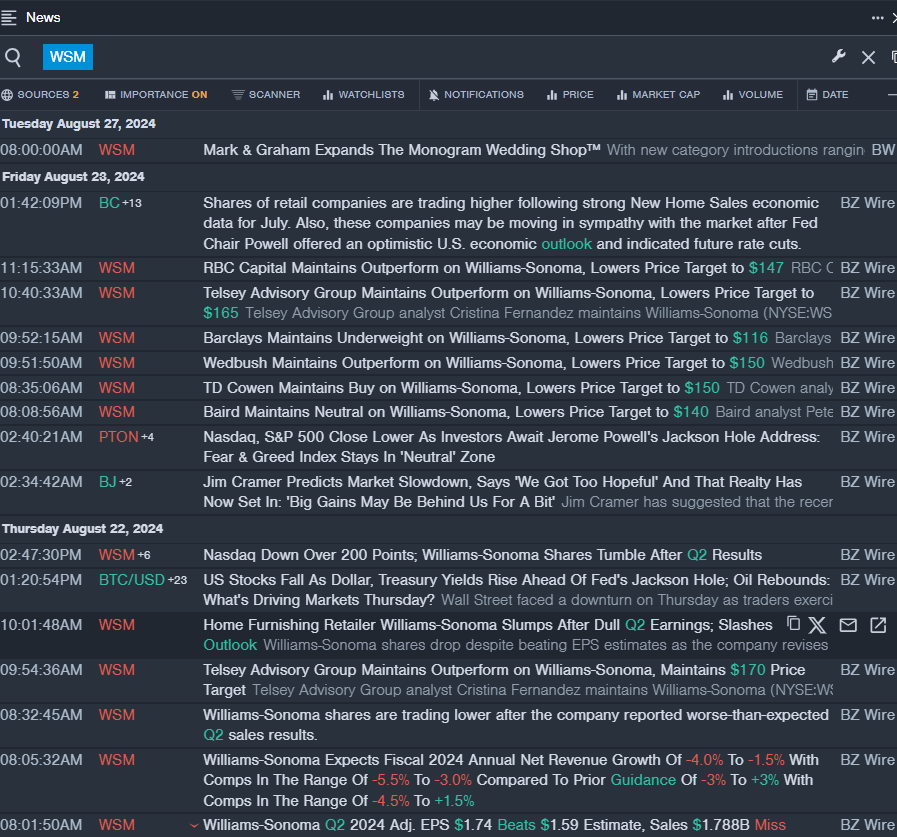
The Trade: Williams-Sonoma, Inc. (NYSE:WSM) EVP CHIEF TALENT OFFICER Karalyn Smith sold a total of 11,100 shares at an average price of $134.66. The insider received around $1.5 million from selling those shares.
What’s Happening: On Aug. 22, the company reported second-quarter adjusted earnings per share of $1.74, beating the analyst consensus of $1.59.
What Williams-Sonoma Does: With a retail and direct-to-consumer presence, Williams-Sonoma is a player in the $300 billion domestic home category and $450 billion international home market, focused on expanding its exposure in the B2B ($80 billion total addressable market), marketplace, and franchise areas.
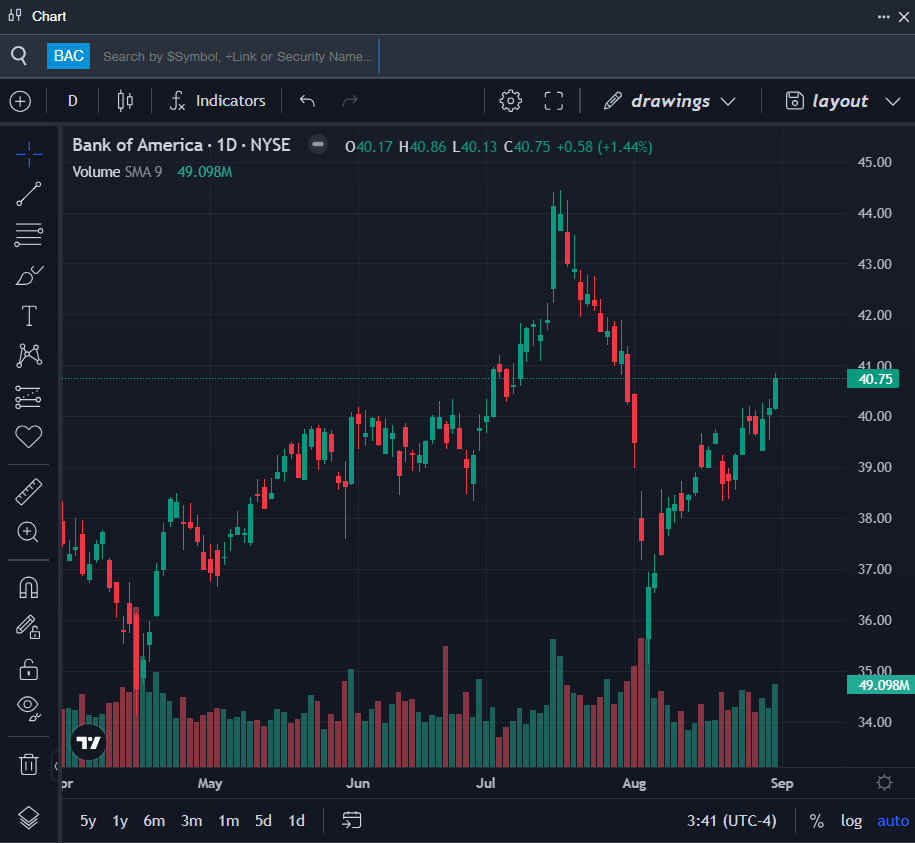
The Trade: Bank of America Corporation (NYSE:BAC) 10% owner Warren E Buffett sold a total of 21,076,473 shares at an average price of $40.24. The insider received around $848.2 million from selling those shares.
What’s Happening: On Aug. 16, Bank of America announced redemption of €1.5 billion of floating rate senior notes, due Aug. 24, 2025.
What Bank of America Does: Bank of America is one of the largest financial institutions in the United States, with more than $3.0 trillion in assets. It is organized into four major segments: consumer banking, global wealth and investment management, global banking, and global markets.
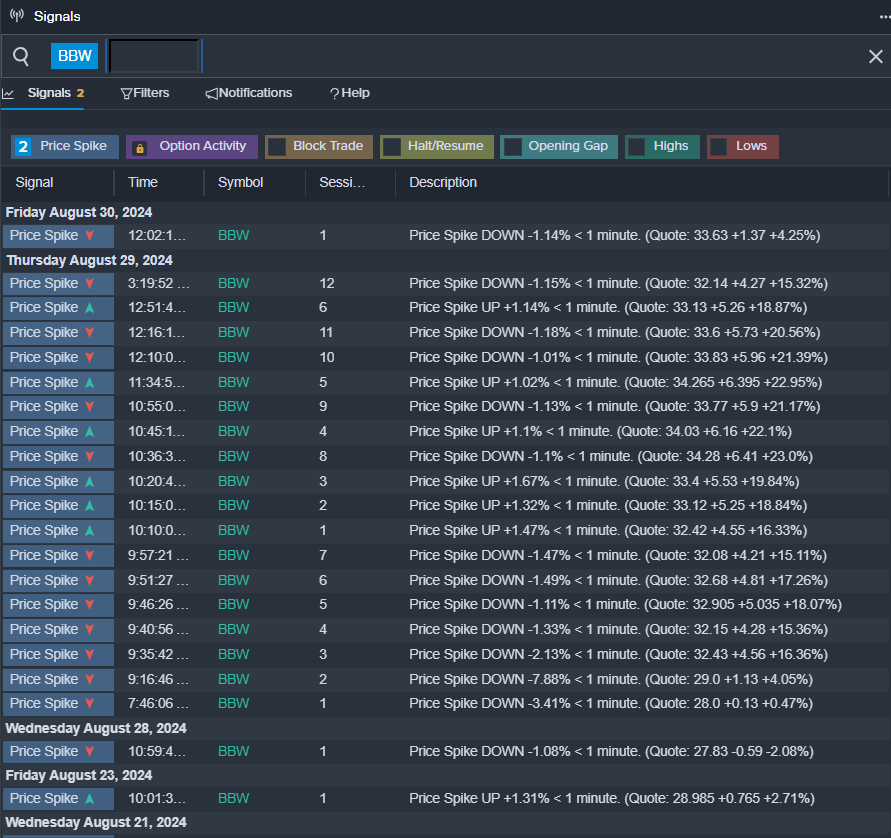
The Trade: Build-A-Bear Workshop, Inc. (NYSE:BBW) CFO Vojin Todorovic sold a total of 10,294 shares at an average price of $33.37. The insider received around $343,493 from selling those shares.
What’s Happening: On Aug. 29, Build-A-Bear Workshop posted better-than-expected second-quarter financial results.
What Build-A-Bear Workshop Does: Build-A-Bear Workshop Inc is a U.S.-based specialty retailer of customized stuffed animals and related products.
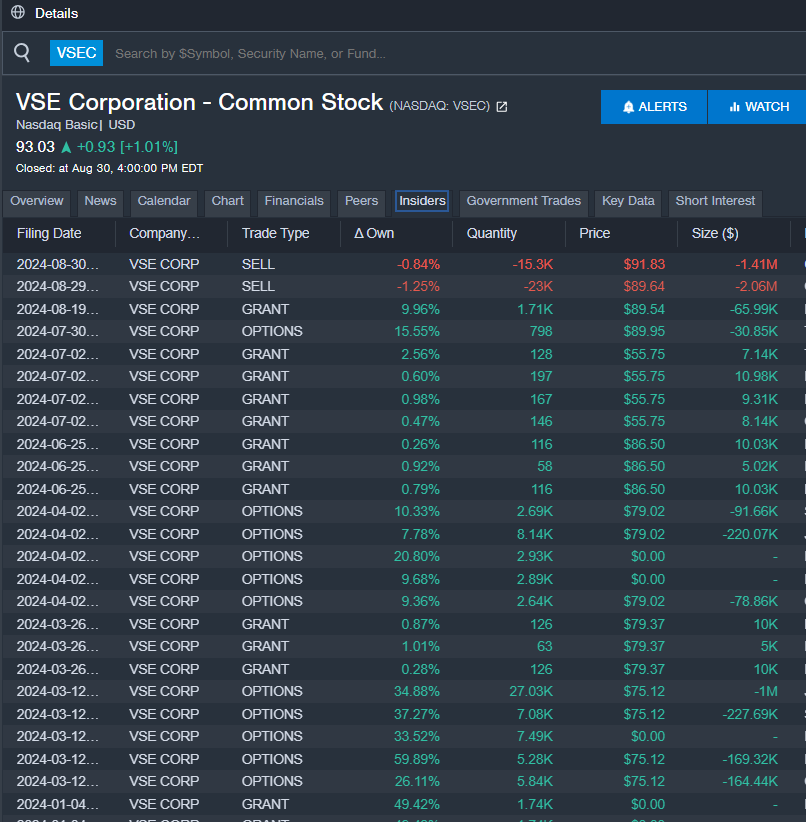
The Trade: VSE Corporation (NASDAQ:VSEC) 10% owner Calvin Scott Koonce sold a total of 15,300 shares at an average price of $91.83. The insider received around $1.4 million from selling those shares.
What’s Happening: On Aug. 20, VSE named Adam Cohn as CFO, effective Sept. 3
What VSE Does: VSE Corp is a diversified aftermarket products and services company providing repair services, parts distribution, logistics, supply chain management and consulting services for land, sea and air transportation assets to commercial and government markets.
Benzinga Pro’s Insiders feature was used to track insider trading activity in VSEC’s shares.
U.S. stocks settled higher on Friday, with the Dow Jones index notching a new record high during the session.
Wall Street analysts make new stock picks on a daily basis. Unfortunately for investors, not all analysts have particularly impressive track records at predicting market movements. Even when it comes to one single stock, analyst ratings and price targets can vary widely, leaving investors confused about which analyst’s opinion to trust.
Benzinga’s Analyst Ratings API is a collection of the highest-quality stock ratings curated by the Benzinga news desk via direct partnerships with major sell-side banks. Benzinga displays overnight ratings changes on a daily basis three hours prior to the U.S. equity market opening. Data specialists at investment dashboard provider Toggle.ai recently uncovered that the analyst insights Benzinga Pro subscribers and Benzinga readers regularly receive can successfully be used as trading indicators to outperform the stock market.
Top Analyst Picks: Fortunately, any Benzinga reader can access the latest analyst ratings on the Analyst Stock Ratings page. One of the ways traders can sort through Benzinga’s extensive database of analyst ratings is by analyst accuracy. Here’s a look at the most recent stock picks from each of the five most accurate Wall Street analysts, according to Benzinga Analyst Stock Ratings.
Analyst: Leo Mariani
Analyst Firm: Roth MKM
Ratings Accuracy: 88%
Latest Rating: Upgraded rating on Coterra Energy Inc. (NYSE:CTRA) from Hold to Buy and raised the price target from $25 to $29 on Aug. 27. This analyst sees around 19% upside in the stock.
Recent News: On Aug. 1, Coterra Energy reported worse-than-expected second-quarter financial results.
Analyst: Richard Davis
Analyst Firm: Canaccord Genuity
Ratings Accuracy: 88%
Latest Rating: Maintained a Hold rating on Okta, Inc. (NASDAQ:OKTA) and slashed the price target from $95 to $90 on Aug. 29. This analyst sees around 14% upside in the stock.
Recent News: On Aug. 28, Okta reported quarterly earnings of 72 cents per share, which beat the analyst consensus estimate of 61 cents per share.
Analyst: Zachary Fadem
Analyst Firm: Wells Fargo
Ratings Accuracy: 87%
Latest Rating: Maintained an Equal-Weight rating on Best Buy Co., Inc. (NYSE:BBY) and increased the price target from $80 to $95 on Aug. 30. This analyst sees around 5% downside in the stock.
Recent News: On Aug. 29, Best Buy reported better-than-expected second-quarter financial results raised its FY25 earnings guidance.
Analyst: William Stein
Analyst Firm: Truist Securities
Ratings Accuracy: 87%
Latest Rating: Maintained a Buy rating on NVIDIA Corporation (NASDAQ:NVDA) and increased the price target from $145 to $148 on Aug. 29. This analyst sees about 24% gain in the stock.
Recent News: On Aug. 28, Nvidia reported better-than-expected earnings and sales results for its second quarter.
Analyst: Trevor Walsh
Analyst Firm: JMP Securities
Ratings Accuracy: 86%
Latest Rating: Reiterated a Market Outperform rating on SentinelOne, Inc. (NYSE:S) with a price target of $33 on Aug. 28. This analyst sees around 40% upside in the stock.
Recent News: On Aug. 27, SentinelOne reported quarterly GAAP losses of 22 cents per share, in-line with the analyst consensus estimate.
The most oversold stocks in the real estate sector presents an opportunity to buy into undervalued companies.
The RSI is a momentum indicator, which compares a stock’s strength on days when prices go up to its strength on days when prices go down. When compared to a stock’s price action, it can give traders a better sense of how a stock may perform in the short term. An asset is typically considered oversold when the RSI is below 30, according to Benzinga Pro.
Here’s the latest list of major oversold players in this sector, having an RSI near or below 30.
On Aug. 26, Altisource Asset Management announced intention to voluntarily delist and deregister its common stock from the NYSE American LLC. The company’s stock fell around 50% over the past month and has a 52-week low of $1.10.
RSI Value: 27.19
AAMC Price Action: Shares of Altisource Asset Management fell 1.9% to close at $1.28 on Thursday.
Wheeler Real Estate Investment Trust Inc (NASDAQ:WHLR)
On Aug. 6, Wheeler Real Estate Investment Trust reported its financial and operating results for the three and six months ended June 30 on Form 10-Q. The company’s stock fell around 78% over the past month. It has a 52-week low of $1.02.
RSI Value: 26.52
WHLR Price Action: Shares of Wheeler Real Estate Investment Trust fell 15.2% to close at $1.17 on Thursday.
Thursday, Johnson & Johnson (NYSE:JNJ) announced the submission of a Biologics License Application (BLA) to the FDA seeking the first approval of nipocalimab globally for generalized myasthenia gravis (gMG).
gMG is an autoantibody-driven neuromuscular disease characterized by fluctuating muscle weakness.
The update marks the first FDA submission for nipocalimab, an investigational treatment that binds with high affinity and specificity to block FcRn and reduce autoantibody levels.
The application included data from the Phase 3 Vivacity-MG3 study, which showed that outcomes for a broad population of antibody-positive participants who received nipocalimab plus standard of care (SOC) were superior compared to those who received placebo plus SOC.
In the Phase 3 VIVACITY study in gMG, nipocalimab met the primary endpoint, achieving a statistically significant reduction in MG-ADL score from baseline over weeks 22 to 24 compared with placebo.
Earlier this year, at the American Academy of Neurology Annual Meeting, Johnson & Johnson presented data on the molecular properties of nipocalimab.
Last year, the FDA approved UCB SA’s (OTC:UCBJF) (OTC:UCBJY)
Rystiggo (rozanolixizumab-noli) for generalized myasthenia gravis (gMG) in adult patients who are anti-acetylcholine receptor (AchR) or anti-muscle-specific tyrosine kinase (MuSK) antibody positive.
The company says Rystiggo is the only FDA-approved treatment in adults for anti-AChR and anti-MuSK antibody-positive gMG, the two most common subtypes of gMG.
Johnson & Johnson’s drug will also compete with Argenx SE’s (NASDAQ:ARGX) Vyvgart Hytrulo for gMG in adult patients who are anti-acetylcholine receptor antibody positive.
The drug is available in subcutaneous and intravenous injections.
Price Action: JNJ stock is up 0.36% at $164.51 at the last check on Thursday.
Dell Technologies Inc (NYSE:DELL) will be reporting its second-quarter earnings on Wednesday. Wall Street expects $1.71 in EPS and $24.138 billion in revenues as the company reports after market hours.
The stock is up 91.43% over the past year, 46.38% year-to-date.
Let’s look at what the charts indicate for Dell stock and how the stock currently maps against Wall Street estimates.
Dell Stock Charts Mixed Ahead Of Q2 Earnings
Dell stock is navigating a complex technical landscape with both bullish and bearish signals in play.
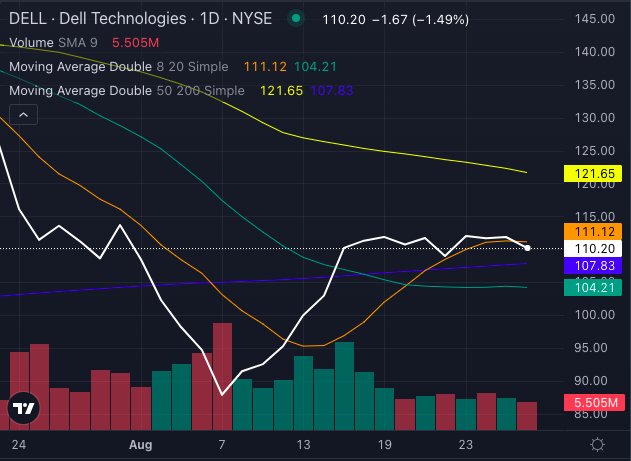
The stock is currently priced at $110.20, showing short-term bullish indicators as it trades above its 20-day simple moving average (SMA) of $104.21.
This suggests some positive momentum in the near term. Though the stock is right below the eight-day SMA of $111.12 which may hint at the possibility of some hiccups in this momentum.
However, the 50-day SMA stands at $121.65, indicating a bearish trend as the current price is below this level. The 200-day SMA of $107.83 provides a bullish signal as the stock is above this longer-term average.
The Moving Average Convergence Divergence (MACD) indicator at a negative 1.80, however, points to bearish momentum.
Additionally, the Relative Strength Index (RSI) of 48.49 suggests the stock is neither overbought nor oversold, while the Bollinger Bands — ranging from $90.05 to $121.37 — however, support a slight bullish stance with the stock trading in the upper band.
Overall, while there is buying pressure that could indicate future bullish movement, the prevailing technical indicators suggest a cautious approach.
Ratings & Consensus Estimates: The consensus analyst rating on Dell stock stands at a Buy currently with a price target of $108.18.
The latest analyst ratings from BofA Securities, Morgan Stanley and Citigroup suggest an average price target of $149 for Dell stock. This implies a potential 35.94% upside based on their recent evaluations.
DELL Price Action: Dell stock was trading at $109.05 at the time of publication.