Cloud and artificial intelligence revenue generation and future opportunities could be the key items analysts and investors are watching for in the second-quarter earnings report from Dell Technologies (NYSE:DELL) on Thursday after market close.
Earnings Estimates: Analysts expect Dell to report second-quarter revenue of $24.14 billion, according to data from Benzinga Pro.
The company reported revenue of $22.93 billion in last year’s second quarter. Dell has beaten analyst estimates for revenue in eight of the last 10 quarters, including two straight quarters.
Analysts expect the company to report second-quarter earnings per share of $1.71, which would be down from $1.74 reported in last year’s second quarter. The company has beaten analyst estimates for earnings per share in nine straight quarters.
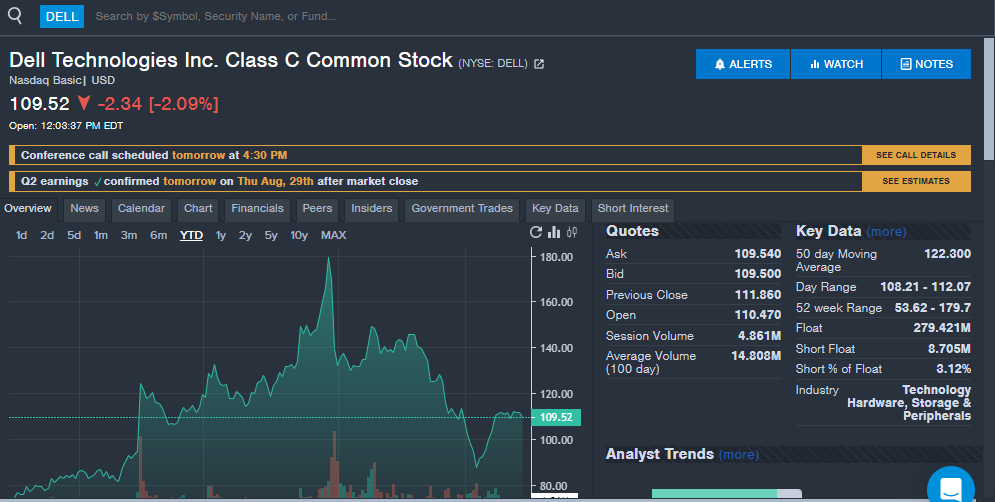
The second-quarter earnings report comes with Dell stock up 46% year-to-date, as shown on the Benzinga Pro chart below.
What Analysts are Saying: Dell’s second-quarter results could be an opportunity for the company to show progress made on margins, JPMorgan analyst Samik Chatterjee said in a new investor note.
The analyst reiterated an Overweight rating and $160 price target ahead of earnings.
“With outlooks now even lower after the Super Micro print, we see a set up where investors will be relieved by significant progress made relative to ISG margins, with lower focus on other metrics, like AI server revenue and backlog, relative to prior quarters,” Chatterjee said.
Chatterjee said investors are concerned that cost cuts and workforce reductions are a sign of weakened demand.
“We believe these concerns will be trounced by the strong demand backup for AI servers, as evidenced by revenue guidance from Super Micro.”
The analyst said cost cuts are part of the company’s transformation and could help improve profit margins from its AI server opportunity.
“We are more positively inclined toward the AI-driven compute investment cycle, which should benefit branded server companies.”
Chatterjee said that while Dell isn’t a primary beneficiary of the AI investment cycle, server companies will benefit from selling higher-end servers with higher average sale prices.
Key Items to Watch: Artificial intelligence will likely be top of mind for investors when reading Dell’s earnings report. The company will be reporting quarterly financial earnings a day after NVIDIA Corporation, one of the companies that is leading the growth of AI use cases.
In its first-quarter financial earnings, Dell made their AI opportunity known.
“No company is better positioned than Dell to bring AI to the enterprise,” Dell Chief Operating Officer Jeff Clarke said.
The first quarter saw AI-optimized server orders growing, with shipments up more than 100% quarter-over-quarter. The backlog of the servers also was up 30% to $3.8 billion in the first quarter.
With the report coming after Nvidia, Dell could have a high bar to clear when talking about its AI opportunity once again.
While many analysts have been cutting their price targets, CNBC host Jim Cramercalled the bottom in the stock in mid-August, following an upgrade from Barclays.
“Historically, you want to buy this company after it’s been hammered. Regardless, it’s just been right to do that, so I agree with Barclays. This stock should be bought right here,” Cramer said.
Cramer also highlighted the fact that Dell CEO Michael Dell was “singled out” at an Nvidia event as a person to do business with, suggesting that Dell could be a strong contender in the AI sector.
DELL Price Action: Dell shares are down 1.4% to $110.22 on Wednesday, versus a 52-week trading range of $53.62 to $179.70.
Nvidia Corp. (NASDAQ:NVDA) is set to report its highly anticipated earnings Wednesday, and the stakes couldn’t be higher.
As the undisputed leader in the AI revolution, Nvidia’s results will be a critical indicator for the broader market, particularly for those invested in semiconductor and technology sectors.
This highly followed market event offers both risk and opportunity. For traders seeking to capitalize on Nvidia’s earnings without the direct exposure to single-stock volatility, ETFs with substantial Nvidia holdings present an appealing alternative.
Wall Street has set an ambitious target for Nvidia this quarter, with revenue expected to hit $28.74 billion — a staggering 17% increase from the previous quarter and an eye-popping 156% jump from the same quarter last year.
Earnings per share (EPS) are forecasted to rise to 65 cents, up from 56 cents in the prior quarter and 21 cents in the same period last year.
Goldman Sachs’ semiconductor analyst, Toshiya Hari, is bullish on Nvidia’s prospects, predicting the company will surpass these already lofty expectations.
“We believe customer demand across the large Cloud Service Providers and enterprises is strong, and Nvidia’s robust competitive position in AI/accelerated computing remains intact,” Hari stated in a note published this month.
The driving force behind this optimism? Data Center revenues and strong operating leverage. Hari highlights three key areas: robust demand for the H100 GPUs, the launch of volume shipments of the H200, and the ramp-up of Nvidia’s Ethernet-based networking product, Spectrum-X. These factors could fuel a significant earnings beat, potentially leading to upward revisions in EPS.
Shares of the AI tech giant are up 159% year to date, after surging by 239% in 2023.
Historical Volatility: A Look At Past Nvidia Earnings
Nvidia’s stock has a history of sharp rallies post-earnings, with an average one-day boost of 9% over the past eight quarters and 7.1% over the last four.
A Goldman Sachs analysis identified the VanEck Semiconductor ETF (NASDAQ:SMH) as having the highest average post-earnings move (3.4%) following Nvidia’s past eight earnings releases.
It was followed by the iShares Semiconductor ETF (NYSE:SOXX) at 2.9% and the ARK Innovation ETF (NYSE:ARKK) at 2.4%.
Top 10 ETFs With Nvidia Exposure
For traders looking to gain exposure to Nvidia’s potential earnings-driven rally, here are 10 ETFs with the largest holdings in the stock:
In a recent episode of CNBC’s “Mad Money,” host Jim Cramer announced that Target Corporation (NYSE:TGT) is back on track after a period of struggle. This follows an earnings report that surpassed market expectations.
What Happened: On Monday, Cramer stated on “Mad Money” that Target is on an upward trajectory, potentially stronger than it has been in years. The retail behemoth had experienced a significant collapse, losing 62% from its peak, and appeared to be floundering. However, Cramer said he has always maintained confidence in the company’s capacity to rebound.
Target’s stock began its recovery last November, rallying nearly 77% from its October low. Despite this, the company did not report strong quarters until last month, when a significant shift caused the stock to surge 10% in a single session. This led Cramer to proclaim, “Target is back.”
Cramer noted that the company achieved a 2% sales growth when analysts were expecting 1.1%. This was the first positive comp since the end of 2022, driven entirely by a 3% increase in traffic. Concurrently, Target’s online business is thriving, with digital sales up 8.7%.
Target’s recent earnings report showed a 43% year-over-year growth, which Cramer labeled as “spectacular.” Despite some concerns about same-store sales forecasts, Cramer believes that Target’s new forecast is better than anticipated for 2024.
Despite the challenging operating environment, Cramer believes that Target is in a better strategic position now and has more room to run. The stock is currently selling at a significant discount to Walmart or Costco, but if Target continues to report numbers like these, the stock will start closing the valuation gap.
Why It Matters: Target’s second-quarter results exceeded expectations, fueling analyst optimism. The company raised its full-year 2024 adjusted EPS outlook to a range of $9.00 to $9.70, up from the previous range of $8.60 to $9.60. This new outlook compares to an estimate of $9.36.
Price Action: At the time of writing, Target was trading 0.13% higher at $159.11 during Tuesday’s pre-market after closing at $158.90 on Monday, according to Benzinga Pro.
All signs point to analysts and investors looking to see if Chewy Inc (NYSE:CHWY) can keep up recent momentum and financials ahead of estimates when second-quarter results are reported Wednesday, Aug. 28 after market close.
Earnings Estimates: Analysts expect Chewy to report second-quarter revenue of $2.86 billion compared to $2.78 billion in last year’s second quarter, according to data from Benzinga Pro.
The company has beaten revenue estimates from analysts in two straight quarters and seven of the past 10 quarters overall.
Analysts see Chewy reporting second-quarter earnings of 2 cents per share, compared to 15 cents per share in last year’s second quarter. The company has beaten analysts’ estimates in nine straight quarters.
Guidance from the company calls for revenue to come in a range of $2.84 billion to $2.86 billion.
Anmuth sees strong execution by the company and the potential for customer growth in the second half of the fiscal year.
“We believe pet is a growing and a highly attractive category that is early in the shift online, and, in our view, Chewy is well-positioned as the leader in online pet with a ~33% market share,” Anmuth said.
Anmuth said secular growth, the shift to online sales, and growth of pharmacy, services and international expansion could all be catalysts for Chewy.
“We continue to like CHWY’s category positioning, improving profitability, and efforts to diversify revenue into healthcare, international & sponsored Ads.”
The analyst said pharmacy and private label are among the fastest growth areas for the companies and also come with high margins.
Chewy’s Autoship subscriptions plan also serves as a competitive advantage, Anmuth said.
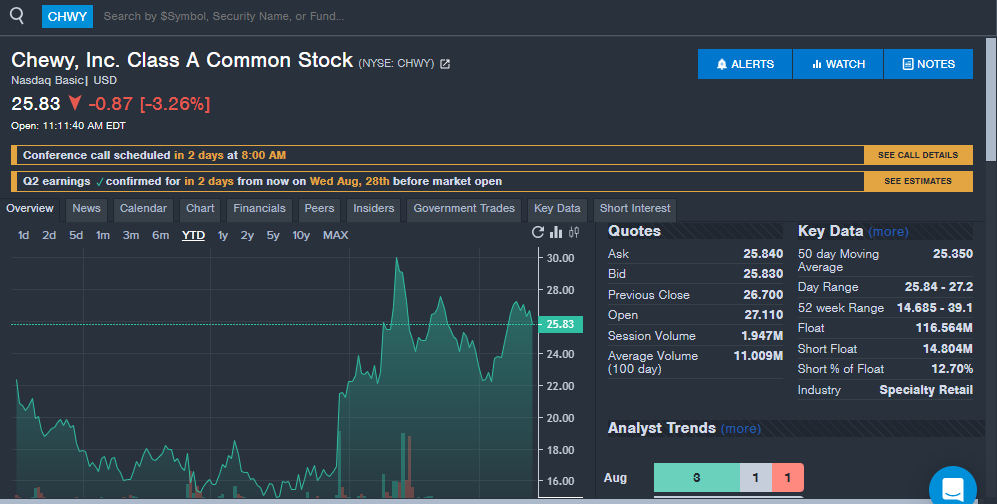
While Chewy shares are up only 8.6% year-to-date in 2024, Anmuth highlights that the stock is up 660% since first-quarter financial results, as illustrated in the Benzinga Pro chart below.
Key Items to Watch: There are many items to watch when Chewy reported with new business verticals like health care among the top items investors and analysts may be watching.
The cross-promotion of pet food and pet care products has resulted in higher net spending per customer in recent quarters.
Chewy also opened several veterinarian clinics with plans to open more in 2024. Investors and analysts could get an update on how this newer segment is performing and what plans are.
Chewy Plus, a paid membership program in beta, could also be a key item shared in the company’s results and outlook.
“Chewy’s value proposition continues to resonate with our customers, and I am proud of the teams at Chewy who are executing flawlessly on our strategic roadmap and the controllable elements of our business,” Chewy CEO Sumit Singh said after first-quarter results.
A $500 share buyback announced in the first quarter could also be a key highlight in the second-quarter results and future guidance.
CHWY Price Action: Chewy shares are down 3.90% to $25.66 on Monday versus a 52-week trading range of $14.69 to $39.10. Chewy stock is down 1.7% over the past year and up 8.6% year-to-date in 2024.
Mind reading technology is hitting the market. It puts our thoughts at risk of being stolen, and renders privacy a relic of the past. There are many examples of neurotechnology devices hitting the market. For example, Elon Musk’s neuralink is developing an implantable chip so individuals can move a computer cursor with their mind. As well, Apple, Meta, and Open-AI are also hard at work on such devices.
The range of neurotechnology devices include devices that allow an individual to control computers with their mind. In many cases, people might not truly understand that their information is being shared and sold in the first place when they use these devices. And while medical research facilities must follow privacy laws, private companies have no such requirement. This despite the fact that they are among the most active collectors of brain data.
The Neurorights Foundation, a non-profit to protect people from the misuse or abuse of neurotechnology, found in a study that two-thirds of private companies already share or sell data to third parties. Yet they do not disclose data storage practices nor security protocols.
Mind reading AI systems can also be used to target passwords, including your Bitcoin password. Mind reading is the final frontier of privacy, and humanity appears woefully unprepared for it.
AI Mind-Reading Technology Exists Already
Mind reading technology has become so advanced that researchers have successfully reconstructed images from direct recordings of brain activity. Basically, the AI recreates images at which an individual is looking. AI reconstructed the original images with near-perfect accuracy.
One team conducted two different studies, placing volunteers inside a functional magnetic imaging (fMRI) machine, which measures blood flow changes in the brain.
Volunteers saw pictures of faces as the fMRI recorded the neural activity in the visual cortex, which was sent to the AI algorithm. The AI then reconstructed the images closely resembling the original pictures.
The second study entailed re-analyzing data from past experiments in which electrode arrays were implanted into macaque monkey’s brain to record its activity while the primate looked at AI images.
The images created from the monkey’s brain activity were almost identical to the original images, since the implanted devices provided precise data on the monkey’s brain activity. The AI system learned which parts of the brain on which to focus when interpreting brain signals.
Present-day mind reading technology is so advanced that it can correlate brain activity with typed characters, defeating passphrase protection such as BIP39, the way in which crypto wallets create mnemonic phrases and convert them into binary seeds.
Change Will Come Quickly
The field of neuro technology evolves quickly. Soon AI technologies will be combined with large language models. Furthermore, researchers came up with a first ever non-invasive mind-reading cap. While this technology is used for good–for instance, helping people unable to speak due to illness or injury–it at the very least poses novel privacy threats.
Abuse of mind technology would not be unprecedented. In the 1950s and 1960s, psychiatrists at America’s top academic institutions supported CIA mind control misadventures like ARTICHOKE and MK-ULTRA, which often entailed experimenting on vulnerable populations.
In an effort to protect consumer privacy, Colorado passed the first law in the nation to include biological and brain data in the State Privacy Act, which grants consumers new rights to their personal data and places obligations on data collectors.
The Colorado law went into effect last summer, and only applies to companies which identify the people whose information they are collecting, sharing, and selling.
Once mind-reading technologies advance beyond this state and into wireless technologies capable of long distances, the whole digital world is compromised. The dystopian world of 1984 would seem utopian by comparison.
In an age when companies access, analyze, and change brains, crypto technologists have a lot of work to preserve liberty through crypto for future generations. It might take a renewed human rights movement to make it happen
The economy is too strong to “justify” four interest rate cuts getting priced in by year-end, according to Apollo Global Management‘s Torsten Slok.
What Happened: “Where is the slowdown that everyone’s talking about?” Slok asked CNBC on Friday morning — just after Federal Reserve Chair Jerome Powell expressed confidence that inflation is on a sustainable path back to 2%.
Apollo’s chief economist presented a case:
“Businesses are spending,” Slok said.
“The guidance in terms of capex is still strong” — particularly with the Magnificent Seven stocks: Apple, Microsoft,Google parent Alphabet, Amazon.com, Nvidia, Meta Platforms and Tesla.
“Broadly speaking, it’s just not clear to me that the economy is slowing down this way that justifies four rate cuts the way the market’s pricing at the moment,” Slok added.
Why It Matters: In a Friday speech, Powell refrained from committing to a predetermined path for interest rate cuts.
“The timing and pace of rate cuts will depend on incoming data, the evolving outlook, and the balance of risks,” he said at the Jackson Hole Symposium. “The time has come for policy to adjust.”
Separately, Evercore founder and senior chair Roger Altman also joined CNBC to discuss the Fed’s inflation fight.
“It’s very hard to pull off a soft landing,” Altman said. “The basic scenario of three cuts, 25 basis points each, between now and the rest of the year, is the base case.”
With its second-quarter earnings on deck, the stock could remain highly volatile in its recovery mode.
What Happened: CrowdStrike is hitting out at competition that could be looking to win customers away after the company’s global outage, which is likely to be a key topic when the company reports second-quarter financial results.
Analysts expect the company to report second-quarter revenue of $958.70 million, compared to revenue of $731.6 million in last year’s second quarter, according to data from Benzinga Pro.
Earnings per share are expected to come in at 98 cents per share versus 74 cents per share reported in last year’s second quarter.
CrowdStrike has beaten both revenue and earnings per share estimates from analysts in more than 10 straight quarters, putting its streak on the line Wednesday, Aug. 28 when it reports after market close.
Previous guidance from the company calls for revenue between $958.3 million and $961.2 million and earnings in a range of 98 cents to 99 cents per share.
While second-quarter results could be minimally impacted by the global outage on July 19, the real key will be guidance and commentary on what happens next.
CrowdStrike previously raised full-year guidance for revenue and earnings per share. Those figures could be in question with the potential loss of revenue from customers leaving and the potential money set aside for lawsuits and settlements as legal challenges mount.
The company is likely to share how it has fixed the issue, progressed and moved on, and what it’s doing to win back customer support and accounts. Shares could move based on the commentary and guidance being lowered or raised, or the company simply reiterating the already heightened figures.
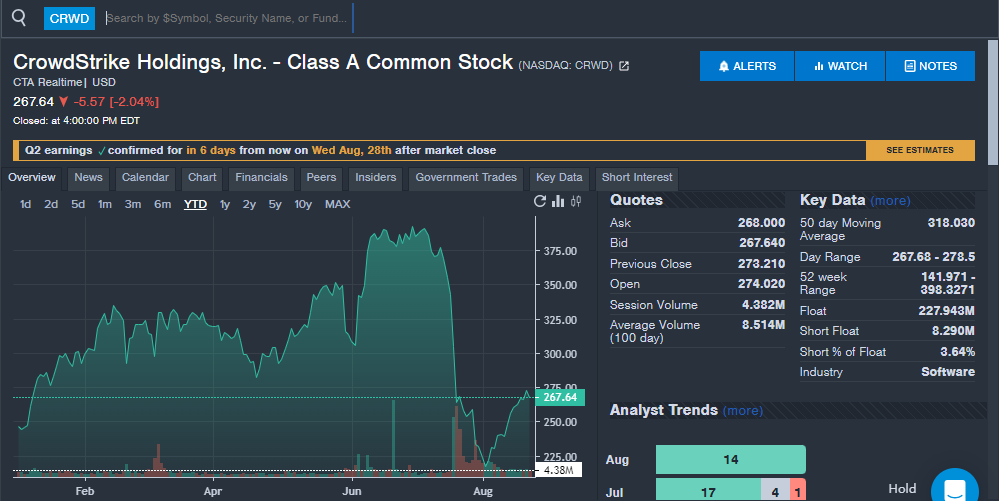
Why It’s Important: A quick look at the CrowdStrike year-to-date chart from Benzinga Pro shows shares are actually up 4.8% in 2024.
Shares fell from a close of $343.05 on July 18 to open at $294.51 on July 19 and trade between $290.10 to $316.75 on the day of the global outage.
CrowdStrike shares have fallen since and were also hit on Aug. 5 when the stock market saw significant drops for companies, with the technology sector hit hard.
Over the past month, shares of CrowdStrike are down 1.4%, nearly recovering from the Aug. 5 losses and continued drop.
A positive earnings report and/or a positive update on guidance could kickstart a rally in shares and get closer to the $294.51 opening price on July 19, as well as closer to the $343.05 level last seen before the outage.
CRWD Price Action: CrowdStrike shares closed Thursday at $267.64 versus a 52-week trading range of $141.97 to $398.33.
According to Benzinga Pro, PLUG stock has lost over 74% in the past year. Investors can gain exposure to the stock via Global X Hydrogen ETF (NASDAQ:HYDR) and ETF Series Solutions Defiance Next Gen H2 ETF (NYSE:HDRO).
The company has appointed Colin Angle, former CEO of iRobot Corporation, to its Board of Directors. Angle brings expertise in technology innovation, robotics, and strategic leadership to Plug Power’s Board.
“Colin’s insights and experience will help guide Plug Power as we scale our operations and deliver on our commitment to sustainability, revenue growth, and profitability,” said Andy Marsh, CEO of Plug Power.
Earlier this month, Plug Power said it announced the appointment of Dean Fullerton as COO. Fullerton comes from Amazon.com, Inc., where he was responsible for global engineering services and oversaw operations engineering for 14 years.
The firm deployed over $70 million of electrolyzer systems in the second quarter. The company noted that because of final commissioning and testing requirements, the majority of the deployments were not recognized as revenue in the quarter. Plug expects to recognize that revenue in the second half of 2024.
Plug Power expects full-year 2024 revenue to be in the range of $825 million to $925 million versus estimates of $917 million.
Price Action: PLUG shares are trading lower by 2.27% to $2.15 at last check Thursday.
As the price of gold recently surpassed $2,500 per troy ounce, the value of a standard 400-troy-ounce gold bar has skyrocketed to the $1-million milestone for the first time in history.
This surge isn’t due to a flood of consumers rushing to buy jewelry or a sudden spike in investor demand for this traditional safe haven. Instead, the rally is largely fueled by expectations surrounding the Federal Reserve’s monetary policy.
Why Have Gold Prices Rallied This Summer?
Gold spiked 2.7% month-to-date as of Aug. 20, following a robust 5.2% gain in July. The driver? Growing anticipation that the Federal Reserve will soon begin cutting interest rates.
Investors are particularly focused on the upcoming Jackson Hole Symposium, set for Aug. 22-24. This event is seen as critical for gaining insight into the Fed’s future policy direction.
Currently, Fed futures suggest a 73.5% chance of a 25-basis-point rate cut in September. Markets are also pricing in a cumulative 82 basis points in cuts by the end of the year, pointing to at least two more rate reductions in November and December.
These expectations have bolstered the bullish sentiment around gold. Lower interest rates generally make non-yielding assets like gold more attractive, as they diminish the allure of yield-bearing alternatives.
Adding to the momentum, the U.S. dollar has weakened sharply, hitting new 2024 lows against a basket of major currencies. As the dollar depreciates, gold—priced in dollars—becomes more affordable for foreign investors, further driving demand.
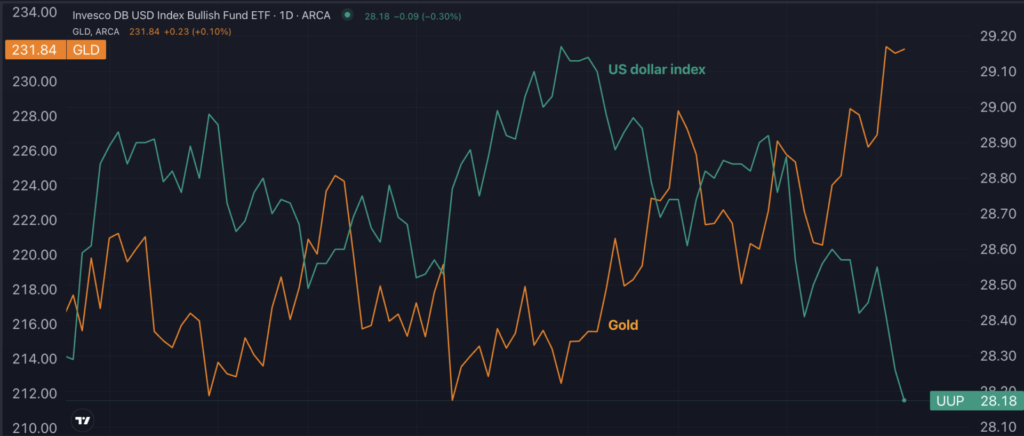
The chart below illustrates the inverse relationship between the U.S. Dollar Index, represented by the green line and tracked by the Invesco DB USD Index Bullish Fund ETF (NYSE:UUP), and gold prices, depicted by the yellow line and tracked by the SPDR Gold Trust (NYSE:GLD).
Year-to-date, gold has surged 22%, setting the stage for its best annual performance since 2020, when it gained 25%. If the current trend holds, 2024 could mark gold’s second-best year since 2008, when it rocketed up by 29.6%.
While most gold bar transactions happen through authorized dealers, it’s becoming easier for individual investors to enter the market. Retail giants like Costco Wholesale Corp. (NASDAQ:COST), Amazon.com Inc. (NASDAQ:AMZN), and WalmartInc. are also selling the bullion, providing a more accessible entry point for consumers.
What Can a 400-Troy-Ounce Gold Bar Buy You?
With a 400-troy-ounce gold bar now worth about $1 million, here’s what you could trade it for:
239,258 pounds of copper
17 Bitcoins according to the latest Bitcoin (CRYPTO: BTC) price of $58,730