The CNN Money Fear and Greed index showed a decline in the overall market sentiment, while the index moved to the “Greed” zone on Tuesday.
U.S. stocks settled mostly lower on Tuesday, with the Dow Jones index falling more than 400 points during the session following a mixed bag of earnings from big banks. The Nasdaq 100 surged to fresh record highs on Tuesday, breaking above the 23,000 mark as Nvidia Corp. (NASDAQ:NVDA) and other chipmakers powered a sharp rally.
On the economic data front, U.S. inflation accelerated for a second straight month. The headline consumer price index rose 2.7% year-over-year in June, the highest since February and in line with expectations. However, core inflation, which strips out food and energy, came in slightly below forecasts at 2.9%, versus 3.0% expected.
Most sectors on the S&P 500 closed on a negative note, with financial, materials and health care stocks recording the biggest losses on Tuesday. However, information technology stocks bucked the overall market trend, closing the session higher.
The Dow Jones closed lower by 436 points to 44,023.29 on Tuesday. The S&P 500 fell 0.40% to 6,243.76, while the Nasdaq Composite gained 0.18% to 20,677.80 during Tuesday’s session.
Investors are awaiting earnings results from Morgan Stanley (NYSE:MS), Goldman Sachs (NYSE:GS) and Bank of America Corporation (NYSE:BAC) today.
What is CNN Business Fear & Greed Index?
At a current reading of 73.6, the index moved to the “Greed” zone on Tuesday, versus a prior reading of 76.2.
The Fear & Greed Index is a measure of the current market sentiment. It is based on the premise that higher fear exerts pressure on stock prices, while higher greed has the opposite effect. The index is calculated based on seven equal-weighted indicators. The index ranges from 0 to 100, where 0 represents maximum fear and 100 signals maximum greediness.
With U.S. stock futures trading lower this morning on Wednesday, some of the stocks that may grab investor focus today are as follows:
Wall Street expects Morgan Stanley (NYSE:MS) to report quarterly earnings at $2.01 per share on revenue of $16.12 billion before the opening bell, according to data from Benzinga Pro. Morgan Stanley shares gained 0.9% to $142.79 in after-hours trading.
J.B. Hunt Transport Services Inc. (NASDAQ:JBHT) posted downbeat earnings for the second quarter after the closing bell on Tuesday. The company reported quarterly earnings of $1.31 per share, missing market estimates of $1.33 per share. J.B. Hunt Transport shares fell 1.1% to $147.25 in the after-hours trading session.
Analysts are expecting Goldman Sachs (NYSE:GS) to have earned $9.56 per share on revenue of $13.36 billion before the opening bell. Goldman Sachs shares gained 0.1% to $703.25 in the after-hours trading session.
ASML Holding N.V. (NASDAQ:ASML) reported better-than-expected bookings for the second quarter but warned that it may not achieve growth in 2026. The company’s net bookings came in at 5.54 billion euros ($6.4 billion), topping market estimates of 4.44 billion euros. ASML shares gained 2% to close at $823.02 on Tuesday.
Analysts expect Bank of America Corp. (NYSE:BAC) to post quarterly earnings at 87 cents per share on revenue of $26.81 billion before the opening bell. Bank of America shares fell 0.2% to $46.05 in after-hours trading.
Bank of America Corporation (NYSE:BAC) looks to keep a streak of beating analyst estimates alive when the company reports second-quarter financial results before the market opens Wednesday.
Here’s a look at the current analyst estimates, what analysts are saying ahead of the report, and key items to watch.
Earnings Estimates: Analysts expect Bank of America to report second-quarter revenue of $26.81 billion, up from $25.54 billion in last year’s second quarter, according to data from Benzinga Pro.
The company has beaten analyst estimates for revenue in five straight quarters and in nine of the last 10 quarters overall.
Analysts expect Bank of America to report second-quarter earnings per share of 87 cents, up from 83 cents per share. The company has beaten analyst estimates for earnings per share in more than 10 straight quarters.
What Analysts Are Saying: Several analysts have downgraded Bank of America stock ahead of the quarterly financial results.
HSBC recently downgraded the stock from Buy to Hold, while also raising the price target from $47 to $51.
Analyst Saul Martinez said there are “downside risks” that are not priced into large U.S. banks like Bank of America. The analyst also downgraded JPMorgan and Goldman Sachs.
The analyst noted that factors such as macroeconomic uncertainty, the potential for economic growth to slow going forward, and future interest rate cuts in 2025 and 2026 could impact the stock’s future valuation.
Martinez said regional banks may be more favorably valued and ripe for rallies.
Truist: Maintained Buy rating, raised price target from $51 to $53
RBC Capital: Maintained Outperform rating, raised rice target from $45 to $53
Baird: Downgraded from Outperform to Neutral, with price target of $52
Citigroup: Maintained Buy rating, raised price target from $50 to $54
Key Items to Watch: Bank of America’s earnings report comes a day after peer JPMorgan & Chasereported results. JPMorgan beat analyst estimates for both revenue and earnings per share and set the table for high expectations being placed on the banking sector.
One person who will be paying close attention to Bank of America’s earnings report is Berkshire Hathaway Inc (NYSE:BRK)(NYSE:BRK) CEO Warren Buffett. The banking company is the third-largest holding in the conglomerate’s investment portfolio.
The Bank of America stake is valued at $29.2 billion. Berkshire has been cutting its stake in Bank of America in recent quarters. Buffett may be looking for specifics or overall health to determine if it makes sense to further trim the position.
Bank of America’s earnings report and subsequent stock move will also be closely followed by owners of the SPDR Select Sector – Financials ETF (NYSE:XLF), with the bank the fifth largest holding at 4.2% of assets.
Recent stress tests were passed by major banks, which could lead to increased dividend payouts and share buybacks, and also open banks to more capital-intensive uses. Analysts may ask the company how it plans to use its cash after the recent stress test.
BAC Price Action: Bank of America stock was down 1.9% to $46.15 on Tuesday versus a 52-week trading range of $33.06 to $49.30. Bank of America stock is up 4.6% year-to-date in 2025.
Bitcoin advocate Udi Wertheimer has made the case that Bitcoin (CRYPTO: BTC) is entering an explosive bull run, akin to what happened with Dogecoin (CRYPTO: DOGE) in 2020–2021.
What Happened: Wertheimer took to X on Monday to point out that Bitcoin’s surge is not just about price, as legacy crypto holders are being replaced by institutions, ETFs and treasuries like Strategy (NASDAQ:MSTR), which are accumulating without regard for past valuations.
This mirrors Dogecoin’s explosive 200x rally in 2020–2021, where old holders sold early, while new buyers, unaware of past price ceilings, kept accumulating until a sudden supply shock triggered massive upside.
That behavior caused a supply shock and sent Dogecoin soaring from fractions of a penny to $0.70 in 2021, a 200x move.
Wertheimer argues Bitcoin is following the same path, but on a much grander scale.
He warns the current consolidation phase isn’t the top, it’s the reset before liftoff.
New institutional buyers, especially via ETF flows like IBIT, aren’t concerned with technical ceilings.
To them, Bitcoin at $110,000 is still cheap, especially compared to other asset classes.
What’s Next: Udi Wertheimer base case is entering the first phase of a truly generational bull run, projecting a top of $400,000 by year-end.
Just as Dogecoin’s old holders missed the bulk of the rally, he warns today’s sidelined Bitcoiners may watch this run from the rearview mirror, unless they act now.
Ethereum (CRYPTO: ETH), he says, will be the biggest loser of this cycle, weighed down by long-term holders and underwhelming performance versus BTC.
The $4,000 target prediction show lack of belief and bagholders are still offloading on every pump. He even suggests that Strategy’s valuation could flip Ethereum’s, signalling a dramatic shift in crypto capital concentration.
Pulled from Benzinga Pro data the above sector movers alert assists traders in understanding macro-level trends and market variations. Traders will look for sector movers providing information on sectors that are over- or under-performing, deriving these results into investing decisions on exchange-traded funds (ETFs) or individual tickers in those sectors.
The CNN Money Fear and Greed index showed an improvement in the overall market sentiment, while the index remained in the “Extreme Greed” zone on Monday.
U.S. stocks settled mixed on Monday, with the Dow Jones index recording gains during the session following President Donald Trump‘s weekend announcement of a sweeping 30% tariff on all imports from the European Union and Mexico, set to take effect August 1.
Investor sentiment was further clouded by inflation concerns ahead of Tuesday’s consumer price index release. Economists anticipate an annual rise from 2.4% to 2.7%, suggesting that companies may be starting to pass on higher import costs to consumers.
Fastenal Company (NASDAQ:FAST) reported better-than-expected second-quarter earnings. Shares of Daré Bioscience, Inc. (NASDAQ:DARE) jumped around 23% on Monday after the company announced interim safety and efficacy results from its ongoing Phase 3 clinical trial evaluating the contraceptive effectiveness, safety and acceptability of Ovaprene.
Most sectors on the S&P 500 closed on a positive note, with financial, communication services and real estate stocks recording the biggest gains on Monday. However, energy and materials stocks bucked the overall market trend, closing the session lower.
The Dow Jones closed higher by 88 points to 44,459.65 on Monday. The S&P 500 rose 0.14% to 6,268.56, while the Nasdaq Composite gained 0.27% at 20,640.33 during Monday’s session.
Investors are awaiting earnings results from JPMorgan Chase & Co. (NYSE:JPM), Wells Fargo & Company (NYSE:WFC) and Citigroup Inc. (NYSE:C) today.
What is CNN Business Fear & Greed Index?
At a current reading of 76.4, the index remained in the “Extreme Greed” zone on Monday, versus a prior reading of 75.6.
The Fear & Greed Index is a measure of the current market sentiment. It is based on the premise that higher fear exerts pressure on stock prices, while higher greed has the opposite effect. The index is calculated based on seven equal-weighted indicators. The index ranges from 0 to 100, where 0 represents maximum fear and 100 signals maximum greediness.
With U.S. stock futures trading slightly higher this morning on Tuesday, some of the stocks that may grab investor focus today are as follows:
Wall Street expects JPMorgan Chase & Co. (NYSE:JPM) to report quarterly earnings at $4.48 per share on revenue of $44.17 billion before the opening bell, according to data from Benzinga Pro. JPMorgan shares gained 0.4% to $289.94 in after-hours trading.
Analysts are expecting Wells Fargo & Co. (NYSE:WFC) to have earned $1.40 per share on revenue of $20.78 billion before the opening bell. Wells Fargo shares gained 0.1% to $83.55 in the after-hours trading session.
Longevity Health Holdings Inc. (NASDAQ:XAGE) announced a merger with THPlasma and the termination of its transaction with 20/20 BioLabs. This strategic move is expected to leverage plasma synergies to drive bioaesthetic innovation. Longevity Health shares jumped 67.5% to $4.43 in the after-hours trading session.
Before the markets open, The Bank of New York Mellon Corp. (NYSE:BK) is projected to post quarterly earnings at $1.76 per share on revenue of $4.83 billion. Bank of New York Mellon shares rose 1.4% to $96.60 in after-hours trading.
Analysts expect Citigroup Inc. (NYSE:C) to post quarterly earnings at $1.62 per share on revenue of $20.89 billion before the opening bell. Citigroup shares gained 0.8% to $88.17 in after-hours trading.
Banking giant JPMorgan Chase & Co (NYSE:JPM) could provide a detailed look at the health of the American economy and consumer and have a big impact on several ETFs when the company reports second-quarter financial results Tuesday before market open.
Here are the earnings estimates from analysts, what experts are saying ahead of the report and the key items to watch.
Earnings Estimates: Analysts expect JPMorgan to report second-quarter revenue of $44.17 billion, down from $50.99 billion, according to data from Benzinga Pro.
The company has beaten analyst estimates for revenue in more than 10 straight quarters.
Analysts expect the company to report second-quarter earnings per share of $4.48, up from $4.40 in last year’s second quarter. The company has beaten analyst estimates for earnings per share in more than 10 straight quarters.
What Experts Are Saying: JPMorgan is one of several large financial institutions that will report quarterly financial results this week.
“The sector itself has been outperforming the S&P 500, experiencing new all-time highs and has been a leading sector in the most recent market rebound,” Freedom Capital Markets Chief Global Strategist Jay Woods said in a weekly newsletter.
Because banks have passed the Fed’s stress test with “flying colors,” Woods expects increased growth or potential M&A activity.
“There is hope that a banking renaissance is on the horizon and maybe this quarter will give a more rosy outlook than more recent forecasts,” he adds.
Truist: Maintained Hold rating, raised price target from $280 to $290
Evercore ISI Group: Maintained Outperform rating, raised price target from $280 to $298
Citigroup: Maintained Neutral rating, raised price target from $250 to $275
Key Items to Watch: Woods notes five of the top holdings from the SPDR Select Sector Fund – Financial (NYSE:XLF).
JPMorgan is the second-largest holding in the ETF at 10.87% of assets. The ETF could be highly volatile during a week of multiple earnings releases and the pressure of JPMorgan’s report.
Another ETF that could be impacted is the SPDR Dow Jones Industrial Average ETF (NYSE:DIA). JPMorgan is the 11th largest holding in the ETF that tracks Dow Jones Industrial Average.
Investors and analysts will closely watch JPMorgan for several items in the quarterly results. These include overall revenue, investment banking, Consumer & Community Banking and Commercial & Investment Bank. Such business segments can exhibit growth or a decline in revenue, and possibly gauge the overall health of the American economy.
Another critical factor is commentary from CEO Jamie Dimon regarding the firm’s future and the banking sector. Dimon offered warnings about geopolitics, tax reform, tariffs, inflation and volatility after the company’s first-quarter results. Investors and analysts will be looking to see if Dimon remains concerned or turns optimistic.
Price Action: JPMorgan stock is up 0.4% to $287.94 on Monday versus a 52-week trading range of $190.90 to $296.40. JPMorgan stock is up 20% year-to-date in 2025.
The SPDR Select Sector Fund- Financial ETF is up 8.9% year-to-date in 2025.
Big bank earnings season kicks off Tuesday, July 15, with key industry heavyweight JPMorgan Chase & Co. (NYSE:JPM), Citigroup Inc. (NYSE:C) and Wells Fargo Corp. (NYSE:WFC) headlining a crucial reporting day for financials, as Wall Street eyes a rebound in quarterly profits fueled by stronger net interest income and healthy capital markets activity.
Here’s what to expect as the second-quarter 2025 numbers roll in before the bell.
Bank Profits Growth Expected
Wall Street expects a strong quarter for major banks, with JPMorgan Chase & Co. forecast to deliver earnings per share (EPS) of $4.48 in the second quarter, a modest 1.8% increase from $4.40 a year ago. Revenue is projected at $44.17 billion, reflecting a pullback from last year’s $50.2 billion.
Citigroup is expected to post more robust growth, with EPS projected to rise 6.6% year over year to $1.62 from $1.52. Revenue is also expected to improve slightly to $20.89 billion, up 3.9% from last year’s Q2.
Wells Fargo is forecast to earn $1.40 per share, a 5.3% increase over the prior-year quarter. Revenue is expected to remain flat at $20.78 billion, indicating stable core banking performance despite macroeconomic headwinds.
BlackRock Inc. (NYSE:BLK), although not a traditional bank, is poised for a solid performance in asset management, with EPS expected to reach $10.80, representing a 4.2% increase over last year. Revenues are projected to be $5.34 billion, representing an 11% increase.
Other names in focus include Bank of New York Mellon Corp. (NYSE:BK), expected to post EPS of $1.76 on $4.83 billion in revenue, and State Street Corp. (NYSE:STT), which is projected to earn $2.37 per share on $3.35 billion in revenue—both reflecting ongoing resilience in custody and asset servicing segments.
The positive earnings outlook follows banks passing the Federal Reserve’s June stress tests with ease, prompting widespread dividend hikes.
The median dividend per share across major banks rose 7%, with standouts like Goldman Sachs Group Inc. (NYSE:GS) lifting its quarterly payout 33% to $4.00.
JPMorgan raised its dividend by 7% to $1.50 and authorized a massive $50 billion stock buyback program.
Citigroup boosted its dividend by 7% and continues its $20 billion multi-year repurchase plan.
Analyst Views: Where’s The Opportunity?
Goldman Sachs analyst Richard Ramsden said Wells Fargo and Bank of America Corp. (NYSE:BAC) offer the best earnings upside for investors heading into 2026.
He sees Bank of America’s net interest income (NII) growing 7% annually through 2026, outperforming large bank peers, driven by stronger loan growth, favorable asset sensitivity and lower deposit costs. “We view BAC’s current ~1.5x 2026E price-to-tangible book value as attractive,” Ramsden said.
For Wells Fargo, the recent removal of its asset cap opens the door to deposit growth, capital markets expansion and cost savings. Ramsden believes these factors could boost earnings by as much as 19% and push return on tangible common equity (ROTCE) to as high as 17.3%.
Bank of America analyst Ebrahim Poonawala echoed bullish sentiment, saying the sector could see “positive EPS revisions and further stock re-rating” if capital expenditures and client activity pick up.
He flagged Citigroup, Wells Fargo, and Goldman Sachs as offering the best risk-reward among money center banks.
What’s At Stake For Investors?
With the Financial Select Sector SPDR Fund (NYSE:XLF) up more than 8% year-to-date, bank stocks have already benefited from a more stable rate environment and strong capital positions.
However, any surprises in loan demand, expense growth, or trading revenue could quickly swing sentiment.
Tuesday’s results will set the tone for the rest of earnings season and could determine whether banks still have room to run, or whether Wall Street has already priced in the rebound.
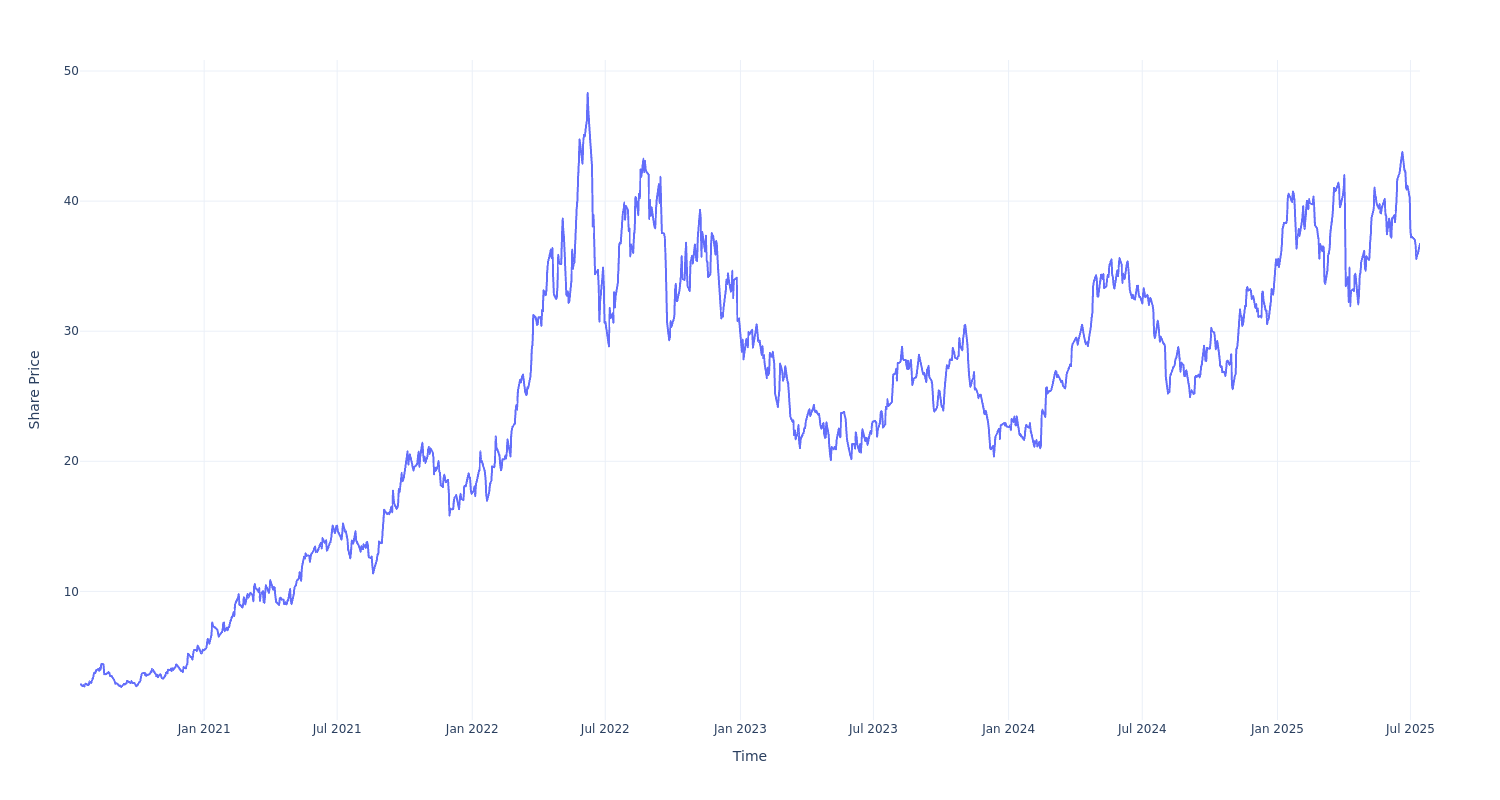
Antero Resources (NYSE:AR) has outperformed the market over the past 5 years by 52.64% on an annualized basis producing an average annual return of 66.73%. Currently, Antero Resources has a market capitalization of $11.24 billion.
Buying $100 In AR: If an investor had bought $100 of AR stock 5 years ago, it would be worth $1,288.07 today based on a price of $36.15 for AR at the time of writing.
Antero Resources’s Performance Over Last 5 Years
Finally — what’s the point of all this? The key insight to take from this article is to note how much of a difference compounded returns can make in your cash growth over a period of time.
This article was generated by Benzinga’s automated content engine and reviewed by an editor.