Matthew Sigel, head of digital assets research at VanEck, sees Bitcoin (CRYPTO: BTC) on a strong upward path as the U.S. presidential election approaches, bolstered by growing interest and shifting macroeconomic conditions.
What Happened: “Our bet is that this is a very bullish setup for Bitcoin into the election,” Sigel told CNBC on Monday, pointing out that factors such as Trump’s increasing popularity in prediction markets and renewed optimism in the crypto sector are helping drive demand.
According to Sigel, Trump’s position as the more pro-crypto candidate, compared to Vice President Kamala Harris, is likely fueling confidence among crypto investors.
Sigel highlighted Bitcoin’s strongest long-term correlations: a negative relationship with the U.S. dollar and a positive relationship with money supply growth, which has accelerated recently due to the Federal Reserve’s pivot on interest rates.
This increase in money supply is contributing to Bitcoin’s upward momentum, along with a “seller’s exhaustion” phase following significant sales by both the German and U.S. governments.
Sigel described these government Bitcoin sales, totaling around $2 billion, as “spiteful,” referring to seizures and subsequent sales intended to prevent criminal misuse of the asset. “That has eased, and I think the election is helping,” he added.
Sigel also pointed out that Bitcoin’s historical volatility pattern tends to remain low before an election, followed by a post-election rally once results are clear.
He compared the current situation to the 2020 election cycle when Bitcoin initially lagged but then surged as clarity emerged.
Sigel believes that, after the election results are finalized, a potential U.S. sovereign debt downgrade by Moody’s could act as a catalyst for Bitcoin, attracting buyers looking for alternatives to traditional fiat currencies.
“Once the election result is finalized, Moody’s is going to downgrade U.S. sovereign debt,” he noted, hinting at a possible “high vol rally” that could bring Bitcoin to new highs.
Sigel’s outlook aligns with projections from other analysts, including Standard Chartered, which anticipates that Bitcoin could reach $73,000 by Election Day on Nov. 5 and potentially surge to $80,000 shortly after if Trump secures a victory.
Standard Chartered’s analysis points to heavy open interest in Bitcoin options with $80,000 call strike prices expiring on Dec. 27, suggesting strong market anticipation of a post-election rally.
“Our estimates show a total price increase of around 10% from the pre-election price,” potentially pushing Bitcoin to $80,000 in the days following the election, Geoffrey Kendrick, Standard Chartered’s head of crypto research, said.
Looking further ahead, Standard Chartered’s year-end target for Bitcoin is $125,000, contingent on a Republican sweep in both the presidential and congressional races.
This bullish projection hinges on Republicans creating a favorable environment for digital assets, as many investors view the party as more supportive of crypto-friendly policies.
However, the outlook shifts if Harris wins; in that case, Standard Chartered anticipates an initial dip in Bitcoin prices, followed by a recovery to $75,000 by year-end, reflecting cautious optimism rather than a rally.
Sigel further highlighted Bitcoin’s growing appeal beyond U.S. borders, especially among BRICS nations.
He pointed out that three new BRICS members—Argentina, UAE and Ethiopia—have started investing in Bitcoin mining as part of national initiatives, marking a significant step toward de-dollarization.
“BRICS GDP is now greater than the combined GDP of the G7,” he said, adding that some BRICS countries are exploring Bitcoin as a medium for global trade.
Russia, for instance, has announced plans to fund Bitcoin mining infrastructure to facilitate trade settlements in Bitcoin, signaling a shift toward alternative financial systems that bypass traditional fiat currencies.
What’s Next: These themes will be further discussed at Benzinga’s Future of Digital Assets event on Nov. 19, where experts will explore the role of Bitcoin in an evolving global economy.
On Wednesday, Cigna’s board declared a cash dividend of $1.40 per share of its common stock, payable on Dec. 19, to shareholders of record as of the close of business on Dec. 4.
Enphase Energy, Inc. (NASDAQ:ENPH) has “just been clobbered already,” Cramer said. “I don’t want you to sell it all the way down here.”
On Oct. 22, Enphase Energy reported third-quarter revenue of $380.9 million, missing the consensus estimate of $391.979 million. The solar company reported adjusted earnings of 65 cents per share, missing analyst estimates of 77 cents per share, according to Benzinga Pro.
Ki Young Ju, CEO of CryptoQuant, suggests that Bitcoin (CRYPTO: BTC) is on track to become a widely used currency by 2030, largely driven by the mass adoption of stablecoins.
What Happened: Ju pointed out in a post on X on Thursday that Bitcoin’s mining difficulty—a measure of competition—has surged by 378% over the past three years. While it was possible to mine 50 BTC with a single PC in 2009, today’s mining is dominated by institutional-backed companies, making it nearly impossible for solo miners to compete.
As institutional involvement grows, Ju predicts Bitcoin’s volatility will decrease, enhancing its potential as a stable currency. He expects this transition to gain momentum after the 2028 halving event.
Why It Matters: Ki Young Ju highlighted the entry of companies like Stripe into the stablecoin infrastructure industry. Earlier in the week, Stripe CEO Patrick Collison announced on X that stablecoin platform Bridge will be acquired by Stripe to facilitate cross-border money movement.
Recently, PayPal completed its first commercial transaction using USD pegged stablecoin, PYUSD, as reported by Bloomberg.
With regulations in place, he expects major fintech players to drive the mass adoption of stablecoins within three years. By around April 2028, during the next halving, Ju believes that Bitcoin’s potential use as a “currency” will start to be seriously discussed as volatility decreases further and the ecosystem matures.
He anticipates that by 2030, Bitcoin may fulfill Satoshi Nakamoto’s vision of being “P2P Electronic Cash” rather than just digital gold.
Fast-food giant McDonald’s Corporation (NYSE:MCD) is one of the most valuable restaurant companies in the world, valued at more than $225 billion and consistently putting out quarterly results with billions of dollars in revenue.
It turns out that the company could have been even more valuable if it had retained its ownership stake in Chipotle Mexican Grill (NYSE:CMG).
McDonald’s Ownership of Chipotle: McDonald’s invested in several restaurant companies during the late 1990s and early 2000s including taking an initial stake in Chipotle in 1998.
The fast-food giant was instrumental in Chipotle’s rapid expansion, helping to grow the chain from 14 to more than 500 locations in seven years.
McDonald’s initially invested $50 million into the fast casual company and invested around $340 million total during its time holding a stake in the company, as reported by Bloomberg. At one time, McDonald’s owned around 90% of Chipotle.
Chipotle went public on Jan. 26, 2006, at $22 a share. Its stock opened for trading at $44 and gained huge interest and a soaring valuation. The company had an initial valuation of approximately $700 million at the time of its IPO, but by the end of 2006, it had grown to $1.85 billion.
McDonald’s sold a portion of its ownership in Chipotle during the IPO and exited its position completely by October 2006.
While it is unknown how much McDonald’s made on their multiple sales of Chipotle stock, it turns out they could have made a lot more by holding or selling at a later date.
Chipotle’s current market capitalization is $82 billion. McDonald’s 90% stake in Chipotle would be worth $73.8 billion today, assuming it held the entire ownership amount.
Why McDonald’s Sold: Chipotle was one of several restaurant companies McDonald’s invested in, a list that includes Donato’s Pizza, Aroma Café, Boston Market, Pret A Manger and a joint venture with Fazoli’s.
The investment in Chipotle was one of the keys for McDonald’s and the larger restaurant company tried to influence business decisions of the smaller brand with ideas like launching a breakfast menu, franchising locations and adding drive-thru locations.
While Chipotle reluctantly added franchised locations, former CEO and co-founder Steve Ells fought back against drive-thru windows and breakfast.
McDonald’s was asked about its decision to sell its Chipotle stake at a shareholder meeting. Then CEO Steve Easterbrook said Chipotle and other restaurant investments took attention away from the core McDonald’s brand, labeling them a distraction, according to a report from Entrepreneur.
Easterbrook said the sale of Chipotle and other restaurant stakes would ensure that everyone was putting 100% of their time and focus into the core McDonald’s brand.
Ells has openly discussed the differences between where he wanted to take Chipotle and where McDonald’s wanted to go, which may also have led to the sale.
“What we found at the end of the day was that culturally we’re very different,” Ellis told Bloomberg. “There are two big things that we do differently. One is the way we approach food, and the other is the way we approach our people culture. It’s the combination of those things that I think make us successful.”
McDonald’s divested all its ownership stakes in restaurant companies but later ventured into the creation of Redbox, a movie kiosk business. The company eventually sold a stake in Redbox to Coinstar before fully exiting the business.
What’s Next: McDonald’s continues to be one of the largest restaurant companies in the world and competes for market share from consumers in the highly competitive fast-food space.
Chipotle and other fast-casual brands have taken market share from the fast-food sector over the years. Chipotle continues to grow and has over 3,000 locations in the United States, Canada, and several other countries.
After the sale of its stake by McDonald’s, Chipotle bought back the franchised locations. The company now owns all of its U.S. locations in a decision to focus on consistent quality and service at all locations as part of its “Food with Integrity” promise.
Chipotle opened its first location in Dubai in October 2024. The restaurant is part of the company’s first-ever international franchise partnership that will see more locations open in the Middle East in the future.
While Chipotle moved away from the franchise model that McDonald’s advocated, the company did adopt one key idea from its former investor. Today, most Chipotle locations, including the majority of new builds, feature a drive-thru lane. This addition aligns with McDonald’s influence and has become a significant feature in Chipotle’s operations.
Avalanche (CRYPTO: AVAX) has launched the Avalanche Card, a crypto payment card that allows users to make purchases at any Visa-accepting location using their digital assets.
This card supports cryptocurrencies such as USDC (CRYPTO: USDC) and AVAX, enabling holders to spend their crypto as easily as traditional currency.
The card, available in both physical and virtual forms, was initially released in Latin America and the Caribbean, with plans to expand into other regions.
The Avalanche Card functions without traditional financial ties, meaning it is not linked to a bank account, and transactions do not impact the user’s credit score.
Upon signing up, users are provided with a self-custody wallet, ensuring secure and instant access to their funds. Security features include spending alerts, the ability to freeze the card, and the option to change the PIN at any time.
Avalanche’s latest move represents an important step towards making cryptocurrency a practical and mainstream payment method.
By offering the ability to use digital currencies for everyday transactions, Avalanche is helping to close the gap between crypto and traditional financial systems.
The card is initially being offered in regions like Latin America and the Caribbean, where financial inclusion and access to traditional banking services can be limited.
However, users from certain countries, including Cuba, Venezuela, Nicaragua, and Russia, are excluded from accessing the card.
In addition to consumer-focused advancements like the Avalanche Card, the company is also strengthening its blockchain infrastructure.
Through a partnership with Chainlink (CRYPTO: LINK), Avalanche is piloting an AI-powered on-chain database that utilizes decentralized Oracle technology.
This new system will offer real-time data handling across blockchain networks, enhancing transparency and efficiency for corporate actions such as mergers and dividends.
Avalanche has also been involved in a recent buyback of 1.97 million AVAX tokens from the Luna Foundation Guard for $45.5 million.
The tokens were originally sold to LFG to build reserves for TerraClassicUSD, but the settlement aims to prevent complications in LFG’s bankruptcy proceedings.
What’s Next: The growing integration of crypto into everyday life and the wider financial system will likely be discussed at the upcoming Benzinga Future of Digital Assets event on Nov. 19, where industry leaders will explore how tools like the Avalanche Card are shaping the future of digital currencies.
Electric vehicle giant Tesla Inc (NASDAQ:TSLA) could share more details on demand and a strategy for the upcoming Cybercab when the company reports third-quarter financial results after market close Wednesday.
The Tesla Analyst: Wedbush analyst Daniel Ives reiterated an Outperform rating on Tesla with a $300 price target.
The Analyst Takeaways: Ives said Tesla CEO Elon Musk will likely address the electric vehicle demand environment for the fourth quarter and 2025 when the company reports financial results Wednesday.
“While many investors left the Robotaxi Day clearly wanting more details on the broader autonomous and AI strategy at Tesla, we would expect Musk to address some of the timing/specifics around its FSD and Cybercab strategy on the conference call,” Ives said.
Tesla investors and analysts didn’t hear updates on Tesla’s sub-$30k vehicle during the Robotaxi Day event and Ives believes this vehicle, which he expects to be released in mid-2025, could be highlighted on this week’s earnings call.
“Overall we expect generally in-line 3Q headline numbers with some slight upside likely on the margins front showing a bottoming on this key metric.”
Ives said the 1.8 million unit estimate for 2024 “remains hittable” after the September quarterly delivery report saw figures in-line with estimates. Going forward, Ives said, “2 million+ number the focus for 2025.”
“We remain confident in Tesla’s ability to hit 1.8 million deliveries for FY24 which we will view as a solid feat given the extensive white-knuckle moments seen throughout the first half of the year.”
The analyst also said margins will be a key focus for analysts.
“We need to start seeing this key metric head into the high teens for 3Q/4Q to give the Street comfort much of the price cuts are in the rear-view mirror showing better margin days are ahead for 2025.”
Ives said strength in China and the evolving AI strategy could be other items to watch for the “bullish Tesla narrative.”
TSLA Price Action: Tesla stock is down 1.52% to $217.36 on Monday versus a 52-week trading range of $138.80 to $271. Tesla stock is down 12% year-to-date in 2024.
Nvidia Corp (NASDAQ:NVDA) announced that it will partner with Aidoc, a startup that offers healthcare organizations artificial intelligence (AI) tools to improve workflows, data accuracy, and overall patient care.
The companies will work on a new framework, “Blueprint for Resilient Integration and Deployment of Guided Excellence” (BRIDGE), a guideline that aims to accelerate AI adoption across the healthcare industry.
The guideline, scheduled for release in early 2025, will introduce a comprehensive, evidence-based framework for more effectively integrating AI into clinical workflows.
It aims to enable healthcare organizations to accelerate AI innovation with increased confidence. The guideline will outline strategies for healthcare systems to fully leverage AI’s potential in enhancing patient outcomes.
Although more than 900 FDA-cleared AI tools for medical imaging have been approved, healthcare systems still face fragmentation, operational inefficiencies, and scalability challenges.
The BRIDGE guideline will offer a vendor-neutral, all-encompassing roadmap to tackle these issues, empowering providers to realize AI’s benefits fully.
“AI holds the potential to revolutionize patient care, but its progress has been stalled by fragmented systems and the inability to scale effectively,” said Demetri Giannikopoulos, Chief Transformation Officer, Aidoc. “The BRIDGE guideline will focus on breaking down these barriers, offering a powerful, evidence-based framework that health systems can rely on not just adopt AI but to help scale it across their operations. This will drive both operational efficiency and significantly better outcomes for patients and clinicians alike.”
The BRIDGE guideline aims to establish a foundation aligned with industry frameworks like MONAI, which will serve as the blueprint for the medical AI enterprise platform.
MONAI, co-founded in 2019 by academia and industry leaders, including NVIDIA, offers essential tools for developing, validating, and deploying medical AI.
With over three million downloads and active use in FDA-approved software-as-medical-device applications, MONAI’s emphasis on standardization, interoperability, and scalability is crucial to driving transformative healthcare solutions.
Price Action: NVDA stock is up 0.32% at $138.32 at last check Monday.
In today’s fast-paced and highly competitive business world, it is crucial for investors and industry followers to conduct comprehensive company evaluations. In this article, we will delve into an extensive industry comparison, evaluating Advanced Micro Devices (NASDAQ:AMD) in relation to its major competitors in the Semiconductors & Semiconductor Equipment industry. By closely examining key financial metrics, market standing, and growth prospects, our objective is to provide valuable insights and highlight company’s performance in the industry.
Advanced Micro Devices Background
Advanced Micro Devices designs a variety of digital semiconductors for markets such as PCs, gaming consoles, data centers, industrial, and automotive applications, among others. AMD’s traditional strength was in central processing units, CPUs, and graphics processing units, or GPUs, used in PCs and data centers. Additionally, the firm supplies the chips found in prominent game consoles such as the Sony PlayStation and Microsoft Xbox. In 2022, the firm acquired field-programmable gate array, or FPGA, leader Xilinx to diversify its business and augment its opportunities in key end markets such as the data center and automotive.
After thoroughly examining Advanced Micro Devices, the following trends can be inferred:
The Price to Earnings ratio of 186.01 for this company is 2.75x above the industry average, indicating a premium valuation associated with the stock.
With a Price to Book ratio of 4.47, significantly falling below the industry average by 0.48x, it suggests undervaluation and the possibility of untapped growth prospects.
The Price to Sales ratio is 11.0, which is 0.99x the industry average. This suggests a possible undervaluation based on sales performance.
The Return on Equity (ROE) of 0.47% is 3.95% below the industry average, suggesting potential inefficiency in utilizing equity to generate profits.
Compared to its industry, the company has lower Earnings Before Interest, Taxes, Depreciation, and Amortization (EBITDA) of $1.12 Billion, which is 0.05x below the industry average, potentially indicating lower profitability or financial challenges.
The company has lower gross profit of $2.86 Billion, which indicates 0.12x below the industry average. This potentially indicates lower revenue after accounting for production costs.
The company’s revenue growth of 8.88% is significantly below the industry average of 11.76%. This suggests a potential struggle in generating increased sales volume.
Debt To Equity Ratio
The debt-to-equity (D/E) ratio is a measure that indicates the level of debt a company has taken on relative to the value of its assets net of liabilities.
Considering the debt-to-equity ratio in industry comparisons allows for a concise evaluation of a company’s financial health and risk profile, aiding in informed decision-making.
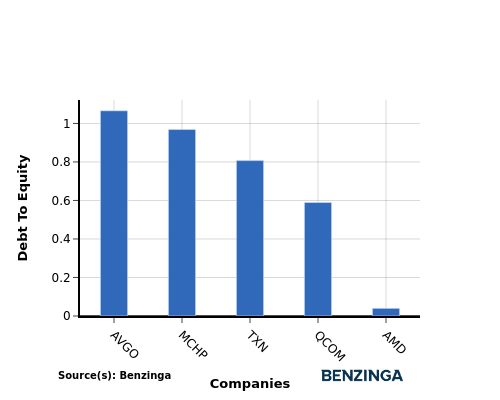
When comparing Advanced Micro Devices with its top 4 peers based on the Debt-to-Equity ratio, the following insights can be observed:
Advanced Micro Devices demonstrates a stronger financial position compared to its top 4 peers in the sector.
With a lower debt-to-equity ratio of 0.04, the company relies less on debt financing and maintains a healthier balance between debt and equity, which can be viewed positively by investors.
Key Takeaways
For Advanced Micro Devices, the PE ratio is high compared to peers, indicating potentially overvalued stock. The PB and PS ratios are low, suggesting undervaluation relative to industry competitors. In terms of ROE, EBITDA, gross profit, and revenue growth, Advanced Micro Devices lags behind its peers, indicating weaker financial performance and growth prospects within the Semiconductors & Semiconductor Equipment industry.
This article was generated by Benzinga’s automated content engine and reviewed by an editor.
During times of turbulence and uncertainty in the markets, many investors turn to dividend-yielding stocks. These are often companies that have high free cash flows and reward shareholders with a high dividend payout.
Benzinga readers can review the latest analyst takes on their favorite stocks by visiting Analyst Stock Ratings page. Traders can sort through Benzinga’s extensive database of analyst ratings, including by analyst accuracy.
Below are the ratings of the most accurate analysts for three high-yielding stocks in the energy sector.
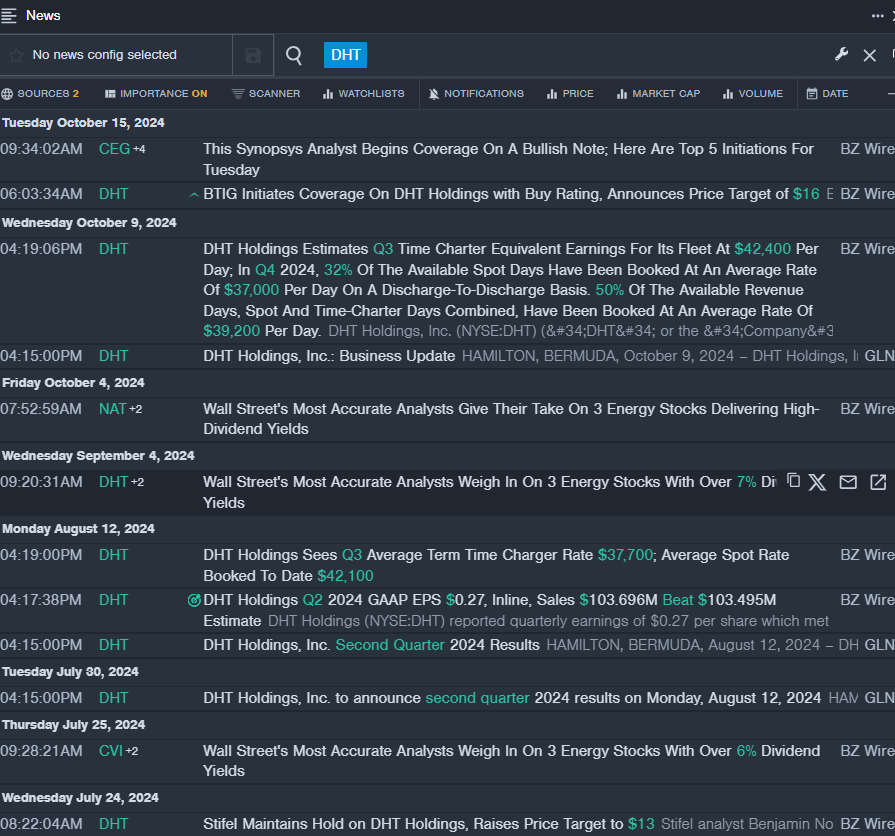
BTIG analyst Gregory Lewis initiated coverage on the stock with a Buy rating and a price target of $16 on Oct. 15. This analyst has an accuracy rate of 74%.
Stifel analyst Benjamin Nolan maintained a Hold rating and raised the price target from $12 to $13 on July 24. This analyst has an accuracy rate of 68%
Recent News: On Oct 9, DHT Holdings said it estimates third-quarter time charter equivalent earnings for its fleet at $42,400 per day.
Alliance Global Partners analyst Jeff Grampp maintained a Buy rating and cut the price target from $28 to $26 on Aug. 7. This analyst has an accuracy rate of 63%.
Roth MKM analyst John White initiated coverage on the stock with a Buy rating and a price target of $30.5 on Oct. 16, 2023. This analyst has an accuracy rate of 69%.
Recent News: On Aug. 5, Vitesse Energy posted downbeat quarterly earnings.
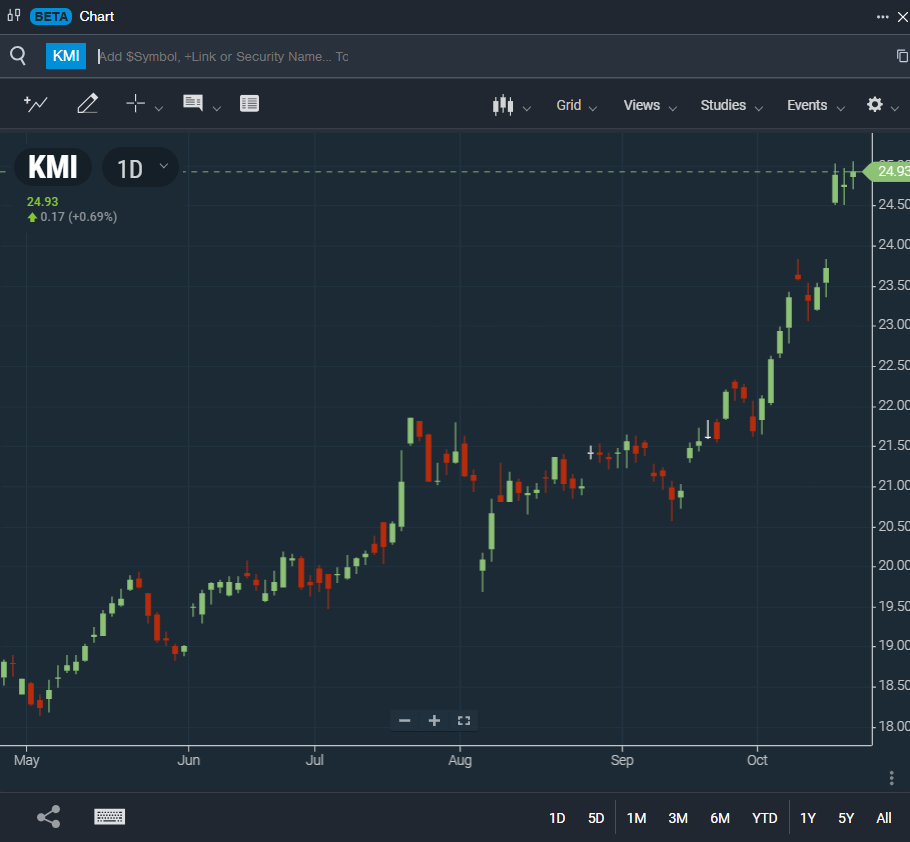
Morgan Stanley analyst Devin McDermott upgraded the stock from Underweight to Equal-Weight with a price target of $24 on Sept. 16. This analyst has an accuracy rate of 80%.
Barclays analyst Theresa Chen maintained an Equal-Weight rating and boosted the price target from $21 to $22 on Sept. 13. This analyst has an accuracy rate of 78%.
Recent News: On Oct. 16, Kinder Morgan reported third-quarter revenue of $3.699 billion, missing the consensus estimate of $3.975 billion, according to Benzinga Pro.