Google has elevated longtime engineering leader Amin Vahdat to oversee its AI infrastructure strategy.
After 15 years at Google, Vahdat will become chief technologist for AI infrastructure and join the small group of 15–20 executives who report directly to CEO Sundar Pichai.
Google expects to spend over $90 billion in capital expenditures by the end of 2025, most of it on the infrastructure Vahdat will now lead, Semafor reported on Thursday, citing an internal memo.
Gemini 3 Powers AI Expansion
In November, Google launched Gemini 3 to outpace OpenAI by rolling out a more intelligent, multimodal, and agentic AI system that understands user intent with fewer prompts, delivers richer and more visual answers across Search.
Google’s Gemini 3 model success stems from a decade of building custom TPU chips, designing cooling systems and optical switches around them, and vertically integrating the hardware and software that power models like Gemini.
Vahdat helped overhaul Google’s Jupiter data-center network in 2022, cutting the cost of serving core products like YouTube, Search, and Cloud.
Rising Competition and Market Impact
CNBC’s Jim Cramerhad warned that Google’s new Gemini 3 model could spell trouble for OpenAI, predicting on X that tens of millions of users would shift to Gemini and leave OpenAI scrambling.
His post followed reports that Sam Altman put the company in “code red” to improve ChatGPT as Google’s latest Gemini system gains momentum, boosts its user base, and intensifies competition across AI models and even Nvidia’s dominance in AI chips.
Bank of America Securities analyst Justin Post said Gemini’s user growth is bolstering Alphabet’s AI ecosystem, boosting engagement and driving a sharp rise in traffic, even as Google Search remains stable against rising competition from ChatGPT.
GOOGL stock has gained over 69% year-to-date, driven by Cloud & AI business (especially with Gemini), increased investment forecasts, and positive analyst sentiment.
Alphabet has a consensus price forecast of $296.69 based on the ratings of 39 analysts.
GOOGL Price Action: Alphabet shares were down 0.22% at $319.50 during premarket trading on Thursday. The stock is trading near its 52-week high of $328.83, according to Benzinga Pro data.
Wheaton Precious Metals Corp. (NYSE:WPM) is positioned to benefit materially from earlier streaming investments as production ramps across several key assets drive strong gold equivalent ounce growth through the end of the decade.
Projects including Blackwater, Copper World, and Salobo are expected to underpin a visible and sustained expansion profile beginning in the latter half of the 2020s.
RBC Capital Markets analyst Josh Wolfson recently upgraded Wheaton Precious Metals to Outperform from Sector Perform and raised his price forecast to $130 from $115.
The move follows RBC’s updated precious-metals assumptions and reflects what he views as a more attractive setup for royalty and streaming companies after a sector-wide valuation reset.
Wolfson argues that royalty names are better insulated than traditional miners ahead of guidance season, given their limited exposure to operating and capital cost inflation.
He also raised his gold price outlook, forecasting average gold prices of $4,600 per ounce in 2026 and $5,100 per ounce in 2027.
Growth Visibility Without New Capital
Under these assumptions, Wolfson expects Wheaton’s slate of previously executed stream deals to translate into clear production growth starting in 2026, followed by consistent annual increases from 2027 through 2031 without requiring incremental investment.
Against the estimated 2025 production of 655,000 gold equivalent ounces, he projects more than 45% growth by 2030, which he characterizes as the strongest growth profile among large-cap royalty peers.
Wheaton’s revenue mix also positions it to benefit from stronger silver prices, with roughly 37% of revenue tied to silver.
Key Assets and Project Ramp-Ups
Salobo remains the cornerstone asset, accounting for approximately 38% of net asset value and EBITDA. Wolfson notes that operator Vale’s recent commentary supports steady performance in 2026, with longer-term upside tied to a potential coarse-particle flotation initiative that could help stabilize output later in the decade.
Beyond Salobo, he highlights a broad pipeline of contributors, including Blackwater, Copper World, El Domo, Fenix, Kone, Kurmuk, Platreef, Santo Domingo and Spring Valley, as multiple projects move through development and ramp-up phases.
Valuation and Risk Framework
Wolfson’s $130 price target is based on a 2.4x risk-weighted net asset value using a long-term gold price of $3,000 per ounce, plus 24x projected 2025–2027 sustainable free cash flow, or roughly 23x EBITDA. He outlines upside to $170 at a $5,000 per ounce long-term gold price and downside to $85 at $2,500 per ounce.
Key risks include asset concentration, particularly at Salobo and Peñasquito, execution challenges during project ramp-ups, and increased competition for new streaming transactions, which could pressure future returns.
WPM Price Action: Wheaton Precious Metals shares were up 2.76% at $112.29 at the time of publication on Wednesday. The stock is trading near its 52-week high of $114.36, according to Benzinga Pro data.
With millions of passengers travelling for the Thanksgiving holiday last week, a new U.S. airport screening record has been set by TSA. Here’s a look at the record.
Along with watching the Macy’s Thanksgiving Day parade and watching NFL games on Thanksgiving, travelling by plane to family gatherings was a Thanksgiving tradition celebrated in 2025.
TSA reported a record for passengers screened on Nov. 30, the Sunday after Thanksgiving.
“TSA screened about 3,133,924 individuals, the highest number ever in TSA’s history, bringing our Top 10 busiest days all above 3M,” TSA tweeted Monday.
The total passengers screened broke a record of 3,096,797 passengers previously set back in June. All 10 of the busiest airport traffic days in the U.S. have taken place in 2024 or 2025.
Here are the top 10 busiest travel days in the U.S. based on TSA screening data by passengers screened:
Nov. 30, 2025: 3,133,924
June 22, 2025: 3,096,797
Dec. 1, 2024: 3,088,836
July 20, 2025: 3,043,973
July 6, 2025: 3,041,954
July 27, 2025: 3,017,861
Oct. 10, 2025: 3,017,612
July 7, 2024: 3,013,622
May 23, 2025: 3,010,183
July 13, 2025: 3,007,773
Along with Sunday’s record, TSA also said more than 18 million passengers were screened from Tuesday, Nov. 25, through Monday, Dec. 1.
Last year saw the Sunday after Thanksgiving (Dec. 1, 2024) rank third all-time among days of screened passengers in the U.S.
While a record amount of passengers in airports probably meant headaches for those flying to and from family gatherings and the people working for airlines and airports, it could be good news at just the right time for airline stocks.
The new TSA record comes less than a month after the end of the government shutdown. The record 43-day government shutdown saw cuts to flights with shortages of traffic controllers and other employees, who were not getting paid during the federal work stoppage.
Leading U.S. airlines like American Airlines Group(NASDAQ:AAL), Delta Air Lines Inc(NYSE:DAL), United Airlines Holdings(NASDAQ:UAL) and Southwest Airlines Company (NYSE:LUV) could all benefit from the record traffic and likely fully-booked flights.
The airline companies could see disruptions in revenue from the government shutdown and may still end up reporting weaker-than-expected results for the current quarter. The record traffic for Thanksgiving could help offset that weakness.
The major airlines will report quarterly earnings in January.
The US Global Jets ETF (NYSE:JETS), which counts the four airline stocks above as its largest holdings, could benefit from strong earnings results from the companies and positive news for the sector.
The ETF closed up 1.71% to $26.65 on Tuesday, nearing a 52-week high set back in January.
What Happened: After the market close on Tuesday, Microchip Technology updated its revenue and adjusted earnings guidance for the current quarter.
The company now expects revenue for the quarter ending Dec. 31 to come in at the high end of its previously provided guidance of $1.109 billion to $1.149 billion. The semiconductor solutions provider also said it expects adjusted earnings of approximately 40 cents per share, significantly higher than prior guidance of about two cents per share.
“With two months of the quarter behind us, our business is performing better than we expected at the time of our November 6, 2025, earnings conference call. Our bookings activity has remained strong through November with backlog filling in better than expected in the current quarter and growing nicely into the March 2026 quarter,” said Steve Sanghi, president and CEO of Microchip Technology.
The announcement comes as the company prepares to attend the UBS Global Technology and AI Conference on Wednesday.
How To Buy MCHP Stock
By now, you’re likely curious about how to participate in the market for Microchip Technology — be it to purchase shares, or even attempt to bet against the company.
Buying shares is typically done through a brokerage account. You can find a list of possible trading platforms here. Many will allow you to buy “fractional shares,” which allows you to own portions of stock without buying an entire share.
If you’re looking to bet against a company, the process is more complex. You’ll need access to an options trading platform or a broker who will allow you to “go short” a share of stock by lending you the shares to sell. The process of shorting a stock can be found at this resource. Otherwise, if your broker allows you to trade options, you can either buy a put option or sell a call option at a strike price above where shares are currently trading — either way it allows you to profit from the share price decline.
MCHP Price Action:Microchip Technology shares were up 1.90% in after-hours, trading at $57.79 at the time of publication on Tuesday, according to Benzinga Pro.
Driven Brands Holdings Inc. (NASDAQ:DRVN) on Tuesday disclosed a definitive agreement to sell its international car wash business, IMO, to Franchise Equity Partners for 406 million euros (around $471 million).
The deal, based on IMO’s June 30, 2025, balance sheet, includes standard locked-box protections and a daily price adjustment from July 1, 2025, until closing.
The transaction is expected to finalize in the first quarter of 2026, pending regulatory approvals.
The sale proceeds are expected to mainly be used to reduce debt and support general corporate purposes.
Starting in the fourth quarter of 2025, Car Wash results will be reported as discontinued operations, while Auto Glass Now will be presented as a separate segment.
The sale supports the company’s balance sheet de-leveraging and sharpens focus on core North American operations.
The transaction is expected to lower Driven Brands’ pro forma leverage by ~0.3x, reinforcing the target of reaching 3x net leverage by year-end 2026.
Executive Commentary
“This transaction sharpens our focus on what we do best — scaling Take 5 and driving consistent cash generation through our Franchise Brands,” said Danny Rivera, president and Chief Executive Officer.
“IMO is a good business, but it is not core to our long-term strategy. By exiting it, we simplify our portfolio, strengthen our balance sheet, and position Driven Brands to create greater value for shareholders.”
Updated 2025 Outlook
The company now sees continuing operations revenue of $1.85 billion–$1.87 billion (versus $2.10 to $2.12 billion earlier) and adjusted EPS of $1.18 to $1.23 (versus $1.23 to $1.28 prior).
Following the reclassification of the international car wash business as discontinued operations, same-store sales are now expected slightly below the low end of the 1% to 3% range.
The company continues to see net store growth of 175 to 200 for 2025.
DRVN Price Action: Driven Brands Hldgs shares were up 1.70% at $14.37 during premarket trading on Monday, according to Benzinga Pro data.
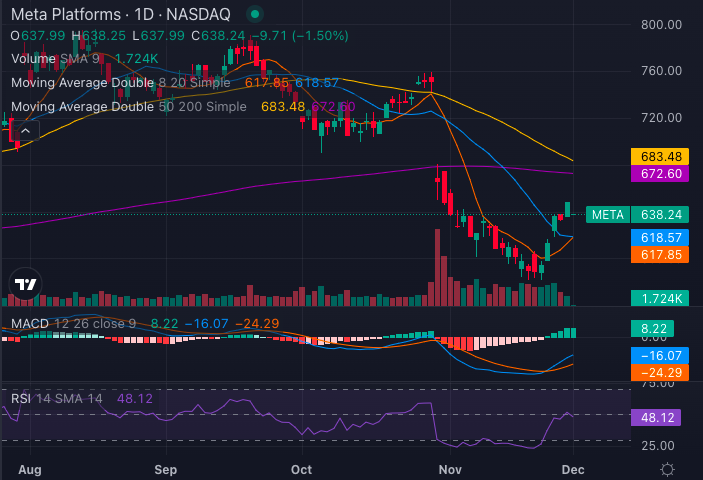
Meta Platforms Inc(NASDAQ:META) just suffered its fourth straight losing month, slipping 1.6% in November and leaving investors wondering if the AI trade has run out of steam. But beneath the red ink sits a narrative the bulls won’t shut up about: Meta’s stock is falling because its AI ambition is exploding.
Meta is still up more than 9% over the past year, but the stock remains well below its 52-week high of $796 after months of relentless selling pressure.
Sentiment is strained as Meta pushes capital spending to a massive $70 billion to $72 billion for 2025, an almost surreal jump from its 2024 outlay. Bears say the AI bill is spiraling. Bulls say the selloff is a temporary tantrum — the future is being built under everyone’s nose.
Even from a chart perspective, Meta just printed a massive hammer-style monthly candle after dropping to November lows — historically a reversal setup that signals aggressive dip-buying. And with META never having logged five straight red months in its 13.5-year history, bulls say the technical backdrop is quietly setting the stage for a sentiment snapback.
The most interesting pressure point in the AI market isn’t performance — it’s supply.
Nvidia Corp(NASDAQ:NVDA) controls as much as 80% to 95% of the global AI accelerator market, but Meta is openly exploring a multiyear deal that would see it rent Alphabet Inc‘s (NASDAQ:GOOG) (NASDAQ:GOOG) Google TPUs in 2026 and run them inside Meta data centers in 2027.
Even a partial migration matters when a single hyperscaler can account for a mid-teens share of Nvidia’s demand, and reports suggest the shift could shave up to 10% off Nvidia’s annual sales. Wall Street is already reacting: Nvidia has shed more than $700 billion in value from its peak, while Alphabet climbs closer to a $4 trillion market cap as investors start pricing TPU revenue like a real business.
Why META Bulls Don’t Mind The Pain
Yes, Meta is bleeding stock price momentum — but its business is strengthening its AI spine while competitors argue about margins. If Meta succeeds in broadening the chip supply chain, it won’t just lower dependency risk — it may fundamentally reshape power inside the AI economy.
The stock chart looks rough. But the strategy looks like a setup. If Meta’s AI engine hits full stride in 2026-2027, this stretch of red may age like the 2022 panic bottom — painful in real time, legendary in hindsight.
The firm said longtime franchisee Pie Investments took over 85 stores formerly run by Colonel’s Limited, LLC, and committed to launching 52 more outlets by 2030.
The acquired restaurants cover markets around Washington, D.C. and Baltimore. Pie Investments now runs over 150 Papa John’s restaurants. The group said it aims to own 250 total outlets by 2030.
The prior operator, Colonel’s Limited, LLC, traced its partnership with Papa John’s back to 1993.
Its leadership built a strong reputation by embracing early digital ordering and fueling pizza delivery growth.
Papa John’s paid tribute to that legacy as it handed control to Pie Investments.
Leadership’s Take On Expansion
“Chris Patel’s growth mindset and entrepreneurial spirit are exactly the qualities Papa John’s is looking to emphasize among our franchisees,” said Ravi Thanawala, the company’s CFO and North America president. Thanawala praised Patel’s track record in acquiring restaurants and boosting profitability.
“Papa John’s well-known commitment to quality continues to make the brand an attractive investment for entrepreneurs,” said Chris Patel, COO and partner at Pie Investments. He added the team plans to leverage enhanced tools to improve operations and deliver better experiences to pizza lovers.
Strategic Significance
This refranchising deal underscores Papa John’s focus on expanding its footprint through trusted operators.
The plan should accelerate growth, especially in key Northeast and Mid-Atlantic hubs. It also lets Papa John’s tap franchisee expertise while scaling up more efficiently.
Investors in pizza chains may now also watch Domino’s Pizza Inc. (NYSE:DPZ) and Yum! Brands Inc. (NYSE:YUM).
Copper prices are set for further gains in 2026. Tightening supply, widening market deficits, and mine disruptions all amplify concerns about the metal’s long-term availability. UBS is the latest bank to upgrade the yearly outlook, warning that persistent operational setbacks and falling inventories are now exerting a decisive influence on the market.
In a note published Friday, UBS raised its March 2026 copper target by $750 per metric ton to $11,500, while lifting its June and September forecasts by $1,000 each to $12,000 and $12,500.
The bank also introduced a new December 2026 target of $13,000 per ton. The revisions come alongside sharply higher deficit projections: UBS now anticipates a 230,000-ton shortfall in 2025 and a 407,000-ton deficit in 2026—both several times larger than earlier estimates—as refined output growth slows to just 1.2% and 2.2% across the two years.
UBS cited multiple mine disruptions as a clear sign of tightening supply. This year’s setbacks include lower-than-expected recoveries in Chile and recurring unrest in Peru. Furthermore, operational issues at Freeport-McMoRan’s(NYSE:FCX) Grasberg complex in Indonesia weigh on production.
Freeport’s Delays
The largest domestic copper miner continues to recover from a September mudflow at the Grasberg Block Cave that killed seven workers and halted operations. The expectations are to restart Block Cave in the first quarter of 2026 and produce 478,000 tons of copper cathode. Meanwhile, the initial goal was 700,000.
Yet the demand continues in the opposite direction. UBS expects global copper consumption to grow by 2.8% in both 2025 and 2026, driven by electric vehicles, renewable energy, grid upgrades, and rapidly expanding data center construction.
The divergence has made copper assets extraordinarily valuable and increasingly difficult to buy. BHP’s(NYSE:BHP) dramatic, last-minute attempt to derail Anglo American’s(OTCQX:AAUKF) planned $53 billion combination with Teck Resources(NYSE:TECK) shows how competitive the race for copper has become.
$100 Billion Budget
Copper’s strategic importance is also reshaping government policy. Securing supplies of copper and other critical minerals has become a matter of national security for the United States, which has unveiled billions in support through multiple agencies.
The largest single source of funding is the U.S. Export-Import Bank (EXIM). The bank plans to invest $100 billion as part of a broader effort to counter Western dependence on China and Russia.
“We can’t do anything else that we’re trying to do without these underlying critical raw material supply chains being secure, stable and functioning,” newly appointed EXIM chair John Jovanovictold the Financial Times.
EXIM has already provided a $1.25 billion loan for Barrick’s (NYSE:B) Reko Diq project in Pakistan, and Jovanovic said the bank is now working on several additional critical-minerals transactions “orders of magnitude larger,” though he offered no further details.
U.S. stock futures rose on Monday after Friday’s advances. Futures of major benchmark indices were higher.
Optimism among investors is rising following New York Fed President John Williams‘ indication that a rate cut in December is still on the table.
He said in a speech on Friday that “I still see room for a further adjustment in the near term to the target range for the federal funds rate to move the stance of policy closer to the range of neutral.”
Meanwhile, investors await earnings from Dell Technologies Inc. (NYSE:DELL), HP Inc.(NYSE:HPQ), Deere & Co. (NYSE:DE), Li Auto Inc.(NASDAQ:LI), and others in this Thanksgiving holiday-shortened week.
The 10-year Treasury bond yielded 4.05% and the two-year bond was at 3.51%. The CME Group’s FedWatch tool‘s projections show markets pricing a 73.5% likelihood of the Federal Reserve cutting the current interest rates during its December meeting.
Futures
Change (+/-)
Dow Jones
0.03%
S&P 500
0.30%
Nasdaq 100
0.51%
Russell 2000
0.20%
The SPDR S&P 500 ETF Trust(NYSE:SPY) and Invesco QQQ Trust ETF(NASDAQ:QQQ), which track the S&P 500 index and Nasdaq 100 index, respectively, were higher in premarket on Monday. The SPY was up 0.19% at $660.28, while the QQQ advanced 0.37% to $592.25, according to Benzinga Pro data.
Stocks In Focus
Pony AI
Pony AI Inc.(NASDAQ:PONY) rose 2.59% in premarket on Monday as it announced a partnership with ride-hailing platform Sunshine Mobility to build a large-scale autonomous driving fleet.
Benzinga’s Edge Stock Rankings indicate that PONY maintains a weaker price trend over the short, long, and medium terms. Additional performance details are available here.
WeRide
WeRide Inc. (NASDAQ:WRD) jumped 7.92% as its revenue grew 144.3% year-over-year to $24.0 million and gross profit rose 1,123.9% YoY to $7.9 million in the third quarter.
WRD maintained a weaker price trend over the short, long, and medium terms. Additional performance details, as per Benzinga’s Edge Stock Rankings, are available here.
Alphabet
Alphabet Inc.(NASDAQ:GOOG) (NASDAQ:GOOGL) gained 2.38% after it surpassed Microsoft Corp.(NASDAQ:MSFT) in market value on Friday, following the launch of Gemini 3 and Nano Banana last week.
Benzinga’s Edge Stock Rankings shows that GOOG maintains a stronger price trend over the short, medium, and long terms, with a strong quality ranking. Additional information is available here.
Zoom Communications
Zoom Communications Inc. (NASDAQ:ZM) was 0.52% higher ahead of its earnings expected to be released after the closing bell. Wall Street expects earnings of $1.21 per share on revenue of $1.21 billion.
It maintained a weaker price trend over the short, medium, and long terms, with a strong growth ranking. Additional performance details, as per Benzinga’s Edge Stock Rankings, are available here.
Keysight Technologies
Keysight Technologies Inc. (NYSE:KEYS) was up 0.45% as analysts expect it to report earnings of $1.77 per share on revenue of $1.39 billion after the closing bell.
KEYS maintained a weaker price trend over the short term but a strong trend in the medium and long terms, with a poor value ranking. Additional performance details, as per Benzinga’s Edge Stock Rankings, are available here.
Cues From Last Session
Communication services, health care, materials, consumer discretionary, and real estate sectors led the gains on Friday as all sectors ended in green.
Index
Performance (+/-)
Value
Nasdaq Composite
0.88%
22,273.08
S&P 500
0.98%
6,602.99
Dow Jones
1.08%
46,245.41
Russell 2000
2.80%
2,369.59
Insights From Analysts
Prominent economic and market voices are sounding alarms regarding U.S. stability, highlighting risks from market concentration and policy choices.
Investor Ruchir Sharma argues that “American exceptionalism” is peaking, warning that “America is now one big bet on AI.” With AI capital expenditure driving 40% of growth, Sharma contends this “maniacal focus” conceals deep fiscal vulnerabilities.
He observes that while investors currently offer a “free pass” on deficits, the market represents “a good story that’s gone too far.” He cautions that “If the AI boom was not happening, the economy would be weaker,” advising diversification as the “gap of outperformance” closes.
Compounding these structural risks, Moody’s Chief Economist Mark Zandi warns of a “serious affordability crisis.” He argues that specific policies, specifically tariffs and immigration restrictions, are “juicing” inflation.
Zandi notes that “It didn’t have to be this way,” but protectionist measures have “upended that outlook,” pointing toward “even higher inflation dead-ahead.”
While Sharma fears a bubble burst, Zandi emphasizes the burden on consumers, predicting that “tough financial times” will persist for the “foreseeable future.”
The nation is suffering a serious affordability crisis. Prices for many necessities, from groceries to a car, have increased significantly since the pandemic, and most prices continue to rise at an uncomfortably quick pace. Consumer price inflation is near 3%, well above the… pic.twitter.com/x3m6z89Pql
Here’s what investors will be keeping an eye on this week;
No data is scheduled to be released on Monday.
On Tuesday, September’s delayed U.S. retail sales, and headline and core PPI will be out by 8:30 a.m. ET.
September’s S&P Case-Shiller home price index for 20 cities will be released by 9:00 a.m., August’s delayed business inventories data, November’s consumer confidence data, and October’s pending home sales data will be out by 10:00 a.m. ET.
On Wednesday, the initial jobless claims data for the week ending Nov. 22 and September’s delayed durable-goods orders data will be announced by 8:30 a.m. ET.
No data is scheduled to be released for the Thanksgiving holiday on Thursday.
On Friday, November’s Chicago Business Barometer (PMI) will be released by 9:45 a.m. ET.
Commodities, Gold, Crypto, And Global Equity Markets
Crude oil futures were trading lower in the early New York session by 0.43% to hover around $57.56 per barrel.
Gold Spot US Dollar rose 0.20% to hover around $4,073.96 per ounce. Its last record high stood at $4,381.6 per ounce. The U.S. Dollar Index spot was 0.04% lower at the 100.1430 level.
Meanwhile, Bitcoin (CRYPTO: BTC) was trading 0.57% lower at $85,875.64 per coin.
Asian markets closed lower on Monday, except Hong Kong’s Hang Seng and Australia’s ASX 200 indices. China’s CSI 300 index. India’s NIFTY 50, Japan’s Nikkei 225, and South Korea’s Kospi indices fell. European markets were mostly higher in early trade.
Bitcoin has plunged around 10% to $82,000 over the past 24 hours, pushing liquidations to around $2 billion.
Spot ETFs saw heavy outflows on Thursday, with $903.1 million exiting Bitcoin funds and another $261.6 million flowing out of Ethereum products.
Bitcoin To Witness Sizeable Correction
Glassnode data shows Bitcoin’s realized losses have surged to levels last seen during the FTX collapse, driven largely by short-term holders capitulating.
This rapid spike suggests a widespread washout of weak hands as traders unwind recent positions.
Crypto chart analyst Ali Martinez highlighted that Bitcoin’s weekly SuperTrend, historically reliable in spotting major reversals, has flipped bearish again. For over a decade, every bearish flip has preceded a notable BTC correction.
Lennaert Snyder noted Ethereum has fallen to $2,650 and continues to trend downward. The next key resistance sits near $3,200, a rejection there favours fresh short setups, while a reclaim could open the door to $3,530.
ETH is also nearing the $2,580 daily support level, where reversal-long opportunities may emerge. Liquidity remains concentrated higher, keeping focus on longs at support and shorts near resistance.
Crypto trader Don pointed out Solana is now sitting on a major support level.
The meme-coin sector was hit even harder, plunging 10.9% and briefly touching a $44.4 billion valuation. Despite the new 21Shares Doge ETF debuting on Thursday, Dogecoin still declined — though trader Tardigrade noted a fresh bullish divergence forming on the daily chart, often an early sign a downtrend is weakening.