Air Products & Chemicals Inc(NYSE:APD) reported first-quarter fiscal 2026 results on Friday, delivering an earnings and revenue beat that pushed the stock higher in early trading.
The industrial gases company posted revenue of $3.103 billion, up 6% from $2.932 billion a year earlier and above the $3.051 billion analyst estimate.
Adjusted EPS was $3.16, up 10% year over year and exceeding the top end of company guidance. The result beat the $3.04 analyst estimate.
Sales growth reflected higher energy cost pass-through, favorable currency, and pricing. Volumes were flat as higher on-site volumes were offset by lower helium demand and a significant, non-recurring helium sale in the Americas segment in the prior year.
GAAP operating income rose 14% to $735 million. GAAP operating margin increased 170 basis points to 23.7%, despite an approximate 50-basis-point headwind from higher energy cost pass-through in the Americas segment. GAAP EPS was $3.04, up from $2.77.
On a non-GAAP basis, adjusted operating income increased 12% to $757 million. Adjusted operating margin rose 140 basis points to 24.4%.
Chief Executive Officer Eduardo Menezes said, “We had strong results from the base business, with a 10% increase in adjusted EPS compared to the prior year period, and also posted a 12% improvement in adjusted operating income despite helium headwinds in the quarter. This is a solid start as the Air Products team continues to focus on unlocking earnings growth, optimizing large projects, and maintaining capital discipline.”
Segment Performance
Americas sales of $1.3 billion were up 4% from the prior year, as 6% higher energy cost pass-through and 2% higher pricing were partially offset by 4% lower volumes. Operating income rose 4% to $404 million, while operating margin was flat at 30.1%.
Asia sales rose 2% to $832 million. Operating income increased 7% to $232 million, and operating margin improved by 140 basis points to 27.9%, driven by productivity improvements and reduced depreciation on gasification assets classified as held for sale.
Europe sales climbed 12% to $782 million. Operating income rose 20% to $224 million, and operating margin expanded 190 basis points to 28.6%.
Middle East and India equity affiliates’ income was $85 million, flat year over year. Corporate and other sales increased 21% to $117 million, and operating loss narrowed to $109 million.
Cash Flow and Balance Sheet
Cash provided by operating activities totaled $900.7 million. Cash and cash items ended the quarter at $1.026 billion.
Long-term debt stood at $17.115 billion, with $169.8 million in the current portion of long-term debt and $66.7 million in short-term borrowings.
The company recorded business and asset actions charges of $28.3 million, or $24.6 million after tax, or $0.11 per share, related to project exits announced in fiscal 2025.
Outlook
Air Products affirmed full-year fiscal 2026 adjusted EPS guidance of $12.85 to $13.15, compared with the $12.96 analyst estimate. The company continues to expect fiscal 2026 capital expenditures of approximately $4.0 billion.
Second-quarter adjusted EPS is expected to range from $2.95 to $3.10, versus the $3.02 estimate.
Recent developments include advanced negotiations with Yara International for low-emission ammonia projects, a quarterly dividend increase to $1.81 per share, and NASA supply contracts totaling more than $140 million.
APD Price Action: Air Products shares were up 0.67% at $257.74 during premarket trading on Friday, according to Benzinga Pro data.
Boeing Company(NYSE:BA) stock fell Tuesday after reporting fourth-quarter results with revenue of $23.948 billion, up 57% from $15.242 billion, as commercial deliveries increased sharply. Boeing delivered 160 airplanes in the quarter, reflecting improved operational performance.
Fourth-quarter revenue of $23.948 billion exceeded the $22.470 billion analyst estimate. The company reported an adjusted loss of $1.91 per share, missing Wall Street expectations for a loss of $39 cents per share.
GAAP diluted earnings per share were $10.23, compared with a loss of $5.46 per share a year earlier, while core earnings per share, a non-GAAP measure, were $9.92, compared with a loss of $5.90.
Boeing said results “primarily reflect a $9.6 billion gain on sale associated with closing the Digital Aviation Solutions transaction, which increased earnings per share by $11.83.”
Segment Results
Commercial Airplanes’ fourth-quarter revenue rose to $11.379 billion from $4.762 billion, with an operating margin of (5.6)% versus (43.9)%. Boeing said results included “impacts associated with the acquisition of Spirit AeroSystems.”
Commercial Airplanes booked 336 net orders in the fourth quarter and 1,173 net orders for the full year, ending the year with a backlog of more than 6,100 airplanes valued at a record $567 billion.
Defense, Space & Security revenue increased to $7.417 billion from $5.411 billion, and the operating margin was (6.8%), including $0.6 billion in losses on the KC-46A program.
Global Services revenue totaled $5.209 billion, compared with $5.119 billion a year earlier, and operating margin was 202.4%, which Boeing said “primarily reflects” the $9.6 billion gain.
Operating cash flow totaled $1.331 billion for the quarter, compared with an outflow of $3.450 billion a year earlier, while free cash flow, a non-GAAP measure, was $375 million, compared with a negative $4.098 billion in the prior-year period.
The 737 production rate increased to 42 per month, and the Federal Aviation Administration approved “the final phase of 737-10 certification flight testing.”
Full-Year Results And Backlog
For full-year 2025, Boeing reported revenue of $89.463 billion, up 34% from $66.517 billion, reflecting 600 commercial deliveries, the highest annual total since 2018.
GAAP diluted earnings per share were $2.48, compared with a loss of $18.36 per share in 2024, while core earnings per share, a non-GAAP measure, were $1.19, compared with a loss of $20.38.
Full-year operating cash flow was $1.065 billion, compared with an outflow of $12.080 billion in 2024, while free cash flow, a non-GAAP measure, was a negative $1.877 billion, compared with a negative $14.310 billion a year earlier.
Boeing ended the quarter with $29.4 billion in cash and investments and $54.1 billion in consolidated debt. The company’s forward-looking risk disclosures cite factors including “tariffs” and “regulatory changes.”
Total company backlog grew to a record $682 billion, with all three segments at record levels.
“We made significant progress on our recovery in 2025 and have set the foundation to keep our momentum going in the year ahead. We completed the acquisition of Spirit AeroSystems and the sale of portions of the Digital Aviation Solutions business and remain focused on promoting stable operations, completing our development programs, rebuilding trust with our stakeholders, and fully restoring Boeing to the iconic company we all know it can be,” said Kelly Ortberg, Boeing president and chief executive officer.
BA Price Action: Boeing shares were down 1.38% at $245.00 during premarket trading on Tuesday. The stock is approaching its 52-week high of $254.14, according to Benzinga Pro data.
The DBC ETF is already up 9% year-to-date. Check live prices here.
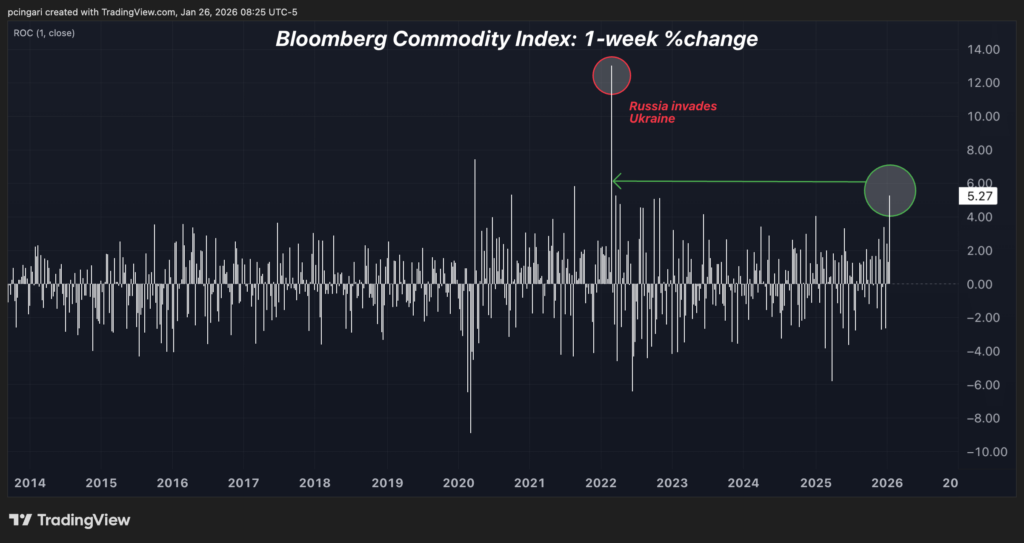
The Bloomberg Commodity Index — a closely watched benchmark tracking prices across 23 major commodities — posted its strongest weekly gain since February 2022, jumping 5.3% in the week that just ended. The rally marked a third consecutive weekly advance and pushed the index up by more than 9% year to date, outpacing the S&P 500.
The last time the index surged like this, Russia’s invasion of Ukraine had triggered a global energy shock. Crude oil vaulted above $100 a barrel, European natural gas prices exploded as Russian supply was cut off, and sweeping sanctions on the Kremlin sent commodity markets into chaos.
That post-pandemic rebound, combined with surging energy prices, led many Wall Street analysts to declare the return of a commodity supercycle reminiscent of the early 2000s.
But the thesis didn’t last.
Aggressive interest-rate hikes by global central banks quickly cooled demand, drained liquidity from financial markets, and pulled most commodity prices back from their extremes as the era of easy money came to an abrupt end.
Fast forward nearly four years, and a new commodity boom is unfolding — but this time, the epicenter looks very different.
Instead of oil and gas, the surge is being led by precious metals.
Gold prices — as tracked by the SPDR Gold Shares(NYSE:GLD) — topped $5,000 on Monday. Silver — tracked by the iShares Silver Trust(NYSE:SIL) — surged to nearly $110 per ounce.
Precious Metals Take Center Stage
Over the past year, silver is up 260%. Gold has climbed 85%. Both are on track for their strongest rolling 12-month returns since 1980.
“History is not a guide to the future, but the average increase in gold during four upward cycles was about 300% over 43 months, which means the gold price could reach $6000 by spring,” Michael Hartnett, chief investment strategist at Bank of America, said in a recent note.
Gold’s rally has been fueled by a weakening U.S. dollar, persistent geopolitical tensions, and rising concerns over political interference in Federal Reserve policy — forces that have drawn a new wave of private investors into the metal.
Silver’s story, however, may be even more complex.
“Silver has also been boosted by a historic short squeeze and strong retail buying. At the same time, industrial demand – particularly from solar, electrification, and grid infrastructure investment – has tightened the physical market at a time when mine supply growth remains limited,” said Ewa Manthey, commodities strategist at ING Group.
Why AI Is Changing The Silver Story
Silver is no longer just a precious metal. Its industrial role is becoming central to the artificial intelligence buildout.
“The global economy is not short of energy. Fossil fuels remain abundant. Renewable capacity continues to expand. From a purely volumetric perspective, there is no immediate energy scarcity,” said Jordi Visser, head of AI Macro Nexus research at 22V Research.
“But AI systems do not run on energy in the abstract. They run on electricity delivered with extreme precision, density, and reliability and that distinction is no longer academic,” he said.
“Electricity plays the same role in the physical world that memory plays in the digital one. It determines whether theoretical capacity can be turned into real performance,” Visser said.
“Silver sits precisely at this interface,” he added.
The Commodity Rally Is Now Spreading
The past week also delivered a reminder that energy markets haven’t gone quiet.
U.S. natural gas prices at the Henry Hub facility posted their largest one-week gain on record — surging roughly 70% — driven by a historic cold wave, heavy snowfall, and widespread ice storms across large parts of the country.
“The extreme conditions will boost heating demand and put energy infrastructure at risk,” warned ING’s Manthey on Monday.
“There will be stronger heating demand and supply hits, industrial demand could come under pressure, with some industrials reducing or temporarily halting operations due to weather conditions,” she added.
Copper could be next, with conditions aligning for a sustained and forceful bull run.
Industrial metals are already up about 40% over the past six months — their strongest run since 2021 — and some analysts believe the rally is only beginning.
Visser frames the broader macro picture as a clash between abundance and scarcity. Software has become ubiquitous. Code is cheap. AI-driven “vibe coding” is accelerating application development at record speed, while agentic AI threatens to disrupt traditional enterprise software models.
Critical minerals, however — including silver, copper, and rare earths — face structural shortages that could persist for more than a decade.
Nvidia Corp.(NASDAQ:NVDA) CEO Jensen Huang recently described the coming AI-driven infrastructure buildout as an $85 trillion opportunity. Bernstein projects copper shortages stretching into the 2040s.
That imbalance may keep commodities in the spotlight longer than many expect.
The firm said it unveiled a long-term concept for its GIBO.ai intelligence layer to unify mobility systems across air, ground, and digital networks.
GIBO.ai platform will serve as a shared computational fabric connecting vehicles and infrastructure.
The company said this approach treats mobility intelligence as a continuous data flow rather than disconnected hardware performance.
In this framework, assets like EV motorbikes, aerial vehicles and transport networks exchange data and learn from each other.
Rather than viewing mobility as a collection of independent vehicles, GIBO envisions a future where intelligence flows continuously across systems, where EV motorbikes, aerial platforms, logistics networks, and urban infrastructure operate as interconnected intelligence nodes within a single computational fabric.
Computational Nervous System
GIBO Holdings said the goal is to build a “computational nervous system” that lets connected systems sense, share and respond together.
The firm said this model will help vehicles and infrastructure adapt to real-world conditions as a unified network.
The company said its architecture shifts focus from isolated machines to collective system-level intelligence.
GIBO Holdings said this design allows insights from ground mobility to benefit aerial operations, and vice versa.
By blending environmental data with vehicle intelligence, the platform helps improve broader mobility behavior, the company said.
The architecture aims to enable more coordinated movement between aerial and ground platforms without rebuilding systems from scratch.
“Vehicles will continue to evolve, but intelligence architectures are what ultimately define eras,” said Zelt Kueh, CEO of GIBO Holdings.
“With GIBO.ai, we are focused on building the nervous system of future mobility—one that allows intelligence to move seamlessly across air and ground, enabling systems to learn collectively and operate as a unified whole.”
GIBO Price Action: GIBO Holdings shares were trading up 2.26% at $1.815 at the time of publication on Friday, according to Benzinga Pro data.
Interest-rate cuts have always been gold’s moment. This cycle, silver could quietly steal the spotlight. As U.S. debt piles up and the cost of servicing it rises, markets are increasingly pricing a more accommodative Federal Reserve —regardless of sticky inflation. That shift, according to Ed Egilinsky, Managing Director and Head of Sales, Distribution & Alternatives at Direxion, could create an unusually powerful macro setup for silver.
“The sizable U.S. debt load and the impact of higher rates on that debt could push the Fed toward further rate cuts,” Egilinsky told Benzinga in an exclusive interview. “A lower-rate environment, especially under a newly appointed Fed chair later in the year, could be a tailwind for silver prices.”
Muted Volatility, Rising Metals
What’s striking is that precious metals have already rallied without a classic fear trigger. As Egilinsky pointed out, “the last two years where the VIX has been mostly muted, yet gold and silver have rallied sharply.”
That breaks the traditional crisis-only narrative. Silver, in particular, is benefiting from a different kind of macro regime—one where policy easing and industrial demand coexist.
Silver’s Dual Engine: Rates And Industry
Gold still dominates as the pure safe haven, backed by central bank buying and reserve asset status. Egilinsky describes it as having “more flight to safety aspect than its brethren Silver.”
Silver, however, has a second growth lever: industrial demand. This is something silver has but gold doesn’t: leverage to economic activity. Rate cuts don’t just weaken the dollar — they support capital spending, infrastructure investment, and industrial demand.
Egilinsky points to structural drivers—semiconductors, data centers, solar, and electrification—as transformative sources of demand for silver. In a rate-cut environment that also supports capital spending and AI infrastructure, silver’s industrial exposure becomes a feature, not a risk.
That dual role enables silver to rally even without a risk-off shock.
Volatility As A Feature, Not A Bug
“Historically, Silver has tended to be more volatile than Gold,” Egilinsky noted, adding that the recent rally has already been accompanied by rising trading volumes. If global economic activity remains resilient and AI and energy spending persist, silver could outperform gold in the next phase of the cycle.
Investor Takeaway: This isn’t just a cyclical spike. A debt-driven Fed pivot plus secular industrial demand creates a rare two-sided tailwind for silver. Gold thrives on fear. Silver thrives on policy easing and growth. In this cycle, that hybrid profile may be exactly what makes silver the accidental Fed trade.
The Bank of New York Mellon Corporation (“BNY”) (NYSE:BK) on Tuesday reported fourth-quarter 2025 diluted earnings per common share of $2.02 and adjusted diluted EPS of $2.08, beating the analyst estimate of $1.98.
Total revenue rose 7% year over year to $5.179 billion, also exceeding the consensus estimate of $5.136 billion, driven by fee revenue of $3.698 billion, up 5%, and net interest income of $1.346 billion, up 13%.
Net income applicable to common shareholders increased 26% to $1.427 billion, and the pre-tax operating margin was 36%. Return on equity was 14.5% and return on tangible common equity was 26.6%.
Results included $51 million of notable noninterest expense, primarily related to severance, partially offset by an adjustment to the FDIC special assessment.
Non-interest expense totaled $3.360 billion, flat year-over-year, or up 4% excluding notable items. Provision for credit losses was a benefit of $26 million, driven by improvements in commercial real estate exposure and changes in the macroeconomic forecast.
The effective tax rate was 20.4%, and net interest margin expanded to 1.38%, reflecting reinvestment of maturing securities at higher yields and balance sheet growth, partially offset by deposit margin compression.
Average deposits rose 8% year over year to $310.482 billion, and average loans increased 11% to $76.678 billion.
Assets under custody and/or administration increased 14% to $59.3 trillion, while assets under management rose 7% to $2.2 trillion.
In Securities Services, revenue increased 7% to $2.497 billion, with a pre-tax operating margin of 34%. Asset Servicing revenue rose 8% to $1.945 billion, and Issuer Services revenue increased 5% to $552 million. Segment AUC/A climbed 14% to $43.0 trillion, and the market value of securities on loan rose 24% to $604 billion.
Market and Wealth Services revenue increased 8% to $1.805 billion, with a 49% pre-tax operating margin. Pershing revenue increased 5% to $741 million, Payments and Trade revenue rose 11% to $524 million, and Clearance and Collateral Management revenue increased 10% to $540 million.
For the full-year 2025, BNY reported diluted EPS of $7.40 and adjusted diluted EPS of $7.50. Total revenue increased 8% to $20.080 billion, and net income applicable to common shareholders rose 22% to $5.306 billion. The full-year pre-tax operating margin was 35% and ROTCE was 26.1%.
BNY returned $5.0 billion of capital to common shareholders in 2025, comprising $1.4 billion in dividends and $3.5 billion in share repurchases, resulting in a full-year payout ratio of 94%.
As of December 31, 2025, the CET1 ratio was 11.9% and the Tier 1 leverage ratio was 6.0%. The average liquidity coverage ratio was 112% and the average net stable funding ratio was 130%, with total loss-absorbing capacity ratios exceeding minimum requirements.
Outlook
For 2026, BNY projected total revenue of $19.027 billion to $21.029 billion, compared with an analyst estimate of $20.023 billion, implying approximately 5% year-over-year growth, plus or minus.
“2025 was another successful year for BNY,” Chief Executive Officer Robin Vince said. “We delivered record net income of $5.3 billion on record revenue of $20.1 billion and generated an ROTCE of 26%.” He added, “We are entering 2026 with positive momentum and excited for the work ahead of us to deliver increased value for our clients and shareholders.”
BK Price Action: Bank of New York Mellon shares were down 0.51% at $120.05 during premarket trading on Tuesday. The stock is trading near its 52-week high of $122.36, according to Benzinga Pro data.
Global chip sales are surging to record highs, underscoring a new growth cycle for semiconductors as demand from AI and tech giants accelerates worldwide.
Global semiconductor sales surged to a record level in November 2025, driven by demand across major product categories, as per the Semiconductor Industry Association (SIA).
The SIA said worldwide chip sales rose 29.8% year-over-year to $75.3 billion in November.
The global chip sales were 3.5% higher than October’s $72.7 billion.
SIA represents 99% of U.S. semiconductor revenue and nearly two-thirds of global chipmakers outside the U.S.
Outlook Points To $1 Trillion Market
John Neuffer, SIA CEO, said, “Looking ahead, the global chip market is projected to grow substantially in 2026, reaching nearly $1 trillion in annual sales.”
On a year-over-year basis, sales rose sharply in Asia Pacific/All Other regions by 66.1%, followed by the Americas at 23.0%, China at 22.9%, and Europe at 11.1%. Japan was the only major market to post a decline, with sales down 8.9% from a year earlier.
Month-to-month growth was also broad-based. Sales increased 5.0% in Asia Pacific/All Other, 3.9% in China, 3.0% in the Americas, and 1.2% in Europe, while Japan recorded a marginal 0.1% decline.
That optimism has been reinforced by the rising market influence of semiconductor leaders. Nvidia Corp. (NASDAQ:NVDA) became the first company to reach a $4.5 trillion market capitalization in 2025, surpassing Apple Inc. (NASDAQ:AAPL) and Microsoft Corp. (NASDAQ:MSFT), highlighting the sector’s growing dominance within global equity markets.
Analysts See Strong Momentum
Analysts say multiple tailwinds are aligning for the sector. Bank of America Securities analyst Vivek Arya said secular, cyclical, and pricing drivers are converging for U.S. semiconductors following meetings with more than a dozen management teams at CES in Las Vegas.
Arya said those discussions strengthened his confidence in an above-consensus forecast for 30% year-over-year growth and what he expects to be the industry’s first $1 trillion revenue year.
He cited strong demand visibility, AI-led secular growth, and pricing power, with particularly positive sentiment around Nvidia, Credo Technology Group Holding Ltd. (NASDAQ:CRDO), Microchip Technology Inc. (NASDAQ:MCHP), Analog Devices Inc. (NASDAQ:ADI), and Micron Technology Inc. (NASDAQ:MU).
He also noted that the PHLX Semiconductor Sector Index has gained about 45% over the past year, far outpacing the S&P 500.
On Nvidia, Arya highlighted projected 2026 R&D spending of $26 billion and demand visibility for roughly $500 billion in combined Blackwell and Rubin orders across 2025 and 2026, reiterating a Buy rating and naming it his top sector pick.
NVDA Price Action: Nvidia shares were down 0.38% at $184.33 at the time of publication on Friday, according to Benzinga Pro data.
Microchip Technology Incorporated(NASDAQ:MCHP) stock rose Tuesday after the semiconductor company disclosed that it now expects fiscal third-quarter revenue to come in above prior expectations.
Third-Quarter Guidance
On Monday, Microchip said it now expects third-quarter fiscal 2026 net sales of approximately $1.185 billion for the period ending December 31, 2025.
The revised outlook exceeds the company’s original guidance range of $1.109 billion to $1.149 billion issued on November 6, 2025, as well as a December 2 update that pointed to the high end of that range.
Last month, the company also raised its third-quarter adjusted earnings per share guidance to 40 cents, up from a prior range of 34 cents to 40 cents, bringing expectations in line with consensus estimates.
Management Commentary
Steve Sanghi, Microchip Technology’s CEO and president, said the company is seeing a broad-based recovery across most end markets as inventory corrections ease both in distribution channels and among direct customers, with new design wins beginning to move into production.
“We continue to experience a fairly broad-based recovery in most of our end markets driven by progress we have made in inventory correction in distribution as well as direct customers, and with new customer designs turning to production,” Sanghi said, adding that booking activity remained strong in the December quarter despite the holiday season.
He noted that the company entered the March quarter with a significantly stronger starting backlog than it had at the start of the December quarter.
Sanghi also highlighted progress on Microchip’s turnaround efforts, saying the company has advanced on most elements of its nine-point recovery plan and broader strategic initiatives. “We have made substantial progress on most elements of our nine-point recovery plan as well as our strategic initiatives,” he said.
He added that internal inventory levels have fallen meaningfully, which should help reduce inventory write-offs, while preparations are underway to ramp factory output in the March quarter, a move expected to lower under-utilization charges.
Wall Street is preparing for another year of massive deals, following a record-breaking 2025 that saw 68 transactions, each surpassing $10 billion.
The Wall Street dealmakers played a significant role in blockbuster mergers in 2025. This activity pushed global M&A volume to its highest level since the pandemic, indicating a resurgence of confidence in corporate boardrooms.
The average transaction size in 2025 was close to $227 million, the highest since 1980. “Large deals are driving the market. And when you see big deals, it’s a sign of CEO and boardroom confidence,” Ivan Farman, global co-head of M&A at Bank of America told The New York Post.
High-profile deals included a $72 billion acquisition of Warner Bros. Discovery’s studios and HBO Max streaming service by Netflix, and a $72 billion merger between Union Pacific and Norfolk Southern.
Electronic Arts also announced its intention to go private in a $55 billion deal, underlining the increasing involvement of private capital in major transactions.
Despite apprehensions about President Trump’s tariff regime, dealmaking barely slowed down, even during the traditionally quiet Thanksgiving period. Farman anticipates this momentum to carry on into 2026 across various industries.
The record-breaking number of high-value deals in 2025 signifies a strong rebound in the M&A market after the economic downturn caused by the pandemic. The surge in mega-deals indicates a renewed confidence in corporate boardrooms, suggesting a positive outlook for the market in 2026.
The involvement of private capital in major transactions also highlights a shift in the market dynamics, potentially leading to more private deals in the future.
Despite potential geopolitical risks, the dealmaking momentum is expected to continue, signaling a robust M&A market in the coming year.
AbbVie Inc.(NYSE:ABBV) and several other drugmakers are reportedly expected to announce agreements with the U.S. government on Friday to cut select prescription drug prices and comply with additional policy demands from President Donald Trump.
Reuters on Tuesday highlighted that around five companies are expected to be included in the initial announcement.
In September, Pfizer Inc.(NYSE:PFE) announced the first agreement with the Trump Administration to ensure U.S. patients pay lower prices for their prescription medicines.
The administration is also set to outline a pilot program that would link Medicare drug payments to the lowest prices charged by manufacturers in a group of comparable foreign markets.
In July, Trump sent letters to 17 major pharmaceutical companies calling for “most-favored-nation” pricing for Medicaid, limits on U.S. launch prices relative to other high-income countries, increased domestic reinvestment, and expanded direct-to-consumer sales models.
Trump has repeatedly targeted the gap between U.S. drug prices and those in other developed countries, where government-run health systems negotiate prices before granting reimbursement.
On Tuesday, Bloomberg also reported that the White House is preparing to announce drug pricing agreements with Novartis and Roche as soon as Friday, a move that could further ease recent trade tensions with Switzerland following a tariff dispute.
Sources told Bloomberg that additional drugmakers may be included, though terms are still being finalized.
Switzerland last month secured a preliminary trade deal cutting tariffs on several domestic exports, including watches, to 15% from 39%, after facing the steepest levy imposed on any developed country. While pharmaceuticals were exempt from those tariffs, the administration had signaled the possibility of future duties.
Novartis told Bloomberg that it is in discussions with the administration and is focused on lowering U.S. drug costs while addressing pricing gaps between the U.S. and other high-income markets.
Price Action: Novartis shares were up 0.34% at $135.49, and AbbVie shares were up 0.36% at $225.11 at the time of publication on Thursday, according to Benzinga Pro data.