JD.com Inc (NASDAQ:JD) will be reporting its third-quarter earnings on Thursday. Wall Street expects $1.06 in earnings per share and $37 billion in revenues as the company reports before market hours.
The stock is up 40.19% over the past year, 32.72% year-to-date.
Ahead of JD’s upcoming earnings release, Mizuho has raised its price target on the stock from $35 to $43, maintaining an Outperform rating. Despite China’s recent stimulus measures sparking some optimism, Mizuho notes that structural challenges—like high unemployment and real estate woes—continue to weigh on Asia’s internet sector.
Adding to the cautious tone, the potential for increased tariffs is adding uncertainty to the outlook.
Let’s look at what the charts indicate for JD stock and how the stock currently maps against Wall Street estimates.
JD Stock Chart Bearish Ahead Of Q3 Earnings
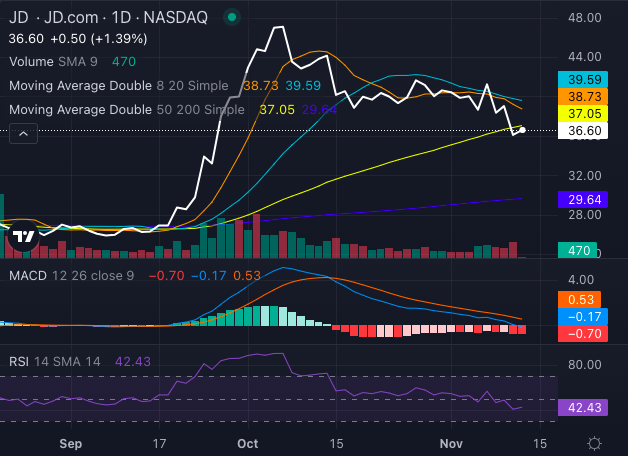
JD stock appears to be facing substantial bearish momentum as its price of $36.60 sits below the five, 20 and 50-day exponential moving averages, underscoring a strong downtrend.
With the eight-day simple moving average at $38.73 and the 20-day SMA at $39.59, JD stock’s ongoing pressure could signal further risk of downside.
Additionally, the 50-day SMA at $37.05 reinforces the challenging technical landscape for JD stock in the near term.
However, the 200-day SMA, well below at $29.64, hints at some underlying resilience. The MACD stands at a negative 0.17 suggesting that momentum continues to be bearish. With an RSI of 42.43, and declining, the stock is approaches oversold territory, which could attract bargain hunters if sentiment stabilizes.
JD Analysts See 35% Upside
Ratings & Consensus Estimates: The consensus analyst rating on JD stock stands at a Buy currently with a price target of $43.76. The latest analyst ratings from Loop Capital, Barclays and JPMorgan imply a 34.79% upside for JD stock, with an average price target of $49.33.
Analysts and investors are particularly focused on JD’s revenue growth, net profit momentum, gross merchandise volume (GMV), and any potential share buyback announcements, all of which could influence JD’s near-term trajectory.
JD Price Action: JD stock closed the trading day Tuesday at $36.10, down 7.48%.
Elon Musk‘s Starlink isn’t just aiming for the stars. It’s making a tangible difference on the ground.
What Happened: After pilot tests were launched in 2023 in partnership with the Tony Blair Institute for Global Change, Starlink’s satellite-powered internet has been installed in 40 health centers across regions like Rusizi, Rulindo, and Kigali, reported Teslarati.
In the past, many of these centers suffered from connectivity struggles. Starlink changed all that.
“The situation before was terrible. We had persistent issues with internet connectivity,” Jean Louis Murhirwa, a midwife at Buyoga Health Centre, said.
Before Starlink, only a few devices could connect at a time, and rationing was necessary.
Starlink’s presence has not only improved communication within these centers but has enabled efficient paperless workflows, faster patient care, and better coordination with national health initiatives.
Healthcare leaders, like Elie Ahimana from Kinini Health Centre, are calling for more widespread adoption of Starlink to further boost healthcare across the country.
Why It Matters: While Starlink is enhancing healthcare in Africa, it’s also helping disaster-stricken parts of the U.S.
Starlink founder and CEO Elon Musk recently announced that Starlink services would remain free for the rest of 2024 in areas affected by Hurricanes Helene and Milton.
For those impacted by Hurricanes Helene or Milton, Starlink service is now free through the end of the year to help with response and recovery efforts → https://t.co/fUko3xSviJpic.twitter.com/vEaGPavsFz
FEMA has already deployed Starlink to assist in North Carolina’s Emergency Operations Center, ensuring that first responders can communicate even in the face of devastation.
Musk’s Starlink has also begun working with T-Mobile US Inc (NASDAQ:TMUS) to launch Starlink Direct-to-Cellular services.
What’s Next: Starlink is looking to expand in India, where it faces a battle over spectrum allocation with local telecom giants.
Musk is also under scrutiny for the role Starlink plays in the Russia-Ukraine war. Russian troops have significantly improved their attacks at the expense of Ukraine due to the growing number of Starlink satellites, The Washington Post reported.
Recent data from JPMorgan’s exclusive survey indicates that price gaps between Walmart Inc (NYSE:WMT) and competitors like Kroger Co (NYSE:KR) and Albertsons Companies Inc (NYSE:ACI) are narrowing.
Kroger has traditionally maintained higher prices than Walmart, resulting in a price premium over its competitor. However, a recent shift in pricing strategies could signal a change in the competitive landscape as companies adjust to attract increasingly price-sensitive consumers. Notably, Kroger has reported a 2% decrease in its tracked prices since June 2024, marking the most significant decline recorded since the survey began.
Price Trends, Consumer Behavior
Walmart has raised its prices by 1.7%, while Albertsons and Sprouts Farmers Market Inc. (NYSE:SFM) have increased their prices by 1.4%, which contrasts sharply with Kroger’s recent price cuts. These changes highlight a shift in consumer sentiment as shoppers prioritize value.
As a result, Kroger’s price premium over Walmart has fallen to 10%, down from 13.3% in June, making it more competitive in a market where consumers are increasingly conscious of pricing.
Meanwhile, Albertsons’ prices have increased 5.8% since August 2023, potentially leading to a decline in customer loyalty and sales.
The narrowing price gaps could have significant implications for investors.
Companies that effectively manage perishables and focus on maintaining competitive pricing may see enhanced market shares and improved earnings.
Notably, while Kroger is cutting prices to stay competitive, Albertsons has invested heavily in perishables, resulting in a 3.2% decline in pricing for this category. SFM, conversely, saw prices rise 4.6%, which might position it differently in terms of market strategy.
As these companies prepare for upcoming earnings reports, investors should closely monitor how they adapt to inflationary pressures and changing consumer preferences.
The insights provided by JPMorgan underscore the importance of strategic pricing in navigating the competitive grocery landscape. Investors should carefully evaluate each retailer’s approach to pricing to make informed decisions.
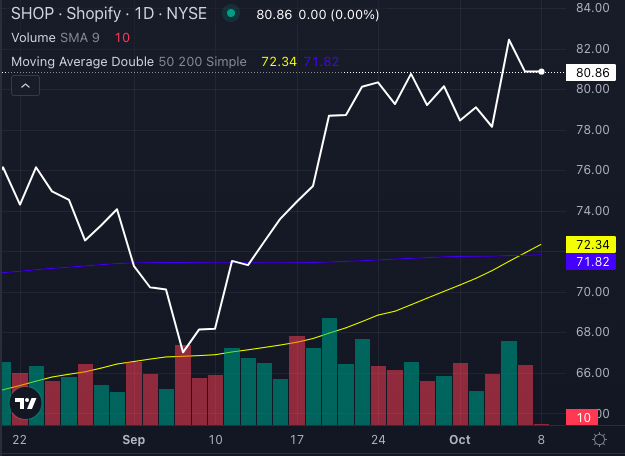
Jim Cramer just reaffirmed his bullish stance on Shopify Inc. (NYSE:SHOP), and the timing couldn’t be more perfect. The stock has just formed a Golden Cross, a powerful technical indicator that suggests brighter days ahead for the e-commerce giant.
For those unfamiliar, a Golden Cross occurs when a stock’s short-term moving average crosses above its long-term moving average—a classic sign that the bulls are ready to charge.
In a recent segment on CNBC’s Mad Money, Cramer didn’t mince words. “I think Shopify is at a great level to buy. Harvey Finkelstein is doing a terrific job, and the stock should be perfect,” he said.
This comes as no surprise, given Shopify’s strong performance. Over the past month, the stock has soared 20.56%; year-to-date it’s up 11.26%. But what’s even more impressive is its 53.50% rise in the past year.
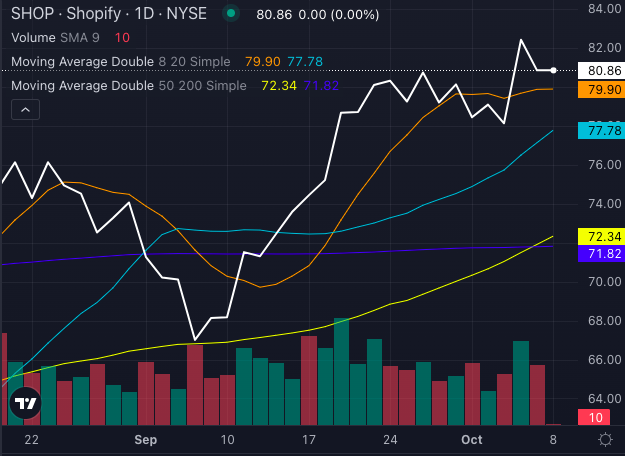
With Shopify’s stock price sitting at $80.86, it’s comfortably above its 50-day simple moving average of $72.34 and its 200-day moving average of $71.82. Combined with its eight-day and 20-day averages, these indicators also show bullish signals and strongly suggest that the momentum is on Shopify’s side.
Even Wall Street is heaping praise on Shopify. Goldman Sachs recently upgraded Shopify to a Buy, while JPMorgan and BofA have also endorsed the stock, citing its product breadth, ease of use, and scale as key advantages.
Shopify’s Q2 Knocked It Out of the Park
If you’re wondering why analysts and investors are so bullish, look at Shopify’s stunning Q2 results. Free cash flow skyrocketed by 240% to $333 million, while revenue jumped by 21% year-over-year. Even though GMV growth slowed slightly, the company still raked in a massive $67.2 billion in gross merchandise volume.
With third-quarter revenue expected to grow in the low-to-mid 20% range, it’s no wonder Shopify is being touted as a “best of breed” stock. Sure, the forward P/E ratio is hovering near 60, but with EPS growth expectations of 43%, Shopify’s lofty valuation looks justified.
Cramer + Golden Cross = Winning Combination For Shopify Stock
Cramer’s bullish call, backed by Shopify’s Golden Cross and strong fundamentals, could be a winning combination.
The stock’s technical setup, combined with Wall Street’s vote of confidence, makes Shopify a name to watch as we head into 2025.
Investors looking for the next big move might find it here. Shopify isn’t just crossing averages—it’s crossing into new territory.
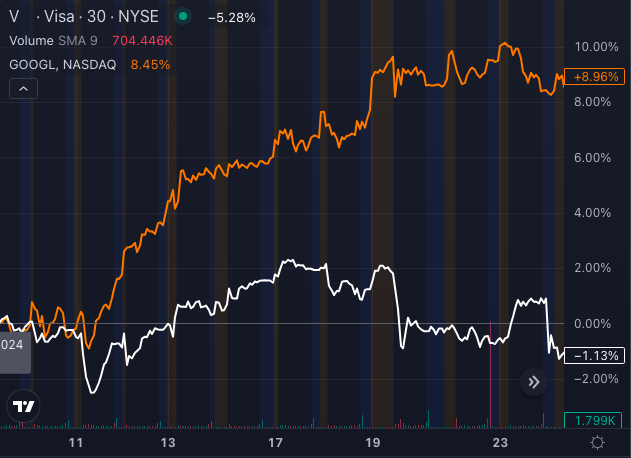
Visa Inc (NYSE:V) shares fell nearly 5% on Tuesday and continued trading lower on Wednesday following reports that the Department of Justice is suing the payment giant for allegedly monopolizing the country’s debit card market.
The lawsuit accuses Visa of engaging in anti-competitive practices, casting fresh scrutiny on the company’s dominance.
This news comes on the heels of Alphabet Inc‘s (NASDAQ:GOOGL) (NASDAQ:GOOG) antitrust battle earlier this month, which caused a temporary dip in the tech giant’s stock before it rebounded by about 10%.
Some investors may wonder if Visa’s stock could follow a similar trajectory.
Visa has long been in the regulatory crosshairs, facing accusations that it uses volume-based discounts to discourage merchants from shifting debit transactions to rival networks.
Brokerage TD Cowen noted that the Justice Department must prove that Visa’s discounts act as barriers to entry, preventing competitors from driving down prices.
While analysts agree this lawsuit poses immediate downside risks, they caution that antitrust cases are notoriously slow-moving.
KBW estimates that Visa’s U.S. debit business accounts for around 10% of its total revenues, and while the lawsuit may drag on, its long-term financial impact may be limited.
Is Visa Stock Offering A Buying Opportunity?
Visa’s recent stock action has caught traders’ attention.
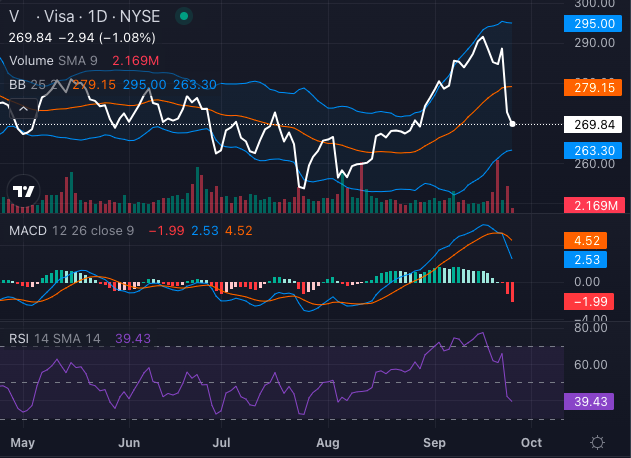
Visa stock is trading below all its moving averages, signaling a bearish trend.
The eight-day and 20-day simple moving averages of $283.96 and $281.81, respectively, indicate a short-term bearish signal, with Visa’s current price at $269.78. Moreover, the stock sits just below its 50-day and 200-day averages, reinforcing the bearish momentum.
However, any correction in the stock from this level could set the course again for a long-term bullish streak.
The Moving Average Convergence Divergence (MACD) is showing a bullish 2.53, while the declining Relative Strength Index (RSI) of 39.43 suggests Visa stock could soon be oversold.
As investors weigh the impact of the DOJ lawsuit, Visa’s stock may present a near-term buying opportunity, much like Alphabet’s rebound earlier this month.
Dell Technologies Inc (NYSE:DELL) will be reporting its second-quarter earnings on Wednesday. Wall Street expects $1.71 in EPS and $24.138 billion in revenues as the company reports after market hours.
The stock is up 91.43% over the past year, 46.38% year-to-date.
Let’s look at what the charts indicate for Dell stock and how the stock currently maps against Wall Street estimates.
Dell Stock Charts Mixed Ahead Of Q2 Earnings
Dell stock is navigating a complex technical landscape with both bullish and bearish signals in play.
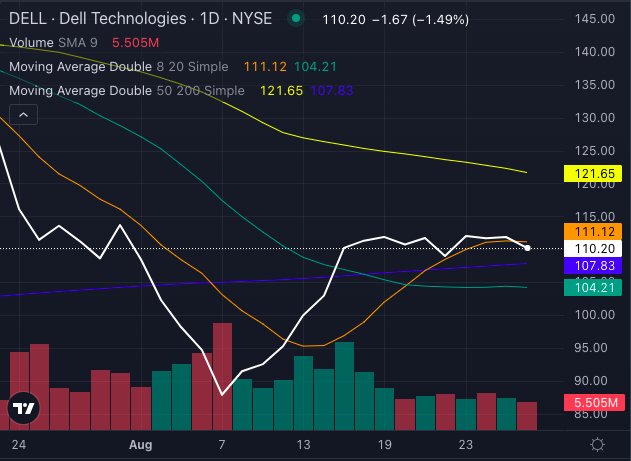
The stock is currently priced at $110.20, showing short-term bullish indicators as it trades above its 20-day simple moving average (SMA) of $104.21.
This suggests some positive momentum in the near term. Though the stock is right below the eight-day SMA of $111.12 which may hint at the possibility of some hiccups in this momentum.
However, the 50-day SMA stands at $121.65, indicating a bearish trend as the current price is below this level. The 200-day SMA of $107.83 provides a bullish signal as the stock is above this longer-term average.
The Moving Average Convergence Divergence (MACD) indicator at a negative 1.80, however, points to bearish momentum.
Additionally, the Relative Strength Index (RSI) of 48.49 suggests the stock is neither overbought nor oversold, while the Bollinger Bands — ranging from $90.05 to $121.37 — however, support a slight bullish stance with the stock trading in the upper band.
Overall, while there is buying pressure that could indicate future bullish movement, the prevailing technical indicators suggest a cautious approach.
Ratings & Consensus Estimates: The consensus analyst rating on Dell stock stands at a Buy currently with a price target of $108.18.
The latest analyst ratings from BofA Securities, Morgan Stanley and Citigroup suggest an average price target of $149 for Dell stock. This implies a potential 35.94% upside based on their recent evaluations.
DELL Price Action: Dell stock was trading at $109.05 at the time of publication.
MicroStrategy Inc. (NASDAQ:MSTR), a name synonymous with enterprise analytics and a heavy Bitcoin (CRYPTO: BTC) bet, finds itself at a substantial discount trading at around $134.
That’s about 35% below its 52-week high of $200. Despite the stock’s volatile journey, it has shown a phenomenal 250% rise over the past year and a 105% increase year-to-date.
The cryptocurrency downturn largely contributed to its steep decline; a long-term commitment to Bitcoin could attract investors looking for a tech-stock-crypto hybrid play.
Dell Technologies Positioned For Future Growth
Dell Technologies Inc. (NYSE:DELL) is trading at around $90. That’s 50% below its 52-week high of $180.
The past month’s decline of 37% reflects broader tech-sector pressures. Yet, Dell has managed to post a 61% rise over the past year, reflecting resilience in its business operations.
Its focus on hybrid cloud solutions and enterprise products positions it well for future growth, even amid near-term headwinds.
Super Micro Computer Forays Into AI
Super Micro Computer Inc. (NASDAQ:SMCI) stock is trading at around $490. That’s approximately 60% below its 52-week high of $1229. Known for its high-performance computing solutions, the stock has experienced about 40% increase over the past year.
Recent performance shows a 47% dip over the last month, indicating potential buying opportunities for long-term investors.
The company’s push into AI and server solutions remains a key driver, as it seeks to capitalize on growing demand in data-intensive sectors.
While trading below their highs, these large-cap stocks present unique opportunities for investors willing to navigate the inherent risks. Whether it’s MicroStrategy’s bold Bitcoin strategy, Dell’s technological resilience, or Super Micro’s foray into AI, these stocks are ones to watch for potential recovery and growth.
Despite global market turbulence and growing fears of a U.S. economic slowdown, major tech companies are ramping up their investments in data centers to support the booming artificial intelligence (AI) sector.
Tech Giants Double Down On AI Infrastructure
Microsoft Corp. (NASDAQ:MSFT), Meta Platforms Inc. (NASDAQ:META), and Amazon.com Inc. (NASDAQ:AMZN) have revealed substantial increases in capital expenditures, underscoring their commitment to expanding their AI infrastructure.
Microsoft’s Bold Move
Microsoft is leading the charge with its data center investments. The company reported a hefty $19 billion in capital expenditures for the quarter and plans to increase this amount in the next fiscal year.
CFO Amy Hood emphasized the strategic importance of these investments by saying, “Our data centers are long-term assets that will be monetized over 15 years and beyond.”
Meta Platforms’s Expanded Budget
Meta Platforms is also investing heavily, adjusting its capital expenditure range for the year to $37 billion to $40 billion.
CEO Mark Zuckerberghighlighted the scale of AI development, noting that the computing power needed to train future large language models will be “almost 10 times more” than previous iterations.
Zuckerberg remains optimistic about these long-term investments and stated, “At this point, I’d rather risk building capacity before it is needed, rather than too late.”
Amazon, the leader in cloud computing, has committed $30.5 billion in data center spending for the first half of 2024 alone, with expectations to exceed this figure in the latter half.
The company plans to spend over $100 billion on data centers over the next decade.
Amazon CFO Brian Olsavsky emphasized the pivotal role of these facilities in supporting AI growth, noting, “Generative AI is now a multibillion-dollar business for us.”
Spending Boost To Support Advanced AI Technologies, Growth In Cloud Services
The increased spending from these tech giants is part of a broader trend towards massive investment in data center infrastructure.
Industry estimates project the top five U.S. hyperscalers will invest $187 billion in data centers by 2028, driven by the need to support advanced AI technologies and the growing demand for cloud services.
As AI continues to revolutionize industries, these investments by Microsoft, Meta and Amazon highlight the critical role of data centers in shaping the future of technology.
Stephanie Link, Chief Investment Strategist and Portfolio Manager at Hightower Advisors, shared her exclusive insights with Benzinga, on the trends propelling this growth.
Cloud Security & Regulatory Efforts: The Key Drivers
“There are multiple tailwinds to the cybersecurity industry,” Link asserted. “We believe the main trends come from cloud security adoption, regulatory efforts, and Generative AI.”
With 85% of global IT spend still on-premises, the opportunity for public cloud service providers and cybersecurity companies is immense.
Partnerships and acquisitions are reshaping the landscape:
International Business Machines Corp (NASDAQ:IBM) sold QRadar software to Palo Alto Networks Inc (NASDAQ:PANW), incorporating WatsonX LLMs into its Cortex solution.
Google’s parent Alphabet Inc (NASDAQ:GOOG) (NASDAQ:GOOGL) was in talks to acquire Wiz.
CrowdStrike Holdings Inc (NASDAQ:CRWD) and Microsoft Corp‘s (NASDAQ:MSFT) partnership is under the spotlight following a software bug incident.
Amazon.com Inc (NASDAQ:AMZN) furthered its collaboration with CrowdStrike earlier this year.
Regulatory spending will boost the industry as global cybercrime costs are expected to grow by 15% annually, reaching $10.5 trillion by 2025.
“Considering the global impact we saw last weekend from CrowdStrike/Microsoft, regulatory action is imminent,” said Link.
Generative AI: Opportunity & Challenge
Generative AI plays a pivotal role in cybersecurity. “Increased Generative AI use cases will prompt more endpoints for companies to look after and increase the skill of hackers,” Link observes. Major players like Palo Alto, CrowdStrike, and Fortinet Inc (NASDAQ:FTNT) are already leveraging AI to enhance their offerings.
According to the Cloud Security Alliance (CSA), more than 55% of companies plan to adopt generative AI in the next year, with 67% using it for security purposes. “More technology will necessitate more protection, insurance, and compliance to safeguard networks,” Link emphasizes.
Undervalued Technologies: Zero-Trust & AI Security
Two areas stand out in the realm of technological innovation:
Zero-Trust Architecture and
Generative AI security products.
“Zero-trust architecture is growing in popularity but remains undervalued,” says Link. As organizations shift to cloud-based servers and remote work, zero-trust becomes essential. “Zero-Trust is based on the idea that no user or device should be automatically trusted,” with Palo Alto, Zscaler Inc (NASDAQ:ZS) and Okta Inc (NASDAQ:OKTA) leading this sub-sector.
Generative AI continues to offer significant opportunities. “It will impact how organizations scan for threats, automate responses, and improve predictive analysis,” Link explains.
Stocks like Palo Alto, CrowdStrike, and Fortinet should be on investors’ radars as they explore these advancements.
Wall Street expects Qualcomm Inc (NASDAQ:QCOM) to report $2.25 in earnings per share and $9.21 billion in revenues as the company reports third-quarter earnings after market hours.
The stock is up 26.31% over the past year — 15.43% YTD.
Let’s look at what the charts indicate for the company’s stock, and how it currently maps against Wall Street estimates.
Further Bearish Movement
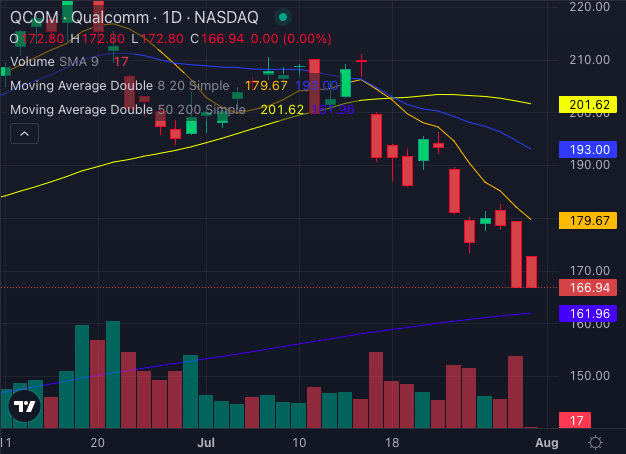
Qualcomm stock is currently experiencing a strongly bearish trend. Its share price of $166.94 remains below its 5, 20, and 50-day exponential moving averages. This indicates ongoing selling pressure and the potential for further bearish movement.
Ratings & Consensus Estimates: The consensus analyst rating on Qualcomm stock stands at a Buy currently with a price target of $194.63. Recent analyst ratings from Baird, Susquehanna, and HSBC suggest a 34.68% upside for Qualcomm Inc, with an average price target of $233.33.
Price Action: Qualcomm stock closed the trading day of Tuesday at $166.94, down 6.55%.