When Oracle Corp‘s (NYSE:ORCL) Larry Ellison declared that artificial intelligence will only reach its “peak value” once models train on privately owned data, it sounded like a warning shot to the open-internet AI crowd. But for Palantir Technologies Inc. (NYSE:PLTR), it was validation in prime time.
“If you look at ChatGPT, Anthropic, Llama, Grok — they’re all trained on all of the data on the internet,” Ellison said during Oracle’s recent event. “But for these models to reach their peak value, you need to make privately owned data available to those models as well.”
Palantir’s entire business has been built on that premise — that data locked inside governments and corporations is more valuable than anything scraped off the public web.
From defense agencies to Fortune 500 clients, Palantir’s Foundry and AIP platforms operate behind the firewall, structuring sensitive operational data for AI-driven decision making. That’s a crucial distinction in an era where generic language models often hallucinate without context or access to verified datasets.
While ChatGPT and its peers chase scale, Palantir is chasing specificity — running proprietary AI models directly on clients’ secure data pools. Its government roots, spanning defense, intelligence and energy sectors, have given it years of experience managing classified data — precisely the private-data moat Ellison argues the AI industry must cross to mature.
Ellison’s Thesis, Palantir’s Timing
Ellison’s call couldn’t come at a better time for Palantir, which has pivoted from pure analytics to becoming the operating system for enterprise AI. Its partnerships with major corporations and U.S. agencies position it to capitalize on the growing recognition that private data, not internet noise, will drive the next leg of AI value creation.
As investors sift through the next wave of AI winners, Ellison’s words echo a core Palantir advantage: it already sits where the most sensitive — and therefore most valuable — data lives.
For AI’s second act, Palantir isn’t rewriting the script. It’s just been waiting for the rest of Silicon Valley to catch up.
When Oracle Corp‘s (NYSE:ORCL) Larry Ellison declared that artificial intelligence will only reach its “peak value” once models train on privately owned data, it sounded like a warning shot to the open-internet AI crowd. But for Palantir Technologies Inc. (NYSE:PLTR), it was validation in prime time.
“If you look at ChatGPT, Anthropic, Llama, Grok — they’re all trained on all of the data on the internet,” Ellison said during Oracle’s recent event. “But for these models to reach their peak value, you need to make privately owned data available to those models as well.”
Palantir’s entire business has been built on that premise — that data locked inside governments and corporations is more valuable than anything scraped off the public web.
From defense agencies to Fortune 500 clients, Palantir’s Foundry and AIP platforms operate behind the firewall, structuring sensitive operational data for AI-driven decision making. That’s a crucial distinction in an era where generic language models often hallucinate without context or access to verified datasets.
While ChatGPT and its peers chase scale, Palantir is chasing specificity — running proprietary AI models directly on clients’ secure data pools. Its government roots, spanning defense, intelligence and energy sectors, have given it years of experience managing classified data — precisely the private-data moat Ellison argues the AI industry must cross to mature.
Ellison’s Thesis, Palantir’s Timing
Ellison’s call couldn’t come at a better time for Palantir, which has pivoted from pure analytics to becoming the operating system for enterprise AI. Its partnerships with major corporations and U.S. agencies position it to capitalize on the growing recognition that private data, not internet noise, will drive the next leg of AI value creation.
As investors sift through the next wave of AI winners, Ellison’s words echo a core Palantir advantage: it already sits where the most sensitive — and therefore most valuable — data lives.
For AI’s second act, Palantir isn’t rewriting the script. It’s just been waiting for the rest of Silicon Valley to catch up.
In a landmark $2.4 billion deal, Dick’s Sporting Goods Inc (NYSE:DKS) has officially acquired Foot Locker Inc (NYSE:FL), creating a retail powerhouse with over 3,200 stores across 20 countries. The merger positions the combined entity as a formidable force in the athletic retail industry. It also has some significant implications for Nike Inc (NYSE:NKE).
The acquisition marks a significant shift in the athletic retail landscape, as two major players join forces to enhance operational efficiencies, expand market reach, and leverage synergies.
Foot Locker will continue to operate as a standalone brand under Dick’s portfolio, maintaining its identity while benefiting from the resources and scale of its new parent company.
Nike, a key supplier to both Dick’s and Foot Locker, stands to both gain and lose from the merger’s ripple effects. Analysts are optimistic about near-term upside:
Jefferies predicts that a better-run Foot Locker under Dick’s will bolster Nike’s wholesale reach, brand presence, and overall market consistency.
UBS even estimates Nike could represent 30–35% of total sales at the merged company, cementing its influence across more than 3,500 stores.
Yet the consolidation also gives the new retail giant stronger negotiating leverage, which could pressure margins or force Nike into less favorable terms over time. If Dick’s decides to lean harder on its own private labels or diversify away from Nike products, the balance of power could quickly shift.
The merger, then, is a double-edged sword: Nike gains scale and reach but faces new questions over control in a rapidly evolving retail landscape.
Looking Ahead
As the dust settles from this historic merger, all eyes will be on how Dick’s and Foot Locker integrate their operations and how Nike capitalizes on the new dynamics in the athletic retail sector. The coming months will be crucial in determining the long-term impact of this strategic alliance on the industry.
The AI phone wars have officially arrived—and for now, Alphabet Inc‘s (NASDAQ:GOOGL) (NASDAQ:GOOG) Google is lapping Apple Inc (NASDAQ:AAPL). With the Pixel 10, Google isn’t just showing off flashy tricks, it’s delivering AI that feels genuinely useful. And that leaves Apple’s much-hyped Siri overhaul looking more like vaporware than a revolution.
On Wednesday, Google unveiled its Pixel 10 and Pixel 10 Pro, loaded with AI features that feel less like gimmicks and more like tools you’d actually use. Real-time translation in your own cloned voice? Check. A Camera Coach that gives posing instructions and edits photos on command? Check. Magic Cue, a personal assistant that plucks relevant info from your inbox, texts and calendar at just the right time? Double check.
Meanwhile, Apple users are still waiting for “Apple Intelligence” to get smarter. Siri, the digital sidekick Apple teased earlier this year, remains largely MIA. Samsung, for its part, is already fusing Google’s Gemini AI into its Galaxy phones.
The Pixel 10’s strength isn’t in hardware—it’s in software that anticipates what you’ll need before you ask. When you call United Airlines, your flight reservation pops up. When a friend asks about that coffee shop you forgot, Magic Cue pulls it from an old thread. And when you’re traveling abroad, your voice can suddenly order dinner in fluent German, Italian or Hindi.
Google has long been the software wizard of the smartphone space, but this time it’s going straight for Apple’s crown: AI that’s personal, practical and seamless.
The Market Reality
Here’s the catch: Google Pixel still only holds a sliver of the smartphone market. iPhone loyalists aren’t likely to ditch their green text bubbles anytime soon. But Google knows it doesn’t need to win the hardware war—it just needs to set the AI bar high enough that Apple looks behind the curve.
For now, the verdict is clear: Google is giving users AI magic today, while Apple is still promising it tomorrow.
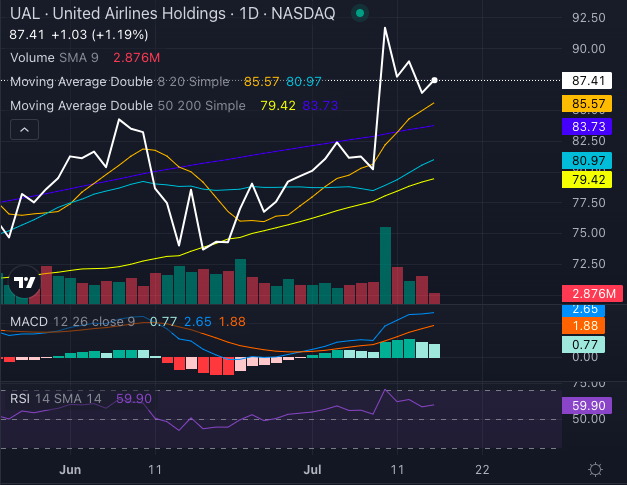
United Airlines Holdings Inc (NASDAQ:UAL) stock is in the green, rallying on strong chart signals ahead of its second quarter earnings report after market close Wednesday.
Shares are trading around $87.41, comfortably above their eight-, 20-, 50-, and 200-day simple moving averages, a classic bullish indicator that suggests the trend is favorable, despite selling pressure indicating caution ahead.
The Relative Strength Index (RSI) is at 59.90, indicating that the stock has momentum without being overbought. At the same time, the Moving Average Convergence Divergence (MACD) stands at 2.65, confirming strengthening momentum and reinforcing bullish sentiment.
Earnings Expectations Soar, But Headwinds Remain
All eyes are now on United’s after-market release, with Wall Street forecasting earnings per share of approximately $3.77 on revenues of nearly $15.35 billion, according to Benzinga Pro data. The travel industry just got a boost after Delta Airlines Inc. (NYSE:DAL) reported a strong quarter – its positive outlook and easing fuel costs triggered a sector-wide rally, lifting the stock by more than 14%.
If United can echo Delta’s performance with solid guidance and cost control, the market rally could gain altitude. However, dark clouds such as labor expenses, aircraft delivery delays, or weaker-than-expected booking demand could quickly ground the stock.
Longer-term, UAL remains down ~8% year-to-date, but still up 86% over the past year—a ride suggesting investors believe in the recovery story, even if the upcoming earnings report marks a turning point.
Whether the post-earnings reaction has lift-off or turbulence will depend on United’s ability to match or exceed expectations and whether it can maintain control of costs and outlook.
With bullish technicals in place, the second quarter reveal could be the spark that sends United Airlines to a new cruising altitude, or expose cracks beneath the runway.
The uranium trade just went nuclear – in a good way. Uranium stocks are on track for their 11th consecutive green week, marking the longest winning streak in the sector’s history.
Uranium Stocks on track for an 11th consecutive green week, their longest winning streak in history pic.twitter.com/QDHXRGhnDh
Behind the surge is a combination of tight supply, rising demand, and a geopolitical backdrop that’s becoming increasingly favorable for nuclear energy. Uranium spot prices have jumped nearly 30% year-to-date, with buyers scrambling to secure future supply as global stockpiles dwindle.
Governments are changing their tune. France is committing to new reactors, and Japan is reactivating nuclear plants post-Fukushima. Even in the U.S., nuclear is no longer a third-rail issue—the administration’s Inflation Reduction Act allocates billions to support domestic nuclear fuel development.
Investors have noticed. The Sprott Uranium Miners ETF (NYSE:URNM) and Global X Uranium ETF (NYSE:URA) have soared more than 27% YTD, handily outperforming the S&P 500.
Meanwhile, uranium majors like Cameco Corp (NYSE:CCJ) and NexGen Energy Ltd (NYSE:NXE) are up over 35% and 28% respectively, over the same stretch.
What Makes This Rally Different
Unlike past uranium spikes driven by hype, this rally is grounded in fundamentals. The world’s push for decarbonization is putting nuclear and uranium in the spotlight. Utilities are returning to long-term uranium contracting after years of underinvestment and supply-side stagnation.
Retail interest is picking up, too. Google search trends for “uranium stocks” have hit multi-year highs, and uranium-focused subreddits are seeing traffic spikes. The uranium narrative is no longer niche – it’s becoming mainstream.
For U.S. investors, CCJ remains the blue-chip play. NXE, Denison Mines Corp (NYSE:DNN) and Energy Fuels Inc (NYSE:UUUU) offer higher-risk, higher-reward exposure. URNM and URA provide diversified bets on the entire value chain.
If this 11-week winning streak is any indication, the uranium bull market is not just alive—it’s glowing.
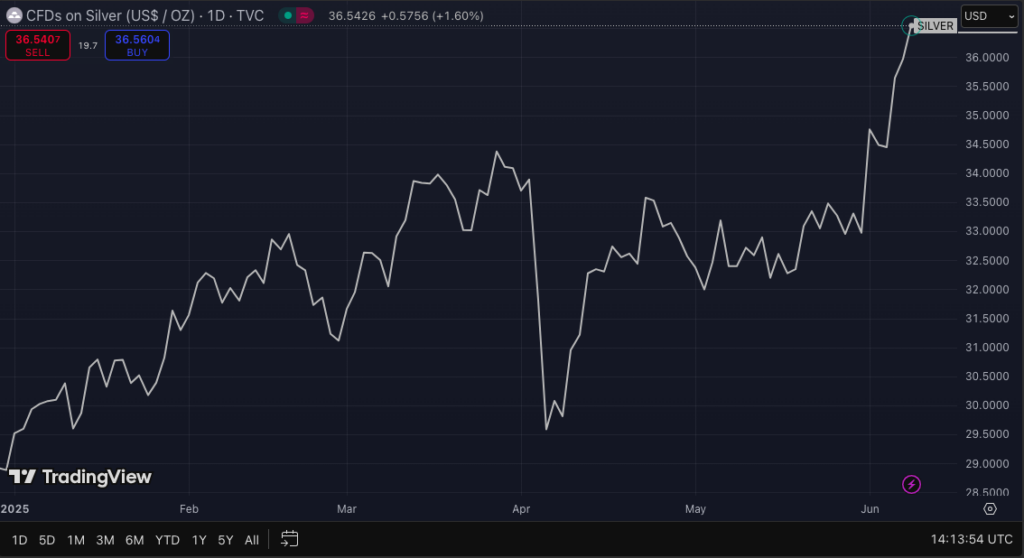
Silver has officially broken through a 14-year ceiling by vaulting past $35 per ounce, a milestone it last cleared in 2011. That same breakout ignited a 36% surge to $49 over seven weeks, notes Katusa Research. This time, history could very well repeat itself.
Today, spot silver is trading around $36/oz, marking an impressive +24% gain for 2025. The precious metal recently broke out of an eight-month base, touching $32.78/oz, and has been climbing steadily.
Supportive winds, such as a weakening U.S. dollar, robust industrial demand tied to solar tech, and five consecutive years of structural supply deficits, are fueling the rally.
Even technicals are giving a green light without getting too geeky. Almost every moving average – from the 10-day to the 200-day – is flashing bullish. Tools like the MACD (moving average convergence/divergence) and the Ultimate Oscillator are also nodding higher, hinting at stronger momentum ahead.
The only caution sign is that the 20-day Commodity Channel Index is overbought, suggesting a brief pause might be in the cards—but nothing that changes the bullish story.
What’s This Mean For Silver Investors?
Simple: silver isn’t just a metal; it’s a portfolio play.
If you’re looking to ride the momentum, consider physical-metal funds like the iShares Silver Trust (NYSE:SLV) or the ProShares Ultra Silver (NYSE:AGQ) if you’re feeling bold.
Eyes On $50?
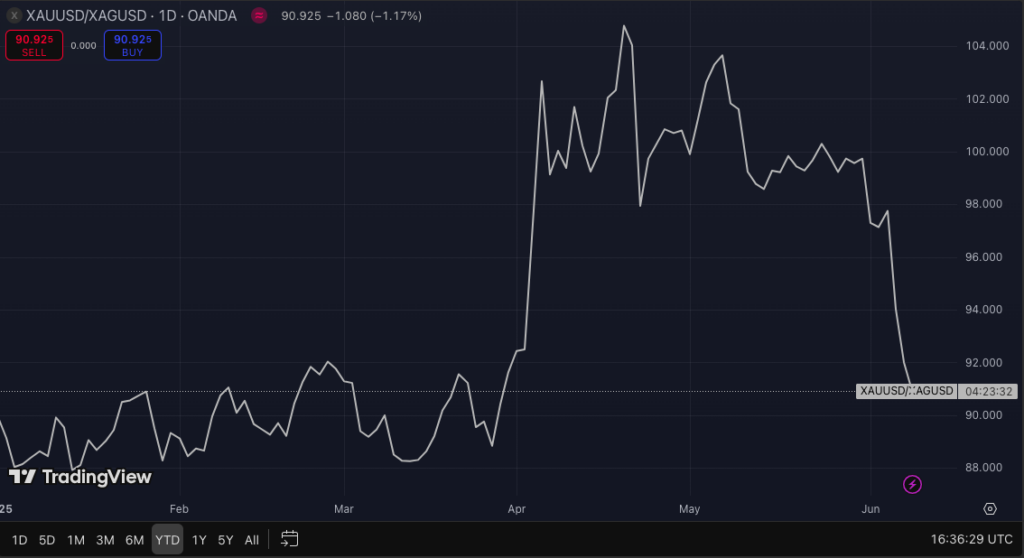
Analysts see technical and fundamental runway up ahead. StoneX and WisdomTree strategists highlight silver’s undervaluation relative to gold – the gold/silver ratio recently fell to 90, down from 105 in April.
Chart created using TradingView
With this gap closing, many view $36 as a checkpoint, which, once cleared (as it has been), could lead to a sprint toward $40 or even $50, particularly if solar and electric vehicle demand keeps scaling.
Why Now?
Unlike gold, most silver is mined as a byproduct, limiting production speed. That means even rising prices won’t instantly flood the market with new supply – sustaining the rally.
Add renewed industrial appetite and central bank buying; the package makes sense.
Silver has officially changed gears. The $35 breakout marks a fresh chapter – with bullish fundamentals, technical momentum, and ETF vehicles catering to every risk appetite. If silver repeats history, traders could see $50 in sight. But remember: quick surges can get bumpy.
For those looking to play smart, SLV offers a smoother ride; aggressive players might edge into AGQ. Keep an eye on that $50 level—you never know when it will be in plain sight.
Nvidia Corp (NASDAQ:NVDA) is charging into its first-quarter earnings report on Wednesday with strong technical momentum, but investors might want to buckle up. Wall Street is expecting the company to report 88 cents in earnings on $43.21 billion revenue for the quarter, as it reports after market hours.
While the charts are flashing bullish signals, Wall Street is bracing for what could be a messy quarter, driven not by a lack of demand—but by supply chain snarls tied to China’s restrictions and the high-profile H20 chip delay.
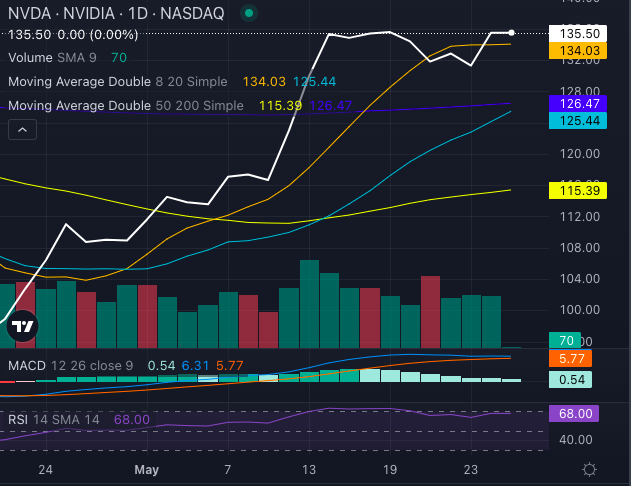
On the technical front, Nvidia stock looks rock solid. The stock is trading at $135.50, well above its eight-day, 20-day and 50-day simple moving averages (SMAs)—$134.03, $125.44, and $115.39, respectively. The 200-day SMA also trails at $126.47, further reinforcing the bullish setup for Nvidia stock.
The Moving Average Convergence Divergence (MACD) indicator stands at 6.31, suggesting upward momentum remains intact. Meanwhile, the Relative Strength Index (RSI) is at 68.00, inching closer to the overbought territory but still showing healthy buying pressure.
Despite these bullish signals, not everyone is convinced the upcoming earnings will sustain Nvidia’s rally.
Guidance Could Trim By 10% – Says Investment Strategist
Stephanie Link, chief investment strategist at Hightower Advisors, is not expecting fireworks. “I don’t think it is going to be a catalyst quarter. It’s noisy– you have the China restrictions, etc. So, July quarter guidance probably has to come down because of the H20 issue,” she warned, estimating the impact could shave off about 10% from outlook expectations.
The H20 chip, a modified version of Nvidia’s flagship AI hardware designed to comply with U.S. export controls, has hit production snags in China, one of Nvidia’s key growth markets. Add in chatter about slower rack production and power supply constraints, and it’s clear why sentiment is mixed.
Still, Link argues that these are supply, not demand, problems. “They’re going to do about $5 in earnings power, this year I would assume,” she added, signaling long-term confidence despite short-term turbulence.
With Nvidia stock up nearly 25% in the past month, optimism is already baked in. Whether the stock extends its bullish run may hinge on how investors digest potentially weak guidance—especially if it’s seen as a temporary blip rather than a structural concern.
Data from Bitinfocharts also validates the trend. There are currently at least 48,995,583 crypto wallets with more than one dollar worth of Bitcoin.
The digital asset has gone from fringe experiment to national reserve asset in a remarkably short time, and the numbers are starting to reflect a generational shift in how Americans think about wealth preservation.
BTC’s 130% Vs. Gold’s 62% Surge Since Bitcoin ETF Approval
The January 2024 approval of 11 spot Bitcoin ETFs by the SEC gave crypto legitimacy and accessibility — two hurdles that had long kept it in the shadow of traditional assets like gold. Since then, Bitcoin has surged 130%, while the S&P 500 is up around 24%, and the SPDR Gold Trust (NYSE:GLD) — the popular ETF tracking gold, has risen about 62% since then.
So what’s behind Bitcoin’s breakout from niche to mainstream?
For one, ease of access. Gold may be timeless, but it doesn’t sit neatly in your smartphone. Meanwhile, Bitcoin can be purchased on any brokerage app, held in cold storage, or allocated through ETFs. Younger investors, less tied to the historical narrative of gold as the ultimate safe haven, seem to be placing their trust in code over coins.
From an investor standpoint, the implications are clear: Bitcoin is no longer just a speculative asset. It’s become a real contender for portfolio diversification — especially among younger demographics who view it as both a hedge and a growth play. Meanwhile, gold continues to hold its ground, but it’s no longer the undisputed king of the “store-of-value” hill.
Whether Bitcoin holds this lead remains to be seen. But if asset flows and ETF inflows are any indication, America’s digital gold rush is still gaining momentum — one block at a time.
CVR Energy, Inc. (NYSE:CVI) is set to report its first-quarter earnings Monday after the bell, and Wall Street is bracing for a loss of $0.89 per share on revenue of $1.31 billion.
The stock is down a rough 43.78% over the past year but has been showing signs of resilience lately, falling just 0.85% year-to-date and 6.05% in the past month. But while the scoreboard looks bruised, legendary investor Carl Icahn clearly sees an opening others are missing.
Let’s dig into what the charts are signaling and how Icahn’s bold moves set the tone ahead of the numbers.
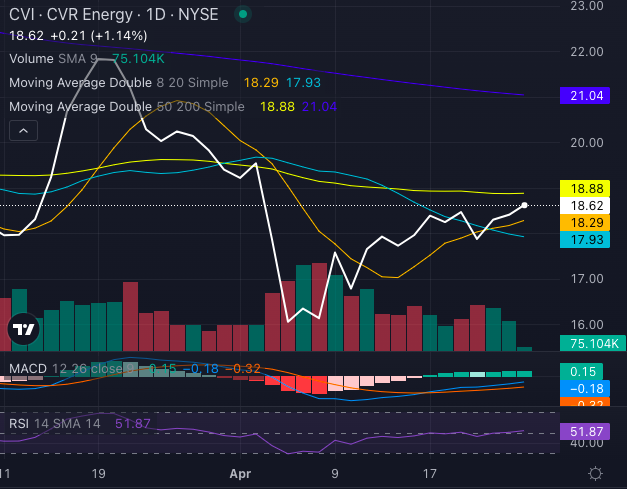
The technicals are flashing mixed signals. CVI stock, at $18.62, is above its eight-day and 20-day simple moving averages, signaling a short-term bullish signal. However, it sits slightly below its 50-day and well below its 200-day moving averages, suggesting there’s still technical damage to repair in the long term.
Meanwhile, CVI’s MACD (moving average convergence/divergence) indicator of a negative 0.18 and an RSI (relative strength index) hovering at 51.87 hints at positive momentum but warn that the stock could be treading into overbought territory if the rally continues unchecked.
Icahn’s Big Bet On CVI
While Wall Street debates CVR’s near-term prospects, Carl Icahn has been busy buying – not talking. In April alone, filings show Icahn snapped up over 1.5 million shares worth more than $27 million. His total stake now sits at a commanding 70.1 million shares.
This isn’t a silent vote of confidence. When Icahn leans into a stock this hard, it’s usually a prelude to strategic shakeups, boardroom battles, or transformational plays. Investors ignoring this power move might be missing the bigger picture.
CVI Price Action: CVI stock was trading at $18.67 per share at the time of publication.