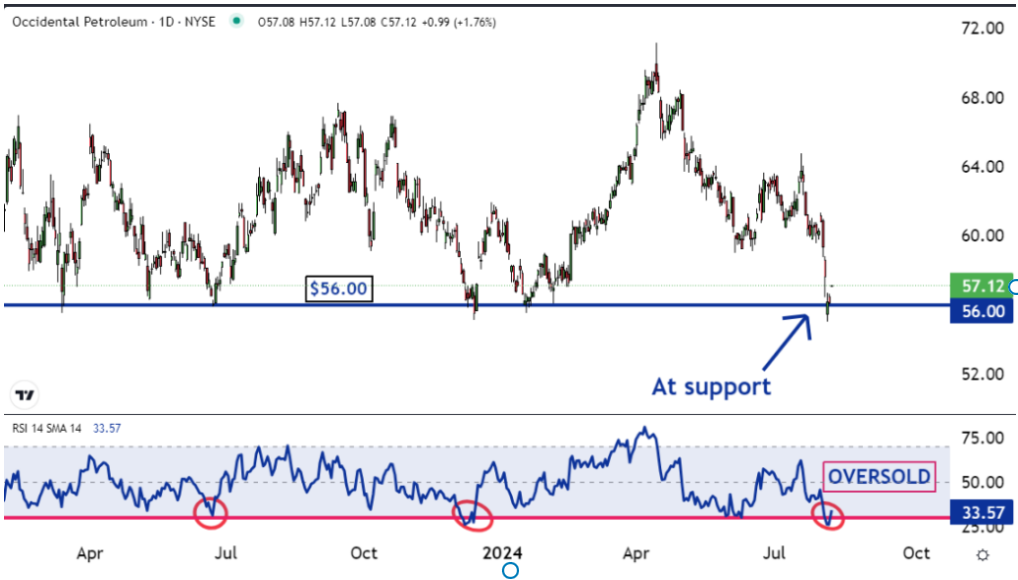
Occidental Petroleum Corp (NYSE:OXY) shares are oversold. They are also at support. And stocks that are oversold and at support tend to rally.
That’s why our team of trading experts has identified it as our Stock of the Day.
Most of the time, a stock stays within its typical or average trading range. But if sellers are extremely aggressive and push the shares below this range, traders say that it is “oversold.”
This is important because it will draw buyers into the market. They will be expecting a reversion back to the average. This means a move higher and their buying could make it happen.
The lower part of the chart is the Relative Strength Index (RSI). When the blue line is below the horizontal red line it indicates oversold conditions.
As you can see that’s the case now. You can also see that the last two times the stock was as oversold as it is now, big moves higher followed.
Support is a large group of traders and investors who are looking to pay the same, or close to the same, price for new shares. For more than a year, there has been support for Occidental around the $56.00 level. As you can also see on the chart, the shares are trading close to this price.
Sometimes shares rally after they reach support. This happens when some of the buyers who created the support begin to worry that they may miss the trade.
They know that the buyers will go to whoever is willing to pay the highest price. They become concerned others will increase their bid prices. As a result, these concerned buyers increase the prices they are willing to pay.
Other concerned buyers see this and do the same thing. This could turn into a bidding war that results in the price moving higher.
This combination of being oversold while simultaneously being at support means there is a good chance shares of Occidental will rally.
The recent box office success of The Walt Disney Company (NYSE:DIS) and its Disney+ streaming platform will likely be the most talked about items from the company’s third-quarter earnings, which come before market open Wednesday August 7.
Earnings Estimates: Analysts expect Disney to report third-quarter revenue of $23.11 billion according to data from Benzinga Pro.
The company reported revenue of $22.33 billion in last year’s third quarter and has missed analysts’ estimates for revenue in four straight quarters.
Analysts expect the company to report third-quarter earnings per share of $1.20 compared to $1.03 reported in last year’s third quarter. The company has beaten analysts’ estimates for earnings per share in four straight quarter.
Disney reported earnings per share of $1.22 and $1.21 in the first two fiscal quarters respectively, which could make the third quarter the lowest total.
What Analysts Are Saying: Disney’s content slate shows signs of a turnaround with Bob Iger at the helm as CEO, Bank of America analyst Jessica Reif Ehrlich said in a July investor note.
The analyst said Iger made two critical changes with a restructuring of divisions to put control back in the hands of creative executives and putting an emphasis on quality content over quantity.
Ehrlich said the box office performance of “Inside Out 2” may have indicated the turnaround has begun with the $1 billion milestone hit. A balance of originals and strong IP is seen in the upcoming content slate, the analyst said.
“Excitement around upcoming titles including ‘Deadpool & Wolverine,’ ‘Moana 2′ and ‘Mufasa: The Lion King’ give us cautious optimism that DIS’ studio will continue to improve,” Ehrlich said.
Outside of the box office, the analyst sees Disney’s Experiences segment as a “key long-term driver” for the company. The segment generates steady profits and has improving margins for international parks, Ehrlich said.
“DIS has a collection of best-in-class premier assets (in content/IP as well as Theme Parks).”
Morgan Stanley: Maintained Overweight rating and lowered the price target from $130 to $110
Loop Capital: Maintained Buy rating and lowered the price target from $139 to $130
Needham: Reiterated Buy rating and $145 price target
MoffettNathanson: Maintained Buy rating and lowered the price target from $130 to $125
Key Items to Watch: The box office performance for Disney in recent months will likely be a key topic for the Q3 results and for what’s next.
In its first 19 days of release, “Inside Out 2” grossed $469 million domestically and more than $1 billion worldwide. The film helped Disney pass the $1 billion milestone that none of its films hit 2023, ending a long streak.
Also released in the third quarter was “Kingdom of the Planet of the Apes,” which ranks ninth domestically and eighth worldwide with box office totals of $171 million and $397 million respectively.
Another topic during the earnings release and conference call will likely be the success of “Deadpool & Wolverine,” which was released in July and will be part of fourth-quarter results.
The movie has grossed $395 million domestically and $824 million worldwide, setting many records for an R-rated film and on its way to also pass the $1 billion milestone.
The rebound of Disney’ box office performance could be a key topic and also comes ahead of other 2024 releases like “Mufasa: The Lion King” and “Moana 2.”
Investors and analysts will also want to hear about Disney’s direct-to-consumer segment that includes Disney+.
Disney ended the second quarter with 117.6 million core Disney+ subscribers, while also sharing that it would crackdown on password sharing. The company is also increasing prices for its ad-supported tier from $7.99 to $9.99 and its ad-free tier from $13.99 to $15.99, as reported by The Hollywood Reporter Tuesday.
The price increase comes around a year after the company last announced an increase that went effective in October that impacted ad-free tiers. The new increase hits multiple plans and could be a key topic of discussion.
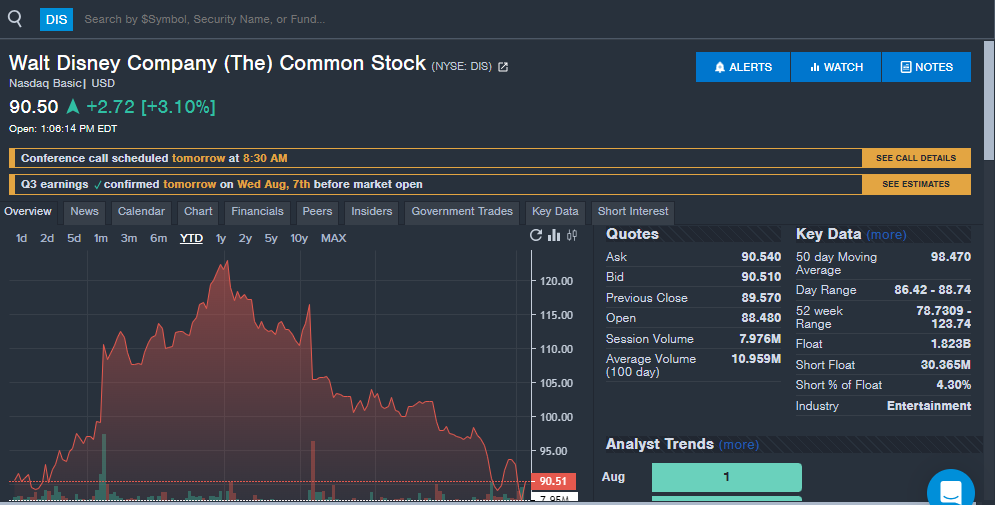
DIS Price Action: Disney shares are up 3% to $90.57 on Tuesday versus a 52-week trading range of $78.73 to $123.74. The Benzinga Pro chart below shows Disney shares are trading flat year-to-date in 2024.
Despite global market turbulence and growing fears of a U.S. economic slowdown, major tech companies are ramping up their investments in data centers to support the booming artificial intelligence (AI) sector.
Tech Giants Double Down On AI Infrastructure
Microsoft Corp. (NASDAQ:MSFT), Meta Platforms Inc. (NASDAQ:META), and Amazon.com Inc. (NASDAQ:AMZN) have revealed substantial increases in capital expenditures, underscoring their commitment to expanding their AI infrastructure.
Microsoft’s Bold Move
Microsoft is leading the charge with its data center investments. The company reported a hefty $19 billion in capital expenditures for the quarter and plans to increase this amount in the next fiscal year.
CFO Amy Hood emphasized the strategic importance of these investments by saying, “Our data centers are long-term assets that will be monetized over 15 years and beyond.”
Meta Platforms’s Expanded Budget
Meta Platforms is also investing heavily, adjusting its capital expenditure range for the year to $37 billion to $40 billion.
CEO Mark Zuckerberghighlighted the scale of AI development, noting that the computing power needed to train future large language models will be “almost 10 times more” than previous iterations.
Zuckerberg remains optimistic about these long-term investments and stated, “At this point, I’d rather risk building capacity before it is needed, rather than too late.”
Amazon, the leader in cloud computing, has committed $30.5 billion in data center spending for the first half of 2024 alone, with expectations to exceed this figure in the latter half.
The company plans to spend over $100 billion on data centers over the next decade.
Amazon CFO Brian Olsavsky emphasized the pivotal role of these facilities in supporting AI growth, noting, “Generative AI is now a multibillion-dollar business for us.”
Spending Boost To Support Advanced AI Technologies, Growth In Cloud Services
The increased spending from these tech giants is part of a broader trend towards massive investment in data center infrastructure.
Industry estimates project the top five U.S. hyperscalers will invest $187 billion in data centers by 2028, driven by the need to support advanced AI technologies and the growing demand for cloud services.
As AI continues to revolutionize industries, these investments by Microsoft, Meta and Amazon highlight the critical role of data centers in shaping the future of technology.
Super Micro Computer Inc (NASDAQ:SMCI) shares are in the spotlight Tuesday ahead of earnings. Here’s what you need to know before the report.
What To Know: Super Micro is set to report financial results for its fiscal fourth quarter after the market close on Tuesday. Analysts are looking for earnings of $8.10 per share and quarterly revenue of $5.314 billion, according to estimates from Benzinga Pro.
Last quarter, Super Micro beat earnings estimates, turning in earnings per share of $6.65 versus estimates of $5.78, but the company missed revenue estimates of $3.952 billion, delivering quarterly revenue of $3.85 billion.
“This year-over-year revenue growth of 200% and year-over-year non-GAAP EPS growth of 308% was well above our industry peers. Strong demand for AI rack scale PnP solutions, along with our team’s ability to develop innovative DLC designs, enabled us to expand our market leadership in AI infrastructure,” Super Micro president and CEO Charles Liang said at the time.
Super Micro guided for fourth-quarter revenue of $5.1 billion to $5.5 billion and adjusted earnings of $7.62 to $8.42 per share. The company expects full-year revenue to be between $14.3 billion and $14.7 billion and full-year earnings to be between $23.29 and $24.09 per share.
Wedbush on Friday reiterated Super Micro with a Neutral rating and maintained a price target of $800. Here’s a look at other recent analyst changes leading up to earnings.
Susquehanna analyst Mehdi Hosseini maintained Super Micro with a Negative rating and raised the price target from $285 to $325.
Nomura analyst Donnie Teng downgraded Super Micro from Buy to Neutral and set a price target of $930.
Goldman Sachs analyst Michael Ng maintained Super Micro with a Neutral and lowered the price target from $937 to $800.
Rosenblatt analyst Hans Mosesmann maintained Super Micro with a Buy and a price target of $1,300.
SMCI Price Action:Super Micro shares are up approximately 112% year-to-date heading into the print. The stock was up 0.5% Tuesday morning, trading at $611.82 at the time of writing, per Benzinga Pro.
In today’s rapidly changing and fiercely competitive business landscape, it is essential for investors and industry enthusiasts to thoroughly analyze companies. In this article, we will conduct a comprehensive industry comparison, evaluating Tesla (NASDAQ:TSLA) against its key competitors in the Automobiles industry. By examining key financial metrics, market position, and growth prospects, we aim to provide valuable insights for investors and shed light on company’s performance within the industry.
Tesla Background
Tesla is a vertically integrated battery electric vehicle automaker and developer of autonomous driving software. The company has multiple vehicles in its fleet, which include luxury and midsize sedans, crossover SUVs, a light truck, and a semi-truck. Tesla also plans to begin selling more affordable vehicles, and a sports car. Global deliveries in 2023 were a little over 1.8 million vehicles. The company also sells batteries for stationary storage for residential and commercial properties including utilities and solar panels and solar roofs for energy generation. Tesla also owns a fast-charging network.
By analyzing Tesla, we can infer the following trends:
Notably, the current Price to Earnings ratio for this stock, 58.34, is 4.91x above the industry norm, reflecting a higher valuation relative to the industry.
It could be trading at a premium in relation to its book value, as indicated by its Price to Book ratio of 9.98 which exceeds the industry average by 8.6x.
The stock’s relatively high Price to Sales ratio of 7.6, surpassing the industry average by 13.82x, may indicate an aspect of overvaluation in terms of sales performance.
With a Return on Equity (ROE) of 2.26% that is 0.65% below the industry average, it appears that the company exhibits potential inefficiency in utilizing equity to generate profits.
With lower Earnings Before Interest, Taxes, Depreciation, and Amortization (EBITDA) of $3.25 Billion, which is 0.01x below the industry average, the company may face lower profitability or financial challenges.
With lower gross profit of $4.58 Billion, which indicates 0.01x below the industry average, the company may experience lower revenue after accounting for production costs.
The company’s revenue growth of 2.3% is significantly below the industry average of 9.85%. This suggests a potential struggle in generating increased sales volume.
Debt To Equity Ratio
The debt-to-equity (D/E) ratio is a financial metric that helps determine the level of financial risk associated with a company’s capital structure.
Considering the debt-to-equity ratio in industry comparisons allows for a concise evaluation of a company’s financial health and risk profile, aiding in informed decision-making.
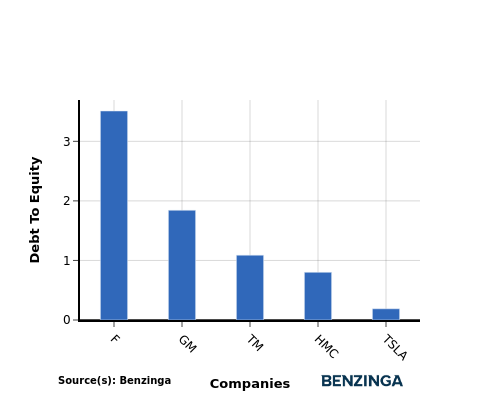
When comparing Tesla with its top 4 peers based on the Debt-to-Equity ratio, the following insights can be observed:
Tesla is in a relatively stronger financial position compared to its top 4 peers, as evidenced by its lower debt-to-equity ratio of 0.19.
This implies that the company relies less on debt financing and has a more favorable balance between debt and equity.
Key Takeaways
For Tesla, the PE, PB, and PS ratios are all high compared to its industry peers, indicating that the stock may be overvalued based on these metrics. In terms of ROE, EBITDA, gross profit, and revenue growth, Tesla lags behind its competitors, suggesting lower profitability and growth potential relative to industry standards.
This article was generated by Benzinga’s automated content engine and reviewed by an editor.
Meta Platforms Inc (NASDAQ:META) continues to build on its social media dominance with its latest platform, Threads, achieving significant milestones in user engagement.
Just a day after Meta CEO Mark Zuckerberg mentioned Threads reaching “almost” 200 million users during the company’s fiscal second-quarter 2024 earnings call, the platform has officially crossed that milestone, TechCrunch reports.
Adam Mosseri, the head of Instagram, confirmed in a post on Threads that the Twitter rival has now reached 200 million active users.
Meta accomplished this feat in just 13 months since the platform’s launch in July 2023.
Threads’ growth has been notable. It reached 150 million users by April 2024 and hit 175 million by its first anniversary in July before quickly jumping to 200 million in August. In comparison, Threads’ main competitor, X (formerly Twitter), reported over 600 million monthly users in May, as stated by its owner Elon Musk.
Prior reports indicated Meta will leverage its success in digital advertising to offer more targeted and personalized ads on Threads.
Meta stock gained over 52% as it remains invested in its artificial intelligence ambitions. In July, the Facebook parent reported second-quarter revenue of $39.07 billion, up 22% year over year and beating analyst consensus of $38.31 billion.
Price Action: META shares traded lower by 1.39% at $490.84 at the last check Friday.
Disclaimer: This content was partially produced with the help of AI tools and was reviewed and published by Benzinga editors.
Stephanie Link, Chief Investment Strategist and Portfolio Manager at Hightower Advisors, shared her exclusive insights with Benzinga, on the trends propelling this growth.
Cloud Security & Regulatory Efforts: The Key Drivers
“There are multiple tailwinds to the cybersecurity industry,” Link asserted. “We believe the main trends come from cloud security adoption, regulatory efforts, and Generative AI.”
With 85% of global IT spend still on-premises, the opportunity for public cloud service providers and cybersecurity companies is immense.
Partnerships and acquisitions are reshaping the landscape:
International Business Machines Corp (NASDAQ:IBM) sold QRadar software to Palo Alto Networks Inc (NASDAQ:PANW), incorporating WatsonX LLMs into its Cortex solution.
Google’s parent Alphabet Inc (NASDAQ:GOOG) (NASDAQ:GOOGL) was in talks to acquire Wiz.
CrowdStrike Holdings Inc (NASDAQ:CRWD) and Microsoft Corp‘s (NASDAQ:MSFT) partnership is under the spotlight following a software bug incident.
Amazon.com Inc (NASDAQ:AMZN) furthered its collaboration with CrowdStrike earlier this year.
Regulatory spending will boost the industry as global cybercrime costs are expected to grow by 15% annually, reaching $10.5 trillion by 2025.
“Considering the global impact we saw last weekend from CrowdStrike/Microsoft, regulatory action is imminent,” said Link.
Generative AI: Opportunity & Challenge
Generative AI plays a pivotal role in cybersecurity. “Increased Generative AI use cases will prompt more endpoints for companies to look after and increase the skill of hackers,” Link observes. Major players like Palo Alto, CrowdStrike, and Fortinet Inc (NASDAQ:FTNT) are already leveraging AI to enhance their offerings.
According to the Cloud Security Alliance (CSA), more than 55% of companies plan to adopt generative AI in the next year, with 67% using it for security purposes. “More technology will necessitate more protection, insurance, and compliance to safeguard networks,” Link emphasizes.
Undervalued Technologies: Zero-Trust & AI Security
Two areas stand out in the realm of technological innovation:
Zero-Trust Architecture and
Generative AI security products.
“Zero-trust architecture is growing in popularity but remains undervalued,” says Link. As organizations shift to cloud-based servers and remote work, zero-trust becomes essential. “Zero-Trust is based on the idea that no user or device should be automatically trusted,” with Palo Alto, Zscaler Inc (NASDAQ:ZS) and Okta Inc (NASDAQ:OKTA) leading this sub-sector.
Generative AI continues to offer significant opportunities. “It will impact how organizations scan for threats, automate responses, and improve predictive analysis,” Link explains.
Stocks like Palo Alto, CrowdStrike, and Fortinet should be on investors’ radars as they explore these advancements.
What Happened With AMD: AMD reported second-quarter revenue of $5.835 billion, beating analyst estimates of $5.724 billion. The chipmaker reported adjusted earnings of 69 cents per share, beating analyst estimates of 68 cents per share.
“We delivered strong revenue and earnings growth in the second quarter driven by record Data Center segment revenue. Our AI business continued accelerating and we are well positioned to deliver strong revenue growth in the second half of the year led by demand for Instinct, EPYC and Ryzen processors,” said Lisa Su, chair and CEO of AMD.
“The rapid advances in generative AI are driving demand for more compute in every market, creating significant growth opportunities as we deliver leadership AI solutions across our business.”
AMD said it expects third-quarter revenue to be between $6.4 billion and $7 billion versus estimates of $6.61 billion. The company anticipates third-quarter gross margin of approximately 53.5%. AMD also said on its conference call that it expects GPU revenue to exceed $4.5 billion this year, up from its prior forecast of approximately $4 billion.
AMD shares were up approximately 9% at the time of writing.
Why It Matters: Several semiconductor names are moving higher alongside AMD as investors and analysts become more optimistic about chip earnings.
Arm is scheduled to report financial results for its fiscal first quarter after the market close on Wednesday. Analysts are looking for earnings of 34 cents per share and revenue of $902.691 million, according to estimates from Benzinga Pro.
Last quarter, Arm reported earnings of 36 cents per share and revenue of $928 million in its third quarter as a public company.
“This growth was driven by record royalty revenue as Armv9 adoption continues, especially in smartphones, server, and automotive markets. Revenue from licensing was also very strong, driven by multiple high-value agreements and the increased demand for Arm’s power-efficient technology for AI from data centers to edge computing,” Arm CEO Rene Haas said at the time.
It’s worth noting that HSBC analyst Frank Lee on Monday downgraded Arm from a Hold rating to a Reduce rating, just days ahead of earnings.
What Else: Some chip stocks may also be getting a lift after Reuters reported that the Biden administration plans to propose a new rule next month that would expand the United States’ ability to stop foreign exports of semiconductor manufacturing equipment to Chinese chipmakers.
The report indicates that shipments from allies that export key chipmaking equipment, including Japan, the Netherlands and South Korea, will be excluded from the new rule, limiting its impact, according to sources familiar with the matter.
ARM Price Action: Arm shares were up 7.21% at $142.55 at the time of writing, according to Benzinga Pro.
Hicham Chahine, founder and CEO of the newly public NIP Group (NASDAQ:NIPG), joined Benzinga’s PreMarket Prep on Wednesday to discuss his company and the gaming industry’s future.
It was a big week for esports. NIP Group, whose acronym is derived from its “Ninjas in Pyjamas” esports teams, went public on July 26.
On July 23, the International Olympic Committee announced the creation of the Olympic Esports Games in 2025. Also, the Esports World Cup is currently in competition.
“For the industry, it’s extremely exciting,” Chahine said. “For our company, it’s also a new chapter — a new journey that we’re embarking on. It’s great to have the Olympics coming in… to drive that momentum that we’ve built our company up around.”
NIP Group is the first esports company to list on Nasdaq.
“When we look at the esports landscape, you have an industry which has been niched, niched in terms of if you look at the landscape our competitors [are] fragmented,” Chahine said. “What we felt with our IPO and taking the company public is we’ve created a global giant in terms of what is not seen, in terms of verticals, diversification, scale of footprints and operations from Europe, to China, to the Middle East, to South America.”
“I would say that looking at our company and how it sits in terms of where the space is going, it’s something that hasn’t really been seen before. We’re plowing uncharted waters,” he added.
Chahine is encouraged about the future of competitive gaming. He noted that early esports fans of the 2000s are having children who are “digitally native” and equally excited about competitive gaming. The founder and CEO sees esports’ momentum continuing as younger demographics become increasingly interested in the digital space.
Chahine said that NIP Group does not have easily comparable peers due to the breadth of its business operations. The company has revenue segments in esports competition, physical merchandise, ticketing and talent management. It also is diversified by geography across the world.
Chahine noted that people are more interested now in video games than ever and that momentum is on NIP Group’s side as the industry grows.
“It’s [the esports industry] already massive, and combined, it’s already exceeding music and film as an industry.”
Price Action: Hoping to raise $20 million, NIPG was listed at $9, selling 2.25 million depository shares. It shot up over 80% to trade at $16.50 on Monday before subsiding to $11.24 at the time of writing.
The Swedish-based company’s market capitalization is over $600 million according to Benzinga Pro.
Wall Street expects Qualcomm Inc (NASDAQ:QCOM) to report $2.25 in earnings per share and $9.21 billion in revenues as the company reports third-quarter earnings after market hours.
The stock is up 26.31% over the past year — 15.43% YTD.
Let’s look at what the charts indicate for the company’s stock, and how it currently maps against Wall Street estimates.
Further Bearish Movement
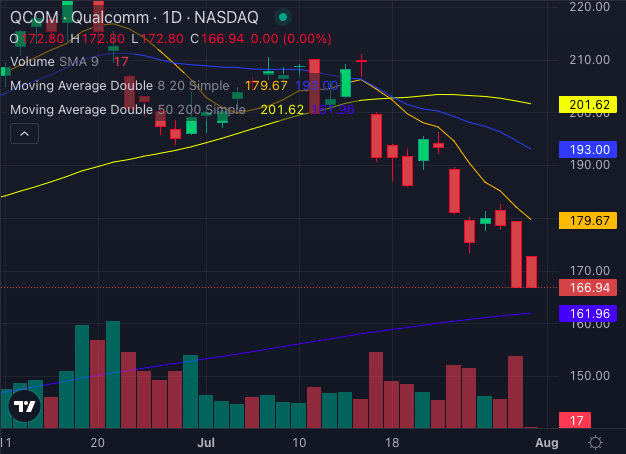
Qualcomm stock is currently experiencing a strongly bearish trend. Its share price of $166.94 remains below its 5, 20, and 50-day exponential moving averages. This indicates ongoing selling pressure and the potential for further bearish movement.
Ratings & Consensus Estimates: The consensus analyst rating on Qualcomm stock stands at a Buy currently with a price target of $194.63. Recent analyst ratings from Baird, Susquehanna, and HSBC suggest a 34.68% upside for Qualcomm Inc, with an average price target of $233.33.
Price Action: Qualcomm stock closed the trading day of Tuesday at $166.94, down 6.55%.