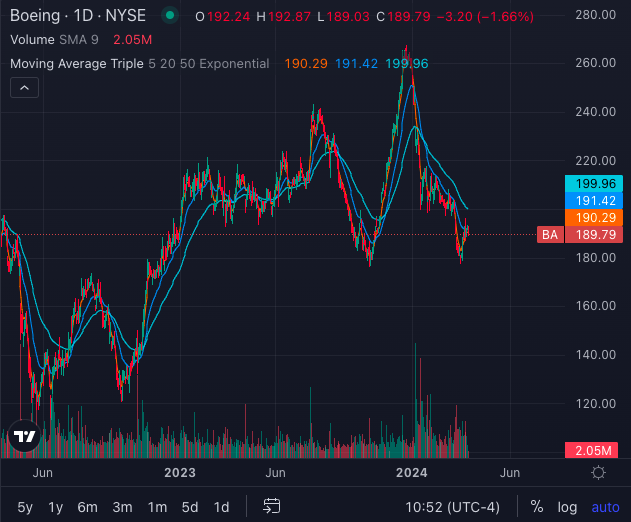
Boeing Co (NYSE:BA) faces a challenging year, with its stock plummeting 25% year-to-date. The recent emergency landing of a Delta Air Lines flight at Minneapolis-St. Paul International Airport (MSP) further compounds the company’s turbulent trajectory.
The Delta flight, en route from Denver to Minneapolis, descended to a lower altitude out of caution to evaluate a potential maintenance issue, reported CBS News.
Fortunately, the Boeing 737 landed safely at MSP, 13 minutes ahead of schedule, according to FlightAware.com.
Emergency Landing Adds Turbulence
This incident is just one in a series that has plagued Boeing and its stock, in recent months. From an Alaska Airlines flight’s emergency landing in January to a low-speed collision involving two Delta planes, Boeing’s safety record has come under intense scrutiny.
Amidst these challenges, investors are left wondering: Is Boeing stock a buy?
Is Boeing Stock A Buy?
Despite the stock’s significant decline, analysts remain divided on its prospects. Boeing stock has a consensus price target of $216.04, established from looking at the 100 latest analyst ratings.
However, the last three analyst ratings were released from Citigroup, Benchmark, and Morgan Stanley in March, have an average price target of $245.67 on the stock. That’s an implied 28.10% upside for Boeing stock from these 3 analyst ratings.
Investors must, however, bear in mind that while analysts foresee a potential upside, others caution against the risks posed by ongoing safety issues and regulatory scrutiny.
On the technical side, Boeing stock trading below its 5, 20, and 50-day exponential moving averages indicates a strong bearish sentiment. The stock also made a Death Cross on March 8. However, buying pressure accompanies this trend, signaling a potential bullish movement in the future.
As Boeing navigates through this turbulent period, investors must weigh the potential rewards against the inherent risks before making any investment decisions.
The headline annual inflation rate, as measured by personal consumption expenditures (PCE), rose to 2.5% in February as expected, up from 2.4% in January as personal spending came in unexpectedly high.
While the monthly inflation rate, according to the Fed’s favored gauge of price increases, dipped from 0.4% to 0.3%, personal spending rose by 0.8% to $145.5 billion, more than the 0.5% expected and higher than the 0.2% increase seen in January.
While the core annual rate came in at 2.8% in February, as expected, January’s 2.8% rate was revised higher to 2.9%.
This leaves inflation still looking a little sticky, especially when taken together with February’s consumer price index (CPI) inflation data published earlier this month that saw the annual headline rate rise to 3.2% from 3.1% in the previous month and the producer price (PPI) data showing even stronger gains.
Analysts were mixed in their thoughts about inflation and its policy implications.
Ian Shepherdson, chief economist at Pantheon Macroeconomics, said: “Our base case is that the core PCE over the next few months will look much more like February than January.
“If we’re right about that, and the labor market weakens anything like as much as is implied by the ongoing drop in small firms’ hiring plans, the Fed will be easing in June.”
Jeffrey Roach, chief economist for LPL Financial, said: “The trajectory for consumer spending is weakening, especially since real disposable incomes declined in February. Core services inflation is slowing and will likely continue throughout the year.
“By the time the Fed meets in June, the data should be convincing enough for it to commence its rate normalization process.”
Joseph Brusuelas, chief economist at RSM U.S., noted a slowdown in spending on services, particularly mortgages and housing rentals, which have proved among the toughest areas of inflation to cool.
He said on X: “The 2.5% year over year increase is well within what a forward-looking central banker would consider tolerable and on way to the 2% target. In my estimation this is consistent with a June rate cut and three overall reductions in the federal funds policy rate this year.”
He added: “Inside the easing of services one can observe a modest slowing in housing-related inflation. We expect this slowing to accelerate in coming months in both the PCE and CPI which will support calls for relaxation of a restrictive policy rate by the Fed.”
Global Markets Investor took a different view of the data. Its analysts posted on X: “The Fed’s preferred inflation gauge Core PCE jumped well above the 2% target. The most watched by the Fed 3-month and 6-month annualized rates increased to 3.5% and 2.9%, respectively in February Sticky, sticky. Are the rate cuts really coming?”
Investor Tim Whelan held a similar view: “Seems like inflation has ‘stabilized’ at around 3% depending on what measure you watch (CPI/PCE)… well above the 2% target. Unclear to me how the Fed could contemplate decreasing rates in 2024.”
Meanwhile, the Kobeissi Lettersaid: “We now officially have rising CPI, PPI and PCE inflation. Is higher for longer back?
Editor’s note: This story was updated with Elon Musk’s latest comments about manufacturing processes.
Tesla Inc (NASDAQ:TSLA) CEO Elon Musk boasted that he might have overseen the construction of a wider range of manufacturing systems than anyone else. Musk’s comment comes hours after he blamed the movie industry for manufacturing being underappreciated as compared to invention.
What Happened: Responding to a Tesla enthusiast who requested an interview with the CEO on the company’s manufacturing practices, Musk on Friday reflected on the difficulties involved in managing a global supply chain.
“Managing a global supply chain is also very difficult and underrated. Tactics wins battles, but logistics (supply chain) wins wars,” the CEO said.
There’s A Cultural Gap: Musk also noted a significant gap between the number of movies focusing on invention and the number of movies looking at manufacturing. This attention, Musk said, is not proportional to the hardship behind each of the two processes.
“Compared to the insane pain of reaching high-volume, positive-margin production, prototypes are a piece of cake,” Musk wrote in a post on X, formerly Twitter. The CEO responded to a user who noted that despite the large number of movies made on cars, none focus on manufacturing.
Musk agreed, “Many movies exist about a lone inventor in a garage having a eureka moment, but almost none about manufacturing.”
Why It Matters: The EV giant CEO has often discussed how production is way harder than prototypes.
In March 2022, Musk said that making an electric car was relatively simpler for Tesla than scaling production, given that many players, such as General Motors, had tried to make an EV before.
“The extreme difficulty of scaling production of new technology is poorly understood. It’s 1000% to 10,000% harder than making a few prototypes. The machine that makes the machine is vastly harder than the machine itself,” Musk wrote in a September 2020 post on X.
Overhauling Old Ways? As per a report from Bloomberg on Thursday, Tesla is currently attempting to replace the traditional production line with an “unboxed” approach for its new and upcoming cheaper EV expected to be priced around $25,000. If the new process succeeds, the company can cut its costs in half, the report said.
During Tesla’s fourth-quarter earnings call in January, Musk said that both the company’s new-gen EV and its manufacturing system would be “revolutionary.” The CEO, however, did not provide more details. The unboxed approach reportedly aims to assemble vehicle parts simultaneously at dedicated areas and put them all together in the end.
Tesla is also currently attempting to scale up the production of its stainless steel Cybertruck. The company began delivering the vehicle in late November and aims to deliver 250,000 units annually. However, Musk has previously said that this delivery target will not be met in 2024 but in 2025, citing production challenges.
Check out more of Benzinga’s Future Of Mobility coverage by following this link.
In a recent study by the American Automobile Association (AAA), it was revealed that a significant number of drivers are apprehensive about the idea of self-driving cars.
What Happened: The AAA study found that 66% of drivers are “afraid” of self-driving cars, with an additional 24% expressing uncertainty about the technology. The findings also show a notable shift in attitudes in 2023 and 2024 compared to the preceding years, reported Teslarati on Monday.
The study also highlighted a concerning trend in the public’s perception of self-driving cars. Despite the absence of fully autonomous vehicles on the market, many consumers believe that such cars are readily available. This misconception has been fueled by high-profile crashes resulting from over-reliance on current vehicle technologies.
Greg Brannon, AAA’s director of automotive research, noted that the decline in trust is not entirely surprising, given the recent crashes linked to over-reliance on existing vehicle technologies.
Adrienne Woodland, a spokesperson for AAA, attributed the fears to widely publicized incidents where drivers lost their lives in car crashes due to the mistaken belief that their vehicle could drive itself.
Woodland emphasized the need for more reliable and advanced self-driving technology, as well as increased public trust and awareness of emerging vehicle technology.
Brannon also highlighted the confusion surrounding the terminology used by automakers to describe their driver assistance programs, which has further contributed to the public’s misunderstanding of a vehicle’s capabilities. He stressed the importance of creating greater consistency across the industry and educating consumers about the type of technology their vehicle has and how to use it.
Why It Matters: The findings of the AAA study reflect a growing concern about the safety and reliability of self-driving technology. This apprehension is in line with Tesla CEO Elon Musk‘s recent comments about the challenges of achieving widespread autonomous driving. Musk suggested that it could take up to a decade before most cars are capable of fully autonomous driving.
These concerns are also reflected in the regulatory scrutiny faced by companies in the autonomous vehicle industry. Following a high-profile incident involving a pedestrian, the AV industry, including major players like General Motors Company (NYSE:GM), has come under intense scrutiny, raising questions about the safety and reliability of self-driving technology.
The GPT-4-based Benzinga Neuro content generation system exploits the
extensive Benzinga Ecosystem, including native data, APIs, and more to
create comprehensive and timely stories for you. Learn more.
Tesla Inc. (NASDAQ:TSLA) investor and Future Fund Managing Partner Gary Black has said that the valuation of the EV giant will only be influenced by its full self-driving (FSD) software once it achieves fully autonomous driving capabilities.
What Happened: Black emphasized that although Wall Street acknowledges Tesla’s progress with the FSD software, it will not impact the valuation until the software achieves fully autonomous driving.
Presently, Black views the FSD software as a remarkable driver assist tool rather than a fully autonomous driving solution. He stated that for the software to truly deliver autonomous driving capabilities, Tesla must assume full liability for any injury or damage incurred.
“Since I don’t see that happening anytime soon, WS won’t add incremental value beyond the normal take rate math in every analyst’s TSLA valuation model,” Black said.
Many $TSLA bulls ask me why WS doesn’t yet get how great FSD 12.3.x is. WS sees the amazing progress between v11 and v12.3.x but WS won’t add value to the TSLA’s valuation unless FSD take rates surge 2-3x, or FSD graduates from being a great driver assist tool to delivering…
To date, Tesla has attributed responsibility for all incidents involving FSD to the driver, emphasizing that the software remains in its testing phase and requires active driver supervision. Earlier this week, Tesla said all its U.S. vehicles with FSD compatibility will have the feature enabled free for a month.
Why It Matters: Tesla CEO Elon Musk previously stated that FSD “should be really shining bright” by late April or May, as the company plans to roll out three significant improvements to the software every two weeks.
Additionally, Black has advocated for Tesla to consider adding a fourth segment focused on its artificial intelligence endeavors to its earnings reports to garner greater investor attention for its FSD project and other initiatives such as FSD licensing, robotaxis, Optimus, and Dojo.
Currently, all attention is on Tesla’s first-quarter delivery numbers, expected next week, according to Black. He believes that any figure surpassing last year’s delivery number of 423,000 will be well received, with his own estimate sitting around 425,000 units.
Check out more of Benzinga’s Future Of Mobility coverage by following this link.
In a packed courtroom on Thursday, the legal saga of Sam Bankman-Fried, the embattled cryptocurrency mogul, took a dramatic turn as his defense team presented a heartfelt portrayal of their client, starkly contrasting the government’s accusations.
As Benzinga’s Future of Digital Assets event approaches on Nov. 19, the case highlights the ongoing scrutiny and regulatory challenges facing the cryptocurrency industry.
Bankman-Fried appeared in court dressed in a light brown jail uniform from MDC-Brooklyn. His post-trial legal team, led by attorneys Mark Mukasey and Torrey Young, vigorously defended his character and actions, emphasizing that despite the gravity of the financial losses involved, SBF was not the “ruthless financial serial killer” portrayed by prosecutors.
Mukasey argued, “He makes decisions with math in his head, not malice in his heart,” portraying Bankman-Fried as a principled individual who never intended to cause harm.
The courtroom, where the first row was occupied by prosecutors, witnessed Judge Lewis A. Kaplan‘s meticulous review of the case, including allegations of misusing customer funds and making speculative investments through Alameda Research.
Despite the defense’s efforts, Kaplan found the loss amount to significantly exceed $550 million, affecting investors, lenders, and customers alike, with total losses estimated at over $11 billion.
Addressing the complexity of the case, the judge acknowledged the overwhelming volume of material submitted for consideration, over 1000 pages from both defense and prosecution, as he prepared to deliver his sentencing.
The judge also addressed the sophisticated nature of the crimes, including money laundering and obstruction of justice, with Bankman-Fried found to have given perjured testimony during the trial.
Amid these serious legal proceedings, SBF’s attorney painted a picture of a man driven by altruism, from his early ethical considerations in middle school to his philanthropic efforts on Wall Street.
Described as an “awkward math nerd” with little interest in material possessions, Bankman-Fried’s commitment to positive global impact was emphasized as a key aspect of his character.
Although U.S. stocks closed higher on Wednesday, there were a few notable insider trades.
When insiders purchase shares, it indicates their confidence in the company’s prospects or that they view the stock as a bargain. Either way, this signals an opportunity to go long on the stock. Insider purchases should not be taken as the only indicator for making an investment or trading decision. At best, it can lend conviction to a buying decision.
The Trade: Snowflake Inc. (NYSE:SNOW) CEO Sridhar Ramaswamy acquired a total of 31,542 shares an average price of $158.52. To acquire these shares, it cost around $5 million.
What’s Happening: On March 19, Redburn Atlantic analyst Alex Haissl downgraded Snowflake from Neutral to Sell and announced a $125 price target.
What Snowflake Does: Founded in 2012, Snowflake is a data lake, warehousing, and sharing company that came public in 2020. To date, the company has over 3,000 customers, including nearly 30% of the Fortune 500 as its customers.
Legacy Housing
The Trade: Legacy Housing Corporation (NASDAQ:LEGH) Director Francisco Javier Coll acquired a total of 1,650 shares at an average price of $20.02. To acquire these shares, it cost around $33,033.
What’s Happening: On March 15, Legacy Housing reported worse-than-expected fourth-quarter financial results.
What Legacy Housing Does: Legacy Housing Corp builds, sell, and finance manufactured homes and tiny houses that are distributed through a network of independent retailers and company-owned stores and also sold directly to manufactured home communities.
The Trade: Mistras Group, Inc. (NYSE:MG) Interim President and CEO Manuel N. Stamatakis bought a total of 15,000 shares at an average price of $6.00. To acquire these shares, it cost around $90,000.
What’s Happening: On March 6, MISTRAS Group reported worse-than-expected fourth-quarter earnings.
What Mistras Group Does: MISTRAS Group Inc provides asset protection solutions and systems. The company evaluates the structural integrity and reliability of critical energy, industrial, and public infrastructure.
Mirum Pharmaceuticals
The Trade: Mirum Pharmaceuticals, Inc. (NASDAQ:MIRM) CFO Eric Bjerkholt bought a total of 2,000 shares at an average price of $24.80. The insider spent around $49,600 to buy those shares.
What’s Happening: On March 13, The FDA approved the company’sLivmarli (maralixibat) oral solution for cholestatic pruritus in patients five years of age and older with progressive familial intrahepatic cholestasis (PFIC).
What Mirum Pharmaceuticals Does: Mirum Pharmaceuticals Inc is a biopharmaceutical company focused on the identification, acquisition, development, and commercialization of novel therapies for debilitating rare and orphan diseases.
Verizon Communications Inc. (NYSE:VZ) shares closed higher during Wednesday’s session amid overall strength in the stock market.
Verizon is scheduled to report first-quarter 2024 earnings before the opening bell on April 22, 2024. Analysts expect the New York-based company to report quarterly earnings at $1.12 per share, down from $1.20 per share in the year-ago period. The company is projected to post revenue of $33.33 billion, up from $32.91 billion in the year-earlier quarter, according to data from Benzinga Pro.
On March 22, Redburn Atlantic analyst Steve Malcolm upgraded Verizon Communications from Sell to Neutral and announced a $39 price target.
With the recent buzz around Verizon, some investors may be eyeing potential gains from the company’s dividends. As of now, Verizon has a dividend yield of 6.40%, which is a quarterly dividend amount of 66.5 cents a share ($2.66 a year).
To figure out how to earn $500 monthly from Verizon, we start with the yearly target of $6,000 ($500 x 12 months).
Next, we take this amount and divide it by Verizon’s $2.66 dividend: $6,000 / $2.66 = 2,256 shares
So, an investor would need to own approximately $93,714 worth of Verizon, or 2,256 shares to generate a monthly dividend income of $500.
Assuming a more conservative goal of $100 monthly ($1,200 annually), we do the same calculation: $1,200 / $2.66 = 451 shares, or $18,735 to generate a monthly dividend income of $100.
Note that dividend yield can change on a rolling basis, as the dividend payment and the stock price both fluctuate over time.
The dividend yield is calculated by dividing the annual dividend payment by the current stock price. As the stock price changes, the dividend yield will also change.
For example, if a stock pays an annual dividend of $2 and its current price is $50, its dividend yield would be 4%. However, if the stock price increases to $60, the dividend yield would decrease to 3.33% ($2/$60).
Conversely, if the stock price decreases to $40, the dividend yield would increase to 5% ($2/$40).
Further, the dividend payment itself can also change over time, which can also impact the dividend yield. If a company increases its dividend payment, the dividend yield will increase even if the stock price remains the same. Similarly, if a company decreases its dividend payment, the dividend yield will decrease.
VZ Price Action: Shares of Verizon gained 1.7% to close at $41.54 on Wednesday.
As of March 28, 2024, five stocks in the health care sector could be flashing a real warning to investors who value momentum as a key criteria in their trading decisions.
The RSI is a momentum indicator, which compares a stock’s strength on days when prices go up to its strength on days when prices go down. When compared to a stock’s price action, it can give traders a better sense of how a stock may perform in the short term. An asset is typically considered overbought when the RSI is above 70, according to Benzinga Pro.
Here’s the latest list of major overbought players in this sector.
On Feb. 28, Pennant posted better-than-expected quarterly sales. “We are pleased with our strong finish to 2023 and continued momentum as we enter 2024,” said Brent Guerisoli, Pennant’s Chief Executive Officer. “By executing on our five key focus areas–leadership development, clinical excellence, employee engagement, margin improvement, and growth–we made steady gains throughout 2023 and solidly delivered on earnings expectations, even after increasing guidance during the year.” The company’s stock gained around 18% over the past month and has a 52-week high of $20.50 .
RSI Value: 90.15
PNTG Price Action: Shares of Pennant Group gained 1.7% to close at $19.84 on Wednesday.
On March 25, the FDA informed Mesoblast that following additional consideration, the available clinical data from its Phase 3 study MSB-GVHD001 appears sufficient to support submission of the proposed Biologics License Application (BLA) for remestemcel-L for pediatric patients with steroid-refractory acute graft versus host disease (SR-aGVHD). The company’s stock gained around 54% over the past five days and has a 52-week high of $10.24.
RSI Value: 71.74
MESO Price Action: Shares of Mesoblast dipped 11.2% to close at $3.49 on Wednesday.
On March 21, ARS Pharmaceuticals reported a narrower-than-expected fourth-quarter loss. The company’s stock gained around 13% over the past five days and has a 52-week high of $10.20.
RSI Value: 70.11
SPRY Price Action: Shares of ARS Pharmaceuticals fell 0.4% to close at $9.96 on Wednesday.
On March 25, NeuroStar Advanced Therapy received the FDA clearance as first-line add-on treatment for adolescents with depression. The company’s stock jumped around 62% over the past month and has a 52-week high is $4.99.
RSI Value: 72.16
STIM Price Action: Shares of Neuronetics gained 0.8% to close at $4.80 on Wednesday.
On March 26, Inozyme Pharma announced that it will discuss topline data from its ongoing Phase 1/2 trial of INZ-701 in adults with ABCC6 Deficiency, and from all cohorts of its ongoing Phase 1/2 trial of INZ-701 in adults with ENPP1 Deficiency. The company’s stock jumped around 22% over the past five days and has a 52-week high of $7.56.
RSI Value: 71.56
INZY Price Action: Shares of Inozyme Pharma climbed 9% to close at $7.39 on Wednesday.
Following Wednesday’s late surge that pushed the S&P 500 Index to a record high, the market sentiment has shifted to cautious. Stock futures on Thursday indicate a flat open on Thursday as traders likely seek to lock in profits before Friday’s release of the key personal consumption expenditure (PCE) data, the Federal Reserve’s preferred inflation gauge. However, it’s important to note the market is closed on Friday due to the Good Friday holiday.
Cues From Previous Session
U.S. stocks ended their three-day losing streak on Wednesday. The Dow Jones Industrial Average and the S&P 500 hovered near flat levels throughout the day. The technology sector displayed hesitation, with the Nasdaq Composite giving up early gains and fluctuating near the unchanged line until a late-session rally propelled it to a solid close.
The S&P 500 closed at a new record high but fell short of surpassing its intraday peak. Notably, all 11 S&P sector classifications finished positive, with real estate and utilities leading the gains.
Small-cap stocks displayed noteworthy outperformance, with the Russell 2,000 Index surging over 2% for the session. Commenting on this strength, Ryan Detrick of Carson Group said: “Historically cheap valuations, improving confidence, and strong EPS/revenue expectations (thanks to a healthy economy) are all other reasons we expect to see a big rally in ’24 from this area.”
Index
Performance (+/-)
Value
Nasdaq Composite
+0.51%
16,399.52
S&P 500 Index
+0.86%
5,248.49
Dow Industrials
+1.22%
39,760.08
Russell 2000
+2.13%
2,114.35
Insights From Analysts:
Not deterred by the extended runup, an analyst recommends staying invested in stocks. “The S&P 500 remains in a strong uptrend, supported by broad participation and cyclical leadership. While stocks are extended to the upside, this backdrop suggests pullbacks should be used as buying opportunities,” said LPL Financial’s Chief Technical Strategist Adam Turnquist.
“Improving relative strength in industrials, financials, and materials provides additional evidence of a bullish rotation that has largely been overshadowed by mega caps and AI enthusiasm,” he added. He noted that over 80% of the S&P 500 stocks traded above their 200-day moving averages and nearly one-fourth of the constituents closed at 52-week highs last week, marking the highest level since May 2021.
“Over the last 25 years, when the percentage of new 52-week highs crossed above the 20% threshold — as it did last week — forward three-month returns for the S&P 500 averaged 1.8%, with 74% of occurrences generating positive returns,” he said.
Turnquist said there could be further upside in April. “Election year lows are often set in Q1, while the S&P 500 has posted an average April return of 1.5% since 1950,” he noted.
Futures Today
Futures Performance OnThursday ( as of 7:15 a.m. EDT)
Futures
Performance (+/-)
Nasdaq 100
-0.04%
S&P 500
+0.03%
Dow
+0.01%
R2K
-0.02%
In premarket trading on Thursday, the SPDR S&P 500 ETF Trust (NYSE:SPY) edged down 0.03% to $523.02, and the Invesco QQQ ETF (NASDAQ:QQQ) slipped 0.04% to $444.64 according to Benzinga Pro data.
Upcoming Economic Data:
The Labor Department is scheduled to release its weekly jobless claims data at 8:30 a.m. Economists, on average, expect the number of individuals claiming unemployment benefits to come in at 214,000 in the week ended March 23, up from 210,000 in the previous week.
The Bureau of Economic Analysis is due to release the final first-quarter GDP estimate at 8:30 a.m. EDT. The GDP growth is expected to be left unrevised at the previously reported 3.2%.
The ISM-Chicago will release the results of the regional manufacturing survey at 9:45 a.m. EDT. The Chicago business barometer is expected to rise modestly from 44 in February to 45 in March. A reading below 50 suggests a contraction in activity.
The National Association of Realtors is due to report its pending home sales data at 10 a.m. EDT. The consensus estimate calls for a 1.0% month-over-month increase in the pending home sales index in February, reversing the 4.9% drop in January.
The University of Michigan is scheduled to release its final consumer sentiment reading for March at 10 a.m. EDT. The flash reading released earlier this month came in at 76.5, down from 76.9 in February. Traders may also focus on the inflation expectations readings of the report.
Specialty chemicals company Chemours Company (NYSE:CC) fell over 11% after the company disclosed revisions to past financials following an internal audit review.
Commodities, Bonds, and Global Equity Markets:
Crude oil futures rose over 1% to over $82 after Wednesday’s modest retreat. Gold futures last traded at $2,233.25 per troy ounce, up about a percent, just off the day’s high of $2,234.35. The yield on the benchmark 10-year Treasury remained around the 4.2% level.
Bitcoin (CRYPTO: BTC) was up modestly and traded around the $70,500 level. In Asia, market sentiment was mixed, with Japan’s Nikkei 225 pulling back sharply while the Singaporean, Indonesian, Malaysian, South Korean, and Taiwanese markets also retreated. The rest of the major markets rallied, led by Hong Kong.
European stocks traded slightly higher in early trading.