Apple Inc. (NASDAQ:AAPL) is likely to introduce its first OLED MacBook Pro model in 2026.
What Happened: Omdia, a prominent tech analyst, has suggested that Apple’s first OLED MacBook Pro models are “highly likely” to be launched in 2026. The report, which forecasts an increase in the demand for OLED screens in the laptop market, reported MacRumors.
The demand for OLED displays in mobile PCs is estimated to grow at a compounded annual growth rate (CAGR) of 37% from 2023 to 2031. This surge reflects the trend of many brands increasingly integrating OLED panels into their premium notebooks and tablets.
The report also notes Apple’s recent launch of the first OLED iPads, which is expected to prompt competitors to hasten the adoption of this technology in their own tablets.
Ricky Park, Senior Principal Analyst at Omdia’s Display research practice, stated, “Apple is highly likely to incorporate OLED into its MacBook Pro models as early as 2026. This move could spark a significant surge in OLED demand within the notebook market, potentially reaching over 60 million units by 2031.”
It was previously reported that Samsung is set to be the exclusive supplier of an OLED screen for a 13-inch MacBook Air, with a more advanced version expected to be used in the MacBook Pro.
A supply-chain report suggests that a 13-inch OLED MacBook Air is now in development, with Samsung Display set to be the exclusive supplier.
Why It Matters: The introduction of OLED MacBook Pro models in 2026 could be a significant development for Apple, especially in light of its recent efforts to revamp its Mac lineup.
Earlier in 2024, the company unveiled a new MacBook Air with an M3 chip and dual display support, and then in April, Apple was reported to be in an AI arms race to revamp its lagging Mac sales. The addition of OLED technology to its MacBook Pro models could further solidify Apple’s position in the laptop market.
Google started rolling out AI-powered overviews in web search results earlier this month. Although CEO Sundar Pichai claimed that the company has observed an increase in people using AI overviews, real-world data has revealed contradictory results.
What Happened: In a recent interview with The Verge, Pichai discussed the implications of the AI Overviews feature, which provides AI-generated answers to user queries without requiring them to click on web links.
He acknowledged the concerns of the creative community and emphasized the need to balance the value of AI-generated content with the interests of content creators.
Moreover, during Alphabet Inc.’s (NASDAQ:GOOG) (NASDAQ:GOOGL) March 2024 quarter earnings call, Pichai said, “Based on our testing, we are encouraged that we are seeing an increase in search usage among people who use the new AI overviews as well as increased user satisfaction with the results.”
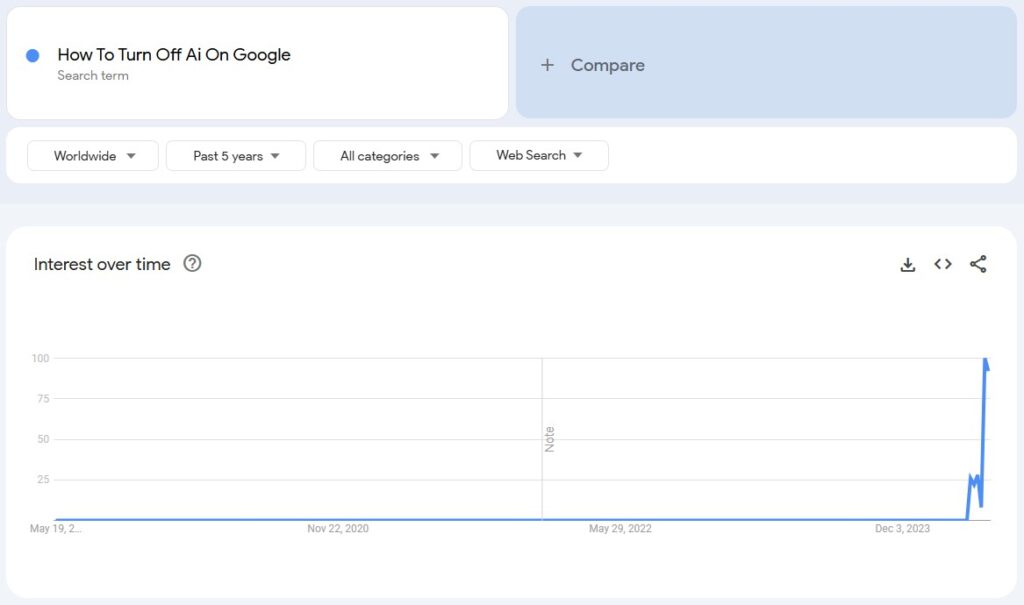
However, according to Google Trends data, people are increasingly searching for ways to “turn off AI on Google.”
Screenshot of Google Trends data
Why It Matters: Google announced the launch of the AI Overviews feature in the U.S. earlier this month, during its annual developer conference, Google I/O.
Earlier in April, Pichai expressed confidence that AI-powered search wouldn’t be “costly to serve” during the company’s Q1 earnings call.
However, this new search experience has raised concerns that it could have an adverse impact on publishers, with worries that it could result in a drop in their web traffic.
Meta Platforms Inc. CEO Mark Zuckerberg made a big bet by acquiring photo-sharing service Instagram for $1 billion exactly 12 years ago. The acquisition was expensive at the time – it was announced days after Instagram raised funds at a valuation of $500 million.
However, Zuckerberg’s bet (at the time) has paid rich dividends over the past few years. Instagram has been making more money from ads than Alphabet Inc.’s YouTube, despite the latter’s dominance in the video streaming industry.
Instagram was being courted by the two dominant social media platforms at the time, Twitter (now X) and Facebook (now Meta Platforms.)
While X offered $500 million to acquire Instagram, Meta Platforms offered twice as much.
But it wasn’t just about the money for Instagram when it came to Meta Platforms – its co-founder Kevin Systrom and Zuckerberg developed a friendship months before Instagram chose to go with Meta Platforms. Zuckerberg also offered something important to Systrom – independence.
If you were to believe in Zuckerberg and invest $1,000 in Meta Platforms when it acquired Instagram in 2012, here’s how much you’d have.
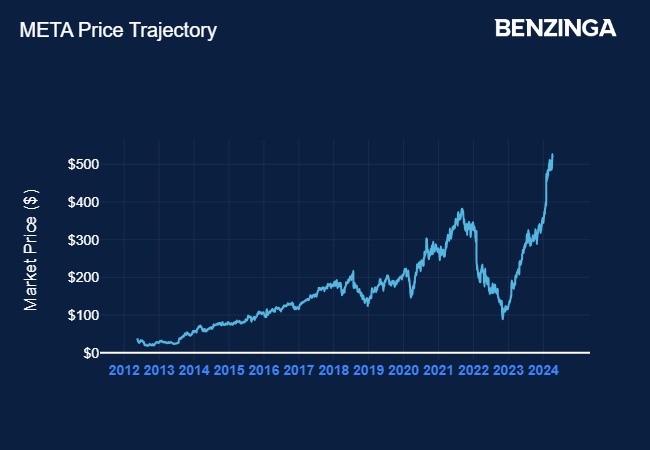
Meta Platforms stock price from May 18, 2012, till today
Meta Platforms’ stock, adjusted for stock splits and other corporate actions, was $38 on May 18, 2012, which is when it went public and was listed on the stock exchanges.
Its stock price today is $519.25, which is an increase of 1,266% during this period.
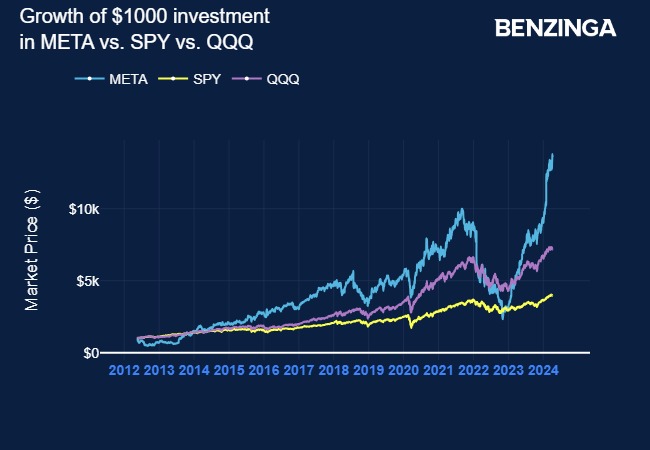
Value of a $1,000 investment in Meta Platforms stock, and the Nasdaq and S&P 500 indices, respectively, from May 18, 2012, till today
If you had invested $1,000 in Meta Platforms stock on May 18, 2012, today, you would have $13,582.
Likewise, if you had invested $1,000 in an index fund replicating Nasdaq, you would have $5,849.
A similar $1,000 investment in an index fund that replicates the S&P 500 would be worth $4,017.
Instagram A Bigger Money Maker Than YouTube
According to court documents filed last week, Meta revealed that Instagram made $32.4 billion in 2021, $22 billion in 2020, and $17.9 billion in 2019 from advertising services.
In contrast, YouTube made $28.8 billion, $19.7 billion, and $15.1 billion from advertising during those three years.
A Bloomberg report states that the share of Instagram’s ad revenue in Meta’s overall revenue has surged from 26% in 2020 to almost 30% in the first six months of 2022.
The Walt Disney Co. (NYSE:DIS) CEO Bob Iger revealed that the Mouse House will start its password-sharing crackdown in June.
What Happened: Iger disclosed the company’s plans to CNBC, stating that the new policy will be implemented in a few countries and markets initially, with a global rollout scheduled for September.
The anti-password sharing rules were first enforced for new Disney Plus subscribers on January 25 and later extended to existing members on March 14.
Subscribers suspected of improper sharing will be prompted to sign up for their own subscription this summer, as confirmed by Disney’s chief financial officer, Hugh Johnston, during an earnings call in February.
While the company has not yet disclosed the additional fee for adding members outside a subscriber’s household, it is expected to be a significant step towards Disney’s goal of achieving profitability in its streaming business by the end of the fiscal year.
Disney’s recent move to combine the Disney Plus and Hulu apps is also seen as a strategy to increase subscriber engagement and reduce churn. The merged app not only integrates content from both services but also combines watch histories to enhance recommendations.
Why It Matters: Disney’s decision to charge for password sharing follows in the footsteps of Netflix Inc., which implemented a similar policy in 2023.
This move is part of Disney’s broader strategy to boost its subscriber base and achieve profitability in its streaming business.
Disney has been making significant strides in its streaming business, with its stock returning over 50% to investors in the past six months. The company’s recent initiatives, including the password-sharing crackdown, are likely to further bolster its position in the streaming market.
Price Action: At the time of writing, Disney’s shares were trading 1% up at $118.26, according to Benzinga Pro.
Dallas Mavericks owner Mark Cuban expressed his opinion about the hype regarding artificial intelligence, addressing skepticism about the existence of an AI bubble in the current market.
What Happened: Cuban addressed concerns surrounding a potential AI bubble on the Lex Fridman Podcast. He recalled the dot-com era “frothiness” in the technology industry to explain whether the current hype is a sign of an AI bubble or not.
“There were people creating companies with just a website and going public. That’s a bubble where there’s no intrinsic value at all,” Fridman said, recalling his sale of Broadcast.com to Yahoo
To recall, Yahoo acquired Broadcast.com from Cuban and his partner, Todd Wagner, for a staggering $5.7 billion. This is Yahoo’s biggest acquisition to date.
Cuban received 14.6 million Yahoo shares, worth $1.4 billion, skyrocketing into the billionaire club overnight. But that is not even the whole story.
Cuban knows a thing or two about stock market bubbles – he saved his $1.4 billion wealth after selling Broadcast.com to Yahoo by entering into “collar” options trade with investment bank Goldman Sachs to protect his wealth.
A collar trade is one where calls are sold and puts are purchased. This is done with the viewpoint of protecting as much capital as possible in times of turbulence, where it is difficult to predict the direction of the market.
“People were not even trying to make operating cap profits, they were just trying to leverage the frothiness of the stock market, that’s a bubble.”
But is the current AI hype a precursor to an AI bubble? Cuban pointed out that the lack of IPOs in the AI sector is a reassuring sign that the market is not in a bubble.
Cuban also mentioned the absence of companies with no intrinsic value going public, a phenomenon that was prevalent during the dot-com bubble.
He noted that the current market does not exhibit such characteristics, which further supports his view that there is no AI bubble at present.
He added that the absence of “funky AI companies” going public is a key indicator.
He did, however, acknowledge the potential risk, citing his son’s investment in Nvidia Corp. (NASDAQ:NVDA) as a sign to watch out for.
Why It Matters: Cuban’s comments come in the wake of growing concerns about a potential AI bubble. Several industry experts have been warning about the possibility of a market correction due to the excessive hype surrounding AI.
This was followed by a warning from Google DeepMind co-founder Sir Demis Hassabis about the exaggerated hype overshadowing the actual scientific progress in the AI sector.
However, Cuban’s perspective offers a different angle, focusing on the lack of IPOs and companies with no intrinsic value going public as key indicators that the market is not in a bubble. This stance adds an interesting dimension to the ongoing debate about the state of the AI market.