Shares of Super Micro Computer Inc (NASDAQ:SMCI) are trading higher Friday morning after the company late Thursday announced the immediate availability of its new NVIDIA Corp (NASDAQ:NVDA) Blackwell-powered solutions.
What To Know: The new product line, featuring the Nvidia HGX B200, GB200 and GB200 NVL72, offers a comprehensive portfolio of systems and data center solutions.
With these chips, Supermicro says the company will build and ship complete, rack-scale, liquid-cooled, plug-and-play AI solutions, enabling customers to rapidly deploy large-scale AI infrastructure.
By quickly adopting Nvidia’s latest technology, Supermicro could be in a prime position to profit from the ongoing AI boom. In a press release Thursday, the company highlighted its capability to deliver these advanced systems on a massive scale.
Benzinga Edge Rankings: According to Benzinga Edge stock rankings, the company boasts an exceptional Growth score of 97.51, underscoring its strong expansion potential.
Price Action: According to data from Benzinga Pro, SMCI shares are trading higher by 3.37% to $45.39 Friday morning. The stock has a 52-week high of $66.44 and a 52-week low of $17.25.
Besides going to a brokerage platform to purchase a share – or fractional share – of stock, you can also gain access to shares either by buying an exchange traded fund (ETF) that holds the stock itself, or by allocating yourself to a strategy in your 401(k) that would seek to acquire shares in a mutual fund or other instrument.
For example, in Super Micro Computer’s case, it is in the Information Technology sector. An ETF will likely hold shares in many liquid and large companies that help track that sector, allowing an investor to gain exposure to the trends within that segment.
Pulled from Benzinga Pro data this sector movers alert provides traders with a compiled way to read macro-level market trends. Investors garner a particular interest in sector movers to better determine sectors that are over- or under-performing to make better investing decisions on exchange-traded funds (ETFs) or individual tickers in those sectors.
Pulled from Benzinga Pro data the above sector movers alert assists traders in understanding macro-level trends and market variations. Traders will look for sector movers providing information on sectors that are over- or under-performing, deriving these results into investing decisions on exchange-traded funds (ETFs) or individual tickers in those sectors.
Spotify Technology S.A. (NYSE:SPOT) has begun rolling out lossless audio streaming for Premium subscribers in select markets, delivering one of its most requested features as competition in music streaming intensifies. Eligible users will receive in-app notifications as the upgrade becomes available.
The launch comes as Spotify prepares for additional price increases to offset higher licensing and AI investment costs.
The new option supports playback up to 24-bit/44.1 kHz FLAC, offering significantly higher fidelity than standard streaming. Spotify has positioned the launch as part of its strategy to strengthen user engagement and reinforce the value of its paid tier.
“We’ve taken time to build this feature in a way that prioritizes quality, ease of use, and clarity at every step, so you always know what’s happening under the hood,” said Gustav Gyllenhammar, Spotify’s vice president of subscriptions. “With Lossless, our premium users will now have an even better listening experience.”
This new feature expands Spotify’s Premium-only suite, which already includes its AI DJ and AI Playlist. Management has consistently emphasized these tools as a way to drive subscriber growth and reduce churn as competition in music streaming intensifies.
Premium subscribers can now customize audio quality across Wi-Fi, cellular, and downloads, with data usage displayed for each setting. Lossless streaming works across mobile, desktop, and tablet apps, as well as via Spotify Connect on devices from Sony, Bose, Samsung, and Sennheiser, with Sonos and Amazon support due next month.
The rollout will expand to more than 50 markets through October, starting with the US, UK, Germany, Japan, Australia, and others. Users must manually enable lossless audio on each device, with an indicator appearing once it is active.
Price Action: SPOT stock is trading lower by 1.29% to $695.00 premarket at last check Thursday.
Adobe Inc (NASDAQ:ADBE) looks to beat analyst estimates once again when the company reports third-quarter financial results Thursday after the market closes.
Here are the earnings estimates, what experts are saying, and key items to watch.
Earnings Estimates: Analysts expect Adobe to report third-quarter revenue of $5.91 billion, up from $5.41 billion in last year’s third quarter, according to data from Benzinga Pro.
The company has beaten analyst estimates for revenue in two straight quarters and nine of the last 10 quarters overall.
Analysts expect Adobe to report third-quarter earnings per share of $5.18, up from $4.65 in last year’s third quarter. The company beat analyst estimates for earnings per share in two straight quarters and in nine of the previous 10 quarters overall.
Adobe expects third-quarter revenue to be between $5.88 billion and $5.93 billion, and earnings per share to land between $5.15 and $5.20.
What Experts Are Saying: Freedom Capital Markets Chief Market Strategist Jay Woods compared Adobe to Salesforce.
Both companies have consistently beaten analyst estimates for revenue and earnings per share, but the stocks have fallen after financial results. Adobe shares fell after eight of the past nine quarterly earnings reports.
“The pioneer behind Photoshop continues to struggle to grow in a landscape where AI competition can do some of the key things they were known for,” Woods wrote in a weekly newsletter.
The stock is in a longer-term downtrend, and rallies should likely be sold until the stock can prove otherwise, Woods says. “The real pressure is to the downside.”
Analysts have been lowering their price targets on Adobe stock ahead of the earnings report. Here are recent analyst ratings on Adobe and their price targets:
Oppenheimer: Maintained Outperform rating, lowered price target from $500 to $460
RBC Capital: Maintained Outperform rating, lowered price target from $480 to $430
Mizuho: Maintained Outperform rating, lowered price target from $530 to $460
Barclays: Maintained Overweight rating, lowered price target from $567 to $460
UBS: Maintained Neutral rating, lowered price target from $430 to $400
Key Items to Watch: With a string of recent beats, analysts and investors will be looking for the company to beat estimates once again and potentially to raise guidance.
Second-quarter revenue was up 11% year-over-year with digital experience revenue up 10% year-over-year. The company said it had $19.69 billion in remaining performance obligations.
Investors will be looking for strong remaining obligations and year-over-year growth.
Artificial intelligence will be a key topic for investors and analysts. Critics say Adobe is falling behind other tech firms, and AI could be a significant threat to some of its products.
However, the company has highlighted its AI innovation in recent quarters, garnering a 38% upside from the price of $391.37 for JPMorgan analyst Mark R. Murphy.
“We continue to invest in AI innovation across our customer groups to enhance value realization and expand the universe of customers we serve,” Adobe CEO Dan Durn said after second-quarter results.
ADBE Price Action: Adobe stock is down 1.49% to $348.78 on Wednesday. Its 52-week trading range is $330.04 to $587.75. Adobe stock is down 20.6% year-to-date in 2025.
Pulled from Benzinga Pro data the above sector movers alert assists traders in understanding macro-level trends and market variations. Traders will look for sector movers providing information on sectors that are over- or under-performing, deriving these results into investing decisions on exchange-traded funds (ETFs) or individual tickers in those sectors.
For more information on sector movers, click here.
As of Sept. 10, 2025, three stocks in the materials sector could be flashing a real warning to investors who value momentum as a key criteria in their trading decisions.
The RSI is a momentum indicator, which compares a stock’s strength on days when prices go up to its strength on days when prices go down. When compared to a stock’s price action, it can give traders a better sense of how a stock may perform in the short term. An asset is typically considered overbought when the RSI is above 70, according to Benzinga Pro.
Here’s the latest list of major overbought players in this sector.
On Aug. 5, Osisko Gold posted in-line quarterly earnings. Jason Attew, President & CEO of OR Royalties said, “OR Royalties’ is on track to achieve its 2025 annual guidance of 80,000-88,000 GEOs, as we expect a slightly stronger second half in terms of GEOs earned. Looking a bit closer at some of our major GEO contributors over the past six months, we have seen continued outperformance at Canadian Malartic largely offsetting silver grade-related underperformance at Mantos Blancos.” The company’s stock gained around 13% over the past month and has a 52-week high of $35.44.
RSI Value: 82.8
OR Price Action: Shares of OR Royalties fell 1.1% to close at $34.61 on Tuesday.
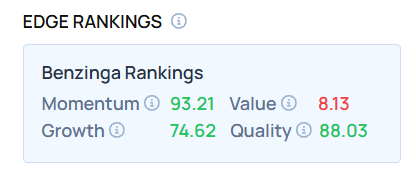
Edge Stock Ratings: 93.21 Momentum score with Value at 8.13.
On Aug. 7, Iamgold posted weaker-than-expected quarterly earnings. “This is an exciting time for IAMGOLD. With the gold prepayment facilities behind us and improving operations, IAMGOLD is positioned to generate significant cash flows, allowing us to advance our strategy to de-lever the balance sheet and unlock the significant value and growth potential of our Canadian portfolio,” said Renaud Adams, President and CEO of IAMGOLD. The company’s stock gained around 33% over the past month and has a 52-week high of $10.27.
RSI Value: 78
IAG Price Action: Shares of Iamgold fell 0.6% to close at $10.02 on Tuesday.
On Aug. 13, Equinox Gold reported better-than-expected second-quarter financial results. Darren Hall, CEO of Equinox Gold, said, “Equinox Gold is entering a pivotal growth phase. Q2 delivered solid results, led by Greenstone, where mining rates increased 23% and processing rates improved 20% over Q1. Building on that momentum, Q3 is off to a strong start, with quarter-to-date ex-pit mining volumes 10% higher than Q2 and process plant throughput averaging 24.5 kptd over the last 30 days, including more than one-third of the days above nameplate capacity of 27 ktpd.” The company’s stock gained around 50% over the past month and has a 52-week high of $10.00.
RSI Value: 85.8
EQX Price Action: Shares of Equinox Gold gained 1.2% to close at $9.95 on Tuesday.
Pet ecommerce company Chewy Inc (NYSE:CHWY) is set to report its second-quarter earnings before market open on Wednesday, with analysts eyeing potential growth in recurring revenue and subscription services.
Here’s a preview of the key estimates, analyst expectations, and what to watch for in the upcoming report.
Earnings Estimates: Analysts expect Chewy to report Q2 revenue of $3.08 billion, up from $2.86 billion according to data from Benzinga Pro.
The company has beaten analyst estimates in two straight quarters and in seven of the last 10 quarters overall.
Analysts expect Chewy to report Q2 earnings per share of 14 cents, down from 24 cents a year ago. The company has beaten analyst estimates for earnings per share in more than 10 straight quarters.
Guidance from the company calls for Q2 revenue in a range of $3.06 billion to $3.09 billion and earnings per share in a range of 30 cents to 35 cents.
What Analysts Are Saying: JPMorgan analyst Doug Anmuth views Chewy as a defensive stock. Most of Chewy’s net sales, 85%, are in non-discretionary goods.
The analyst said Chewy is seeing around 80% of its revenue come from Autoship. The analyst also highlighted that Chew is not seeing its hard goods impacted by tariff-driven inflation.
“We remain bullish on CHWY’s product improvements, execution, and marketing, along with stable industry trends,” Anmuth said.
The analyst maintained an Overweight rating with a price target of $47.
Anmuth said the U.S. pet category is still transitioning to digital. Around 38% of sales were online in fiscal 2024, opening up room for future growth. In the online pet category, Chewy has around a 33% market share.
The analyst said Chewy is showing momentum for new customers ahead of the earnings report. Anmuth estimates Chewy will add 126,000 net new customers in the second quarter and 656,000 in the fiscal year.
Mizuho recently upgraded Chewy stock from Neutral to Outperform. It also raised the price target from $44 to $50 ahead of the earnings report.
Key Items to Watch: As mentioned by Anmuth, Autoship is a strength for Chewy and will be one of the areas investors and analysts closely monitor.
Autoship sales were up 14.8% year-over-year in the first quarter to $2.56 billion.
Another area to watch is net sales per active customer with Chewy adding more products and services and diversifying itself in the pet sector. In the first quarter, net sales per active customer were up 3.7% year-over-year to $583.
Chewy CEO Sumit Singh said first-quarter results were above company expectations, highlighting the sales figure, active customer growth and free cash flow.
Another strong quarter could lead to the company raising guidance with initial expectations from the company guiding for fiscal 2025 sales between $12.30 billion to $12.45 billion.
CHWY Price Action: Chewy shares trade at $41.59 on Tuesday versus a 52-week trading range of $26.28 to $48.62. Chewy stock is up 22.8% year-to-date in 2025.
Pulled from Benzinga Pro data the above sector movers alert assists traders in understanding macro-level trends and market variations. Traders will look for sector movers providing information on sectors that are over- or under-performing, deriving these results into investing decisions on exchange-traded funds (ETFs) or individual tickers in those sectors.
Investors are increasingly turning their attention to dividend stocks as a reliable income source amid turbulent market conditions. The focus on generating consistent returns has intensified as economic uncertainties make fixed income streams more appealing.
Analysts expect the company to report quarterly earnings at $1.18 per share, down from $2.77 per share in the year-ago period. Oxford Industries is projected to report quarterly revenue of $406.12 million, compared to $419.89 million a year earlier, according to data from Benzinga Pro.
On Sept. 5, Telsey Advisory Group analyst Dana Telsey maintained Oxford Industries with a Market Perform rating and maintained a $52 price target.
With the recent buzz around Oxford Industries, some investors may be eyeing potential gains from the company’s dividends too. As of now, Oxford Industries offers an annual dividend yield of 6.80%, which is a quarterly dividend amount of 69 cents per share ($2.76 a year).
So, how can investors exploit its dividend yield to pocket a regular $500 monthly?
To earn $500 per month or $6,000 annually from dividends alone, you would need an investment of approximately $88,286 or around 2,174 shares. For a more modest $100 per month or $1,200 per year, you would need $17,665 or around 435 shares.
To calculate: Divide the desired annual income ($6,000 or $1,200) by the dividend ($2.76 in this case). So, $6,000 / $2.76 = 2,174 ($500 per month), and $1,200 / $2.76 = 435 shares ($100 per month).
Note that dividend yield can change on a rolling basis, as the dividend payment and the stock price both fluctuate over time.
How that works: The dividend yield is computed by dividing the annual dividend payment by the stock’s current price.
For example, if a stock pays an annual dividend of $2 and is currently priced at $50, the dividend yield would be 4% ($2/$50). However, if the stock price increases to $60, the dividend yield drops to 3.33% ($2/$60). Conversely, if the stock price falls to $40, the dividend yield rises to 5% ($2/$40).
Similarly, changes in the dividend payment can impact the yield. If a company increases its dividend, the yield will also increase, provided the stock price stays the same. Conversely, if the dividend payment decreases, so will the yield.
OXM Price Action: Shares of Oxford Industries fell 3.6% to close at $40.61 on Monday.