Each week, Benzinga’s Stock Whisper Index uses a combination of proprietary data and pattern recognition to showcase five stocks just under the surface and warrant attention.
Investors are constantly on the hunt for undervalued, under-followed and emerging stocks. With countless methods available to retail traders, the challenge often lies in sifting through the abundance to uncover new information and making sense of why these stocks should be of interest.
Here’s a look at the Benzinga Stock Whisper Index for the week of July 5:
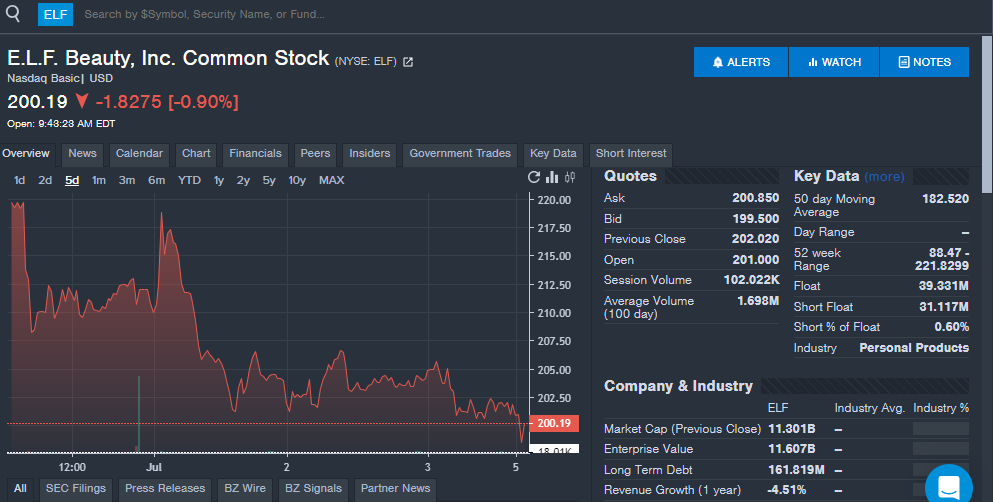
E.l.f. Beauty Inc (NYSE:ELF): The beauty products company saw strong interest from readers as shares fell 7.2% on the week. It could be expanding its reach with several new initiatives announced. e.l.f. Beauty expanded a partnership with gaming company Roblox Corporation (NYSE:RBLX) as the first beauty brand to test selling real-world products through the game.
E.l.f. received over 12 million visits to its Roblox experience and distributed over one million free virtual items. e.l.f. Beauty is also seeing its Alicia Keyscollaboration, Keys Soulcare, join Amazon.com (NASDAQ:AMZN) for a custom Alexa theme.
The new partnerships could see e.l.f. Beauty reach new consumers and increase its brand awareness. Below is a chart of the stock over the last week from Benzinga Pro.
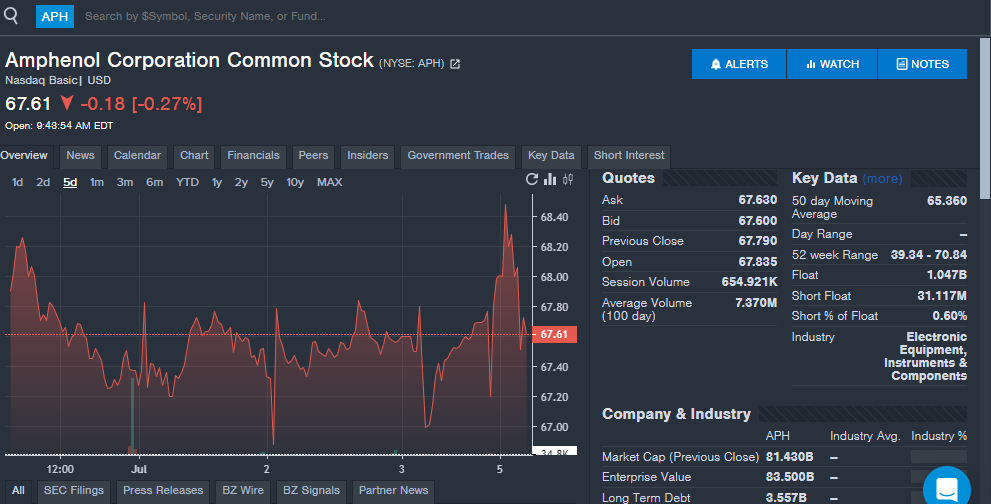
Amphenol Corporation (NYSE:APH): The supplier of connectors, sensors and interconnect systems saw strong interest from readers, which comes with shares trading near 52-week highs.
There is minimal news on the stock and several analysts have been lowing their price targets over the past month.
Amphenol reported first-quarter revenue of $3.3 billion, up 9% year-over-year. The company also announced a new $2 billion share buyback, which may have led to increased optimism in the stock going forward. Amphenol is forecasting second-quarter revenue to grow in a range of 6% to 8% year-over-year.
Amphenol shares traded nearly flat over the last week, as seen in the chart from Benzinga Pro below.
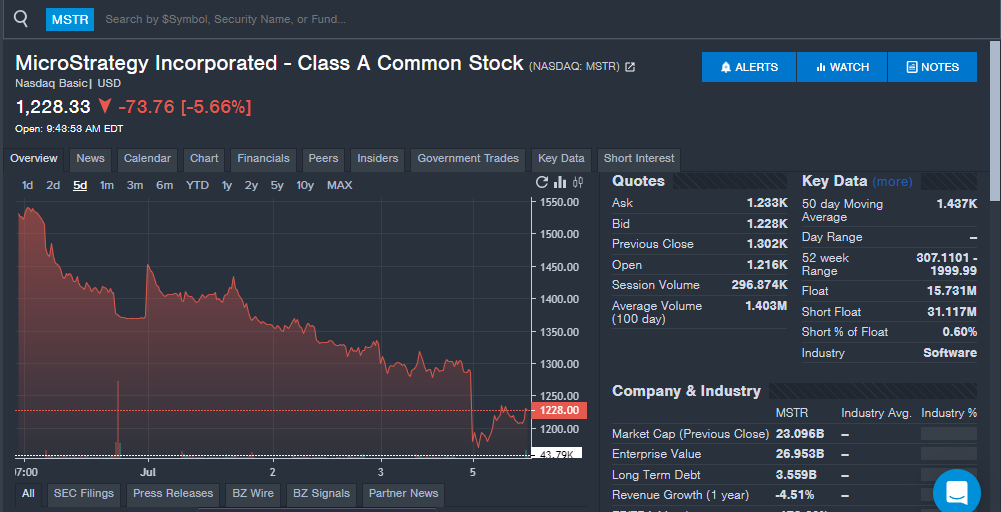
MicroStrategy Inc (NASDAQ:MSTR): Shares of the software company and Bitcoin (CRYPTO: BTC) holder took a breather over the last week down 11%, as seen in the Benzinga Pro chart below. The company recently bought an additional 11,931 Bitcoin for $786 million. MicroStrategy has been buying Bitcoin since August 2020 and now holds 226,331 BTC, valued at around $14.9 billion.
With the price of Bitcoin falling in recent weeks, shares of MicroStrategy have followed the leading cryptocurrency lower.
Outside of its cryptocurrency holdings, MicroStrategy announced changes to its MicroStrategy ONE and HyperIntelligence platform. The company is integrating more artificial intelligence powered data insights into its platforms.
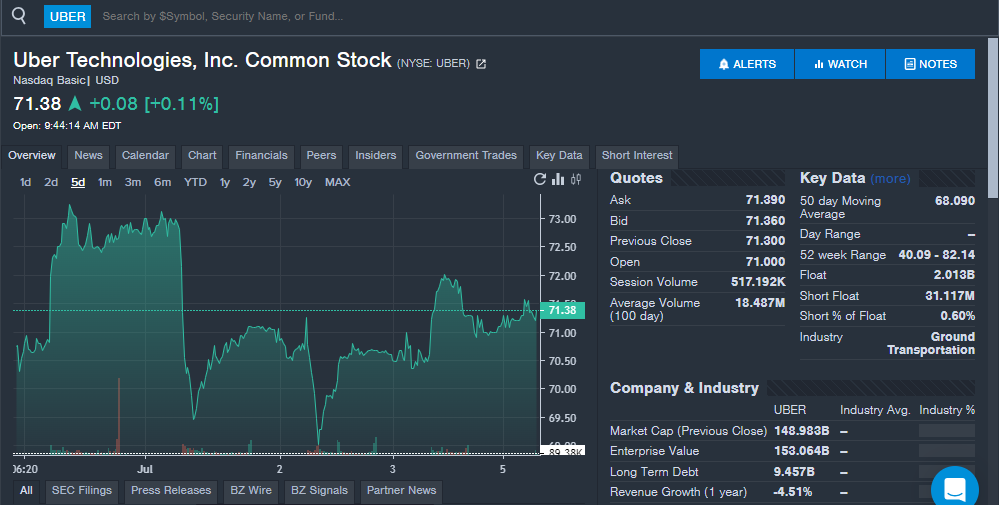
Uber Technologies (NYSE:UBER): The ride-share company saw shares volatile over the last week with the Massachusetts Attorney General announcing a settlement with the company. The settlement will see Uber pay a minimum $32.50 per hour for drivers and pay $175 million to settle allegations of violating state wage and hour laws.
The conclusion of the multi-year litigation could be a welcome sign for Uber and investors, but comes ahead of a key event that could impact the company’s future. Tesla Inc(NASDAQ:TSLA) is set to host its robotaxi day next month (Aug. 8). The event is expected to be a negative for Uber in the future, but the event could also lay out the timeline of how long it will take Tesla to reach its ambitious goals.
Bank of America recently named Uber as one of the top second-half 2024 stocks to watch.
“While there is risk of new competition, less competitive uncertainty following Tesla’s robotaxi day could also benefit Uber and Lyft given overhangs,” Bank of America said.
Uber shares are down 2% over the last five days, as seen on the chart below.
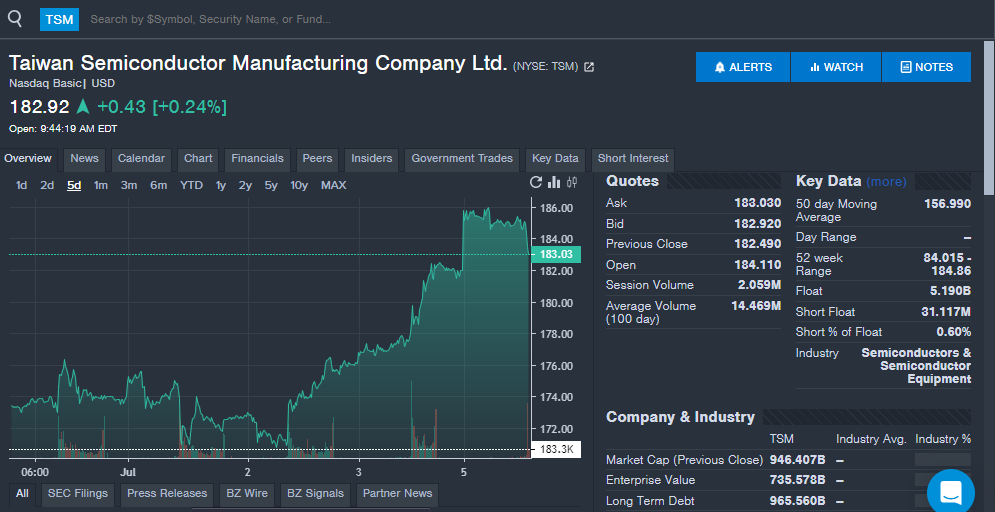
Taiwan Semiconductor (NYSE:TSM): While semiconductor giant Nvidia gets most of the attention, Taiwan Semiconductor is seeing increased interest from Benzinga readers. The interest comes with shares hitting new all-time highs. The company is also nearing a market capitalization of $1 trillion, which could put an increased spotlight on the stock.
UBS has a Buy rating on the stock and sees demand for generative AI continuing for the company. Analyst Lin Lijun sees TSMC’s gross margins rising with increased AI demand.
The analyst sees TSMC gaining as a supplier to Nvidia and strong market share as a supplier in the semiconductor space.
Taiwan Semiconductor shares are up 4% over the last five days, as viewed on the chart below and are up 75% year-to-date in 2024.
VanEck’s Head of Digital Assets Research Matthew Sigel on Wednesday stated that cryptocurrency voters could swing the upcoming U.S. presidential election.
What Happened: “There’s a good chance that crypto voters are going to make the difference in this election,” Sigel said when Addressing the potential impact of the upcoming presidential election.
He observed a shift in the regulatory environment at the elected official level, with multiple Democrats supporting pro-crypto legislation. This change reflects the increasing political weight of the crypto community.
Sigel also emphasized the growing importance of regulatory treatment of Ethereum (CRYPTO: ETH) and Solana (CRYPTO: SOL).
“Ethereum applications are going smoothly, and this might be the only time in three years that I’ve agreed with Gary Gensler about something,” he said, in an interview with Bloomberg, noting a remark by SEC Chair Gary Gensler during a recent conference.
He explained that if Ethereum-based products are permitted to trade, it would confirm Ethereum’s status as a commodity, a classification that could extend to Solana as well.
Sigel pointed out the lack of a regulated futures market for Solana, which might be hindering ETF approvals. He criticized Gensler’s approach, saying, “We think that is a Gensler psyop. He has created that condition since taking power.”
Sigel argued that various ETFs, such as those for shipping, uranium and power, operate independently of futures markets.
He expressed optimism that a slight regulatory shift in Washington could lead to approval for these digital asset ETFs.
When discussing the competition between Ethereum and Solana ETFs, Sigel acknowledged the fiduciary responsibilities of asset managers, saying, “Fiduciaries want to pick the asset that they think is going to go up the most and then take a bet.”
He emphasized that VanEck provides extensive research to help clients make informed decisions, highlighting their belief in Solana’s potential to capture the largest market share in the blockchain space.
Sigel also mentioned the ongoing SEC filings for Ethereum ETFs, urging the regulatory body to adhere to its traditional approval process.
“It is not too late for the SEC to do the right thing and revert to its traditional first come, first serve process towards approving these ETFs. And under that framework, VanEck would go first,” he said.
What’s Next: The evolving regulatory landscape and the influence of crypto voters will be key topics at Benzinga’s Future of Digital Assets event on Nov. 19.
American AirlinesGroup Inc (NASDAQ:AAL) has announced a conditional purchase agreement with clean aviation innovator ZeroAvia for 100 hydrogen-electric engines, aiming to power regional jet aircraft with zero inflight emissions, except for water vapor.
This move aligns with American’s commitment to sustainability and reducing its carbon footprint.
Alongside the engine purchase agreement, American has increased its investment in ZeroAvia, following its initial investment in 2022 and participation in the company’s Series C financing round.
ZeroAvia is developing hydrogen-electric engines that offer close to zero inflight emissions. The company is testing a prototype for a 20-seat plane and designing an engine for larger aircraft, such as the Bombardier CRJ700, used by American on regional routes.
American Airlines CEO Robert Isom said, “Advancing the transition of commercial aviation to a low-carbon future requires investments in promising technologies, including alternate forms of propulsion.”
This initiative supports American’s goal of achieving net-zero greenhouse gas emissions by 2050.
The airline has undertaken a significant fleet renewal effort, making investments in sustainability, including an agreement with Infinium for low-carbon sustainable aviation fuel and partnering with Graphyte for carbon removal processes.
“The solutions that can serve the largest airlines are within reach, and the clean future of flight is coming,” said ZeroAvia’s Founder and CEO Val Miftakhov.
ZeroAvia’s hydrogen-electric engines generate electricity using hydrogen in fuel cells, powering electric motors to turn aircraft propellers.
The only inflight emission is low-temperature water vapor, with the potential for significant cost savings due to lower intensity electrical systems.
Price Action: AAL shares are trading lower by 0.50% at $10.99 at last check Tuesday.
Disclaimer: This content was partially produced with the help of AI tools and was reviewed and published by Benzinga editors.
Is FedEx Corp (NYSE:FDX) helping law enforcement spy on private citizens? A new report presents compelling evidence in the latest controversy over privacy.
What Happened: Forbes reported that the Memphis, Tennessee-based shipping giant has partnered with local law enforcement agencies by distributing surveillance footage from cameras on FedEx vehicles.
There are instances of local police departments reciprocating by sharing data with FedEx, which has a secretive, private police force. These include the Shelby County Sheriff’s Office in Tennessee and Pittsboro Police Department in Indiana.
Jay Stanley, senior policy analyst at the American Civil Liberties Union (ACLU), called the program “profoundly disconcerting.”
“It raises questions about why a private company…would have privileged access to data that normally is only available to law enforcement,” Stanley told Forbes.
The company utilizes surveillance cameras from the start-up Flock Safety.
What is Flock?: Flock, a multi-billion dollar startup founded in 2017, leases surveillance equipment to the private and public sectors.
Flock uses artificial intelligence technology to track vehicles by license plate, make, model, color and other identifying qualities.
Why it Matters: FedEx operates in all 50 states, with over 200,000 vehicles and hundreds of operational centers. FedEx’s partnership expands surveillance efforts to the road.
The extent of data sharing between law enforcement and FedEx remains unclear. The arrangement underscores broader issues surrounding privacy, transparency, and the increasing use of private surveillance technologies in law enforcement efforts.
While the program may help police departments reduce crime, it also opens the door for questions about curtailing personal liberties.
Simon Property Group Inc (NYSE:SPG), Lowe’s Companies Inc (NYSE:LOW) and Kaiser Permanente similarly share data with law enforcement, per Forbes.
Each week, Benzinga’s Stock Whisper Index uses a combination of proprietary data and pattern recognition to showcase five stocks just under the surface and warrant attention.
Investors are constantly on the hunt for undervalued, under-followed and emerging stocks. With countless methods available to retail traders, the challenge often lies in sifting through the abundance to uncover new information.
This index layers editorial commentary to help make sense of why these stocks should be of interest and whether investors or casual readers should watch them.
Here’s a look at the Benzinga Stock Whisper Index for the week of June 28:
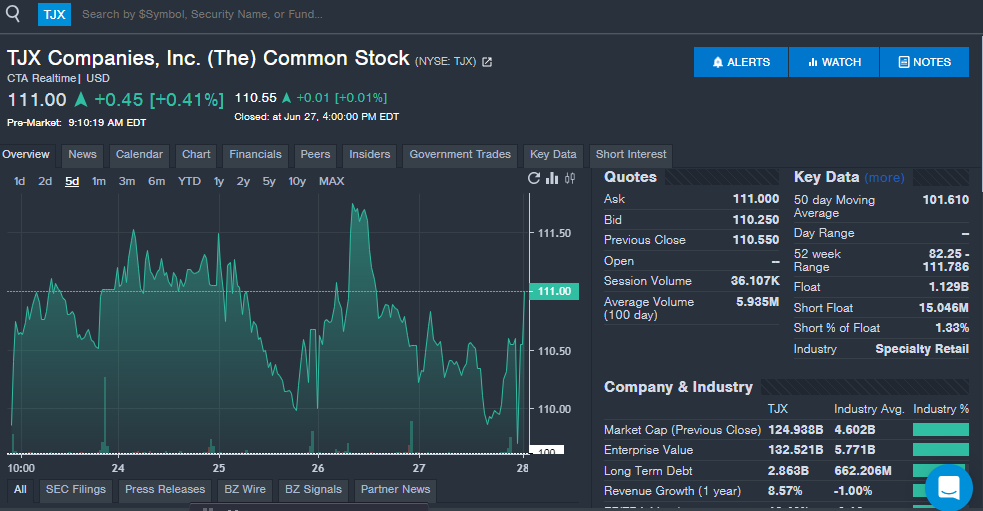
The TJX Companies (NYSE:TJX): The discount retailer saw strong interest from readers, which comes after peer companies Big Lots and Five Belowreported quarterly earnings.
The parent company of TJ Maxx and Marshalls recently announced a joint venture with Grupo Axo, an operator of global brands and Mexico and South America. TJX will own 49% of the joint venture, which will include Axo’s off-price, physical store business in Mexico.
“As the world’s retail leader in off-price apparel and home fashions, we are excited about the opportunity to expand to Mexico through our partnership with Axo, and grow and enhance that country’s leading off-price retailer,” TJX Companies CEO Ernie Herrman.
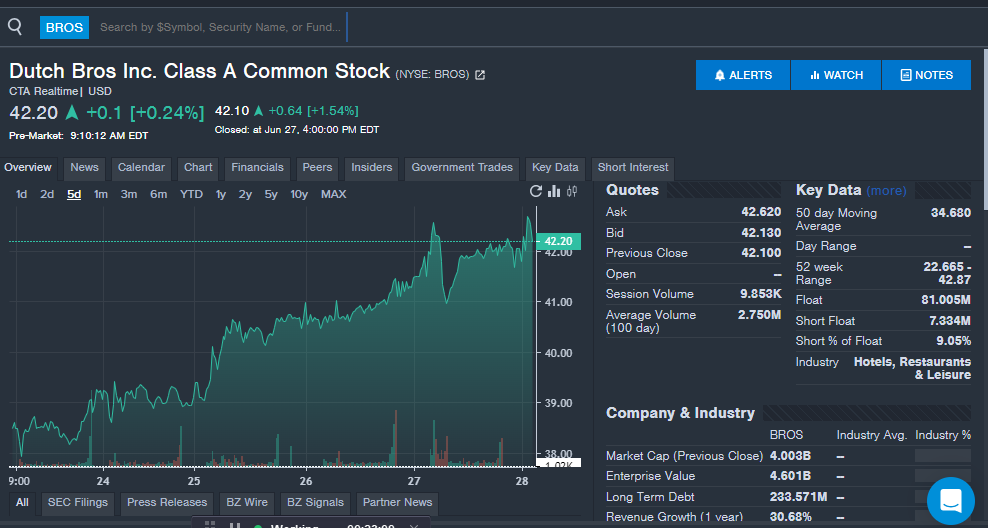
Dutch Bros Inc (NYSE:BROS): The coffee company saw strong interest as a new board of directors member was announced: Wendy’s Company CEO Todd Penegor will join the board as an independent director. Penegor also held leadership roles with Kellogg and Ford.
“We look forward to leveraging his extensive experience as we continue to build a board of directors that understands the unique needs of a high growth company dedicated to scaling not only performance, but culture,” Dutch Bros CEO Christine Barone said.
Dutch Bros shares also moved on TD Cowen naming the company one of the top small to mid-cap stock ideas with a Buy rating and $50 price target.
Shares of Dutch Bros were up 9% over the last week, as seen in the chart from Benzinga Pro below.
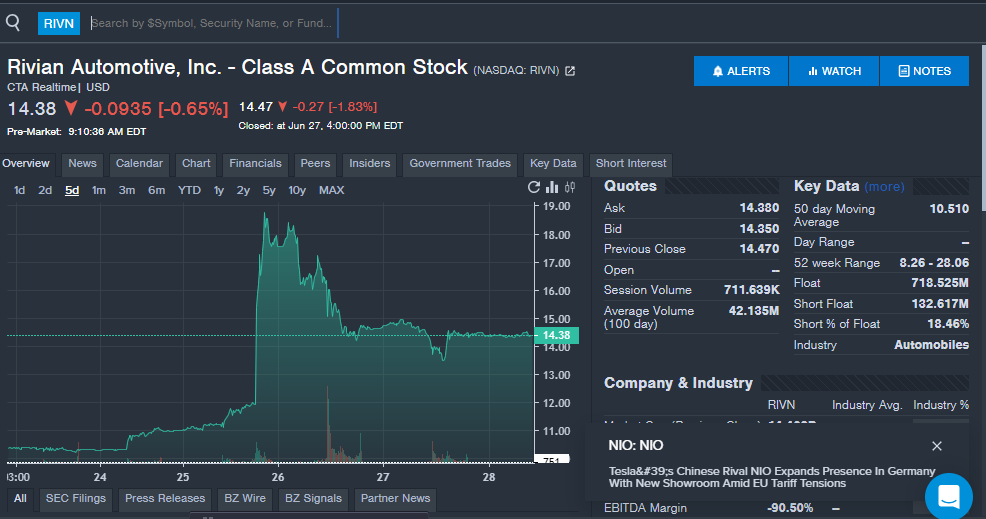
Rivian Automotive (NASDAQ:RIVN): Shares of the electric vehicle company soared after announcing a $5 billion investment and joint venture with automotive company Volkswagen (OTC:VWAGY).
Rivian also hosted its first-ever investor day on Thursday. During the investor day, the company shared updates on key financial metrics, cost savings, and what the joint venture means for the company.
Analysts were mixed on the Volkswagen joint venture, with the funding helping in the short-term, but could come at the cost of dilution and as Rivian needs more money down the road.
The company shared guidance for vehicle production for the second quarter and full year and said it expects to launch the highly anticipated R2 vehicle in the first half of 2026.
Rivian shares were up 35% during the trading week.
Pacific Gas & Electric Co (NYSE:PCG): The utility company saw strong interest from readers with limited news. Several analysts have issued updated ratings and price targets on the California utility company. Morgan Stanley maintained an Equal-Weight rating and lowered the price target from $18 to $17. Barclays maintained an Overweight rating and lowered the price target from $22 to $21. Citi shared a spotlight on utility companies overall as power grid demand increases.
Utility stocks could be in the spotlight during the summer months.
Shares of the utility company were down 1% on the trading week.
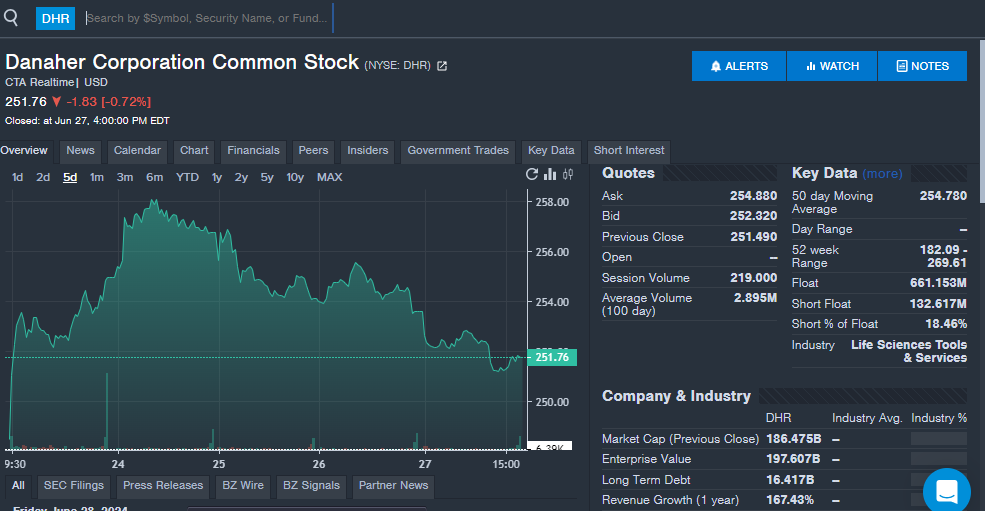
Danaher Corporation (NYSE:DHR): The scientific instrument manufacturing company saw increased interest from readers. The interest comes after the company’s Cepheid subsidiary landed FDA approval for a point-of-care Hepatitis C test. According to Cepheid, 2.4 million to 4 million people in the U.S. have Hepatitis C and many are unaware they have it. RBC Capital recently maintained a Buy rating on Danaher with a $297 price target. Danaher shares were down 2% over the trading week.
In today’s rapidly changing and highly competitive business world, it is vital for investors and industry enthusiasts to carefully assess companies. In this article, we will perform a comprehensive industry comparison, evaluating GameStop (NYSE:GME) against its key competitors in the Specialty Retail industry. By analyzing important financial metrics, market position, and growth prospects, we aim to provide valuable insights for investors and shed light on company’s performance within the industry.
GameStop Background
GameStop Corp is a U.S. multichannel video game, consumer electronics, and services retailer. The company operates across Europe, Canada, Australia, and the United States. GameStop sells new and second-hand video game hardware, physical and digital video game software, and video game accessories, mainly through GameStop, EB Games, and Micromania stores and international e-commerce sites. The majority of sales are from the United States.
Upon a comprehensive analysis of GameStop, the following trends can be discerned:
At 302.5, the stock’s Price to Earnings ratio significantly exceeds the industry average by 16.74x, suggesting a premium valuation relative to industry peers.
It could be trading at a premium in relation to its book value, as indicated by its Price to Book ratio of 7.89 which exceeds the industry average by 2.42x.
The Price to Sales ratio of 1.5, which is 2.78x the industry average, suggests the stock could potentially be overvalued in relation to its sales performance compared to its peers.
With a Return on Equity (ROE) of -2.44% that is 6.44% below the industry average, it appears that the company exhibits potential inefficiency in utilizing equity to generate profits.
Compared to its industry, the company has lower Earnings Before Interest, Taxes, Depreciation, and Amortization (EBITDA) of $-30 Million, which is -0.1x below the industry average, potentially indicating lower profitability or financial challenges.
Compared to its industry, the company has lower gross profit of $240 Million, which indicates 0.21x below the industry average, potentially indicating lower revenue after accounting for production costs.
The company’s revenue growth of -28.72% exceeds the industry average of -45.66%, indicating strong sales performance and market outperformance.
Debt To Equity Ratio
The debt-to-equity (D/E) ratio measures the financial leverage of a company by evaluating its debt relative to its equity.
Considering the debt-to-equity ratio in industry comparisons allows for a concise evaluation of a company’s financial health and risk profile, aiding in informed decision-making.
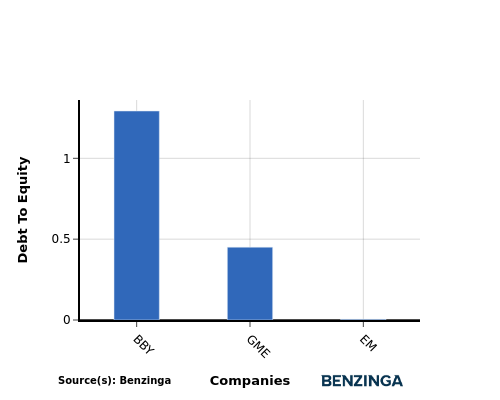
In terms of the Debt-to-Equity ratio, GameStop stands in comparison with its top 4 peers, leading to the following comparisons:
In the context of the debt-to-equity ratio, GameStop holds a middle position among its top 4 peers.
This indicates a moderate level of debt relative to its equity with a debt-to-equity ratio of 0.45, which implies a relatively balanced financial structure with a reasonable debt-equity mix.
Key Takeaways
For GameStop, the PE, PB, and PS ratios are all high compared to its peers in the Specialty Retail industry, indicating overvaluation. The low ROE, EBITDA, and gross profit suggest lower profitability and operational efficiency relative to industry competitors. However, the high revenue growth rate may present a potential opportunity for GameStop to improve its financial performance in the future.
This article was generated by Benzinga’s automated content engine and reviewed by an editor.
The Car: Electric vehicle news site Electrek reviewed the Honda CR-V e:FCEV fuel cell plug-in hybrid following the Tokyo-based company’s announcement of lease costs.
The fuel cell plug-in hybrid has 29 miles of range from its electric capabilities and a hydrogen tank with 241 miles of range.
The CR-V, Honda’s compact SUV, is currently sold in gas and hybrid models (gas and electric capabilities).
How Much Does it Cost?: Honda unveiled three leasing options for drivers wanting to drive the vehicle. Monthly payments range from $389 to $489 per month over a two to six-year lease. A substantial hydrogen fuel credit is offered to drivers to pay for expensive hydrogen fueling.
Is it Practical?: Electrek’s review expressed amusement at the vehicle’s existence and skepticism that it would be practical for drivers.
Non-commercial fuel cell vehicles are almost exclusively driven in California. Honda only plans to offer 300 fuel cell hybrids in a state with 30 million vehicles.
Not many hydrogen fueling stations exist, making fuel cell vehicles impractical for some drivers. The review posed the question, “Why not just get a battery-electric car instead?”
Why it Matters: Honda’s continued experiments with fuel cell vehicles come amid an industry-wide decline in price for electric vehicles. The Tesla Model 3 now costs less than the Honda vehicle mentioned above.
Semiconductor company Micron Technology (NASDAQ:MU) is set to report third-quarter financial results after market close Wednesday.
Here are the earnings estimates, what analysts are saying and key items to watch.
Earnings Estimates: Analysts expect Micron to report third-quarter revenue of $6.63 billion, according to data from Benzinga Pro.
The revenue estimate would be an improvement from $3.75 billion reported in last year’s third quarter. Micron has beaten analysts’ revenue estimates in four straight quarters and seven of the last 10 quarters overall.
Analysts expect Micron to report third-quarter earnings per share of 49 cents, compared to a loss of $1.43 in last year’s third quarter. The company has beaten earnings estimates in four straight quarters and eight of the last 10 quarters.
Company guidance calls for third-quarter revenue to be $6.6 billion, plus of minus $200 million and earnings per share to be 38 cents to 52 cents according to estimates given during the second quarter results.
What Analysts Are Saying: Micron has been getting lots of analyst updates and price target changes ahead of the third quarter earnings report.
Higher average selling prices for the third quarter could be a key item to watch according to Wedbush analyst Matt Bryson.
The analyst has an Outperform rating and raised the price target recently from $130 to $170.
Bryson expects Micron to beat estimates from analysts and raise guidance. The analyst saw Micron’s average selling prices, revenue, margins and earnings per share all trending higher.
“We expect only positive news for MU’s financials for some time to come, and expect the stock will continue to lift until we see a change in industry investment plans,” Bryson said.
A third-quarter beat-and-raise is also expected by Rosenblatt analyst Hans Mosesmann.
The analyst has a Buy rating and $225 price target on Micron.
Mosesmann sees increasing demand for artificial intelligence applications continuing in Micron’s third quarter and several positive trends continuing into 2026 and 2027.
Morgan Stanley: Equal-weight rating, raised price target from $130 to $140
Citi: Buy rating, raised rice target from $150 to $175
Baird: Outperform rating, raised price target from $150 to $172
Raymond James: Outperform rating, raised price target from $130 to $160
Wolfe Research: Outperform rating, raised price target from $150 to $200
Key Items to Watch: Micron is among the companies benefitting from growth in the artificial intelligence sector.
“Our preeminent product portfolio positions us well to deliver a strong fiscal second half of 2024. We believe Micron is one of the biggest beneficiaries in the semiconductor industry of the multi-year opportunity enabled by AI,” Micron CEO Sanjay Mehrota said after second-quarter results.
Investors will likely be looking for an update on customer demand and AI growth during the quarterly results.
A recent Bloomberg report said Micron is facing construction delays for a factory site in New York. The delays have pushed the groundbreaking into 2025. The project could help Micron increase domestic chip production.
Micron could share an update on this recent delay and other production projects that could impact future growth.
MU Price Action: Micron shares closed Tuesday at $141.12 versus a 52-week trading range of $60.50 to $157.54. Micron stock is up 113% over the last year and up over 60% year-to-date in 2024.
Editor’s note: This story has been corrected to remove an incorrect statement about Chipotle Mexican Grill’s market cap and to make the language regarding Chipotle’s market cap clearer.
The battle for the world’s most valuable public company took a turn last week with NVIDIA Corporation briefly taking over the spot as the company’s share price soars on growth of artificial intelligence-related revenue.
On Companiesmarketcap.com, Chipotle Mexican Grill (NYSE:CMG) was briefly listed as having a $4.428-trillion market cap Tuesday — likely an error in calculating the current value multiplied by 50.
On the site, Chipotle, which has a market cap of $88 billion, is shown as moving up 187 places and passing the three largest companies:
Microsoft Corporation (NASDAQ:MSFT): $3.33 trillion
The same error was recognized on Yahoo Finance with a $4.44-trillion market capitalization shown.
The restaurant company will complete a 50-for-1 stock split after the market closes on Tuesday, with shares trading at a new split-adjusted price to open Wednesday’s trading session.
When stock splits and reverse stock splits occur, finance sites can sometimes take time to show adjusted financials and market capitalizations. Tuesday’s error is less frequently seen, as it is occurring ahead of the planned stock split.
Why It’s Important: Chipotle is one of the top-performing restaurant stocks over the last 10 years, gaining over 440%.
The stock has been a top performer since its 2006 IPO at $22 per share.
Chipotle beat analyst estimates for both revenue and earnings per share in the first quarter. The company also reported that comparable restaurant sales were up 7% year-over-year.
The company plans to open 285 to 315 restaurants in the current fiscal year, with around 80% coming with a Chipotlane, the company’s version of a drive-thru.
Chipotle’s first-ever stock split could make shares easier to obtain for employees and investors looking to buy whole shares instead of partial shares, given a current share price in the thousands.
CMG Price Action: Chipotle shares are up 1% to $3,233.48 on Tuesday versus a 52-week trading range of $1,768.64 to $3,463.07.
Logistics and shipping giant FedEx Corporation (NYSE:FDX) is set to announce fourth-quarter (Q4) financial results after market close Tuesday, June 25.
Here’s a look at the earning estimates, analyst ratings and key items to watch.
Earnings Estimates: Analysts expect FedEx to report fourth-quarter revenue of $22.06 billion according to estimates from Benzinga Pro. The company had revenue of $21.9 billion in last year’s fourth quarter.
The company has missed analysts’ revenue estimates in eight straight quarters and eight of the last 10 quarters overall.
Analysts expect the company to post fourth-quarter earnings per share of $5.37 compared to $4.94 in the previous year’s fourth quarter.
FedEx has beaten analysts’ earnings per share estimates in seven of the last 10 quarters.
Analyst Ratings: Here’s a look at recent analyst ratings and price targets for FedEx ahead of the quarterly earnings report.
Raymond James: Outperform rating, lowered price target from $325 to $300
Evercore ISI Group: Outperform rating, lowered price target from $351 to $318
Wells Fargo: Initiated with Equal-weight rating, $275 price target
JPMorgan: Neutral rating, lowered price target from $301 to $296
UBS: Buy rating, lowered price target from $340 to $333
Key Items to Watch: FedEx recently unveiled a plan to streamline operations in Europe, that could result in cost savings.
The company plans to reduce 1,700 to 2,000 positions across segments that include commercial and back-office roles.
The announcement comes with the company seeking to save $250 million to $375 million from various cost cutting plans.
FedEx authorized a $5 billion share buyback plan in the third quarter. The company said it planned to buy back $500 million in shares in the fourth quarter. Investors and analysts will likely monitor to see if this was completed and how much the company forecasts to buy in the coming quarters.
The company’s revenue misses are a concern to shareholders and analysts and come as FedEx is working on an ongoing business transformation.
“We are making meaningful progress on our transformation, while strengthening our value proposition and improving the customer experience. I’ve never been more confident in our path ahead as we build a more flexible, efficient, and intelligent network,” FedEx CEO Raj Subramaniam said after third-quarter results.
FDX Price Action: FedEx shares trade at $255.58 versus a 52-week trading range of $224.64 to $291.27. FedEx stock is up 13% over the last year and up only 1% year-to-date in 2024.