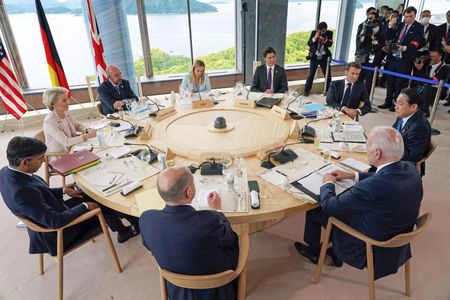
HIROSHIMA, Japan (Reuters) – The Group of Seven (G7) rich nations signalled to Russia their readiness to stand by Ukraine for the long haul while giving President Volodymyr Zelenskiy a chance to win over countries such as Brazil and India on the last day of a summit in Japan.
UKRAINE
* Potential allied training programmes for Ukrainian pilots on F-16 warplanes were a message to Russia not to expect to succeed in its invasion of Ukraine even in a prolonged conflict, said German Chancellor Olaf Scholz.
* President Joe Biden told G7 leaders that Washington supports the joint allied training programmes, senior U.S. officials said, a significant endorsement as Kyiv seeks to boost its air power against Russia.
* Zelenskiy held talks with India’s Narendra Modi and was due to meet other “Global South” leaders at a summit aimed at broadening support for his country in its war against Russia.
* Russian Foreign Minister Sergei Lavrov said G7 decisions at the summit were aimed at the “double containment” of Russia and China.
* The U.S. announced sanctions on more than 300 targets, aiming to punish Russia for its invasion and intensifying one of the harshest sanctions efforts ever implemented. Biden will announce a $375 million military aid package for Ukraine that includes artillery, ammunition and HIMARS rocket launchers, a U.S. official said.
* Britain published plans to ban imports of Russian diamonds, copper, aluminium and nickel and announced a new wave of sanctions against Russia, targeting companies connected to the alleged theft of Ukrainian grain.
* Zelenskiy’s arrival on a French government-labelled military aircraft for the G7 summit in Hiroshima, after addressing an Arab League summit, marked an achievement for French President Emmanuel Macron.
CHINA
* G7 leaders outlined a shared approach towards China, looking to “de-risk, not decouple” economic engagement with a country regarded as the factory of the world.
* G7 nations will ensure big investments in China continue even as they pare risky exposure to the world’s second-largest economy, said German Chancellor Olaf Scholz.
* The G7 is looking to bridge a vast gap with emerging economies in the “Global South” by focussing on infrastructure and debt relief, officials say, part of a strategy to blunt China’s influence in lower-income countries.
* China firmly opposes the G7 joint statement out of Hiroshima and has complained to summit organiser Japan, the Chinese foreign ministry said.
ECONOMY, CLIMATE
* The G7 leaders put support for gas investments back into their communique, calling it a “temporary” step as they try to de-couple from Russian energy, in a move climate activists say may hurt climate goals.
* G7 leaders agreed on an initiative to counter “economic coercion,” pledging action to ensure that any actors attempting to weaponise economic dependence would fail and face consequences.
* The G7 called for the development and adoption of international technical standards for “trustworthy” artificial intelligence (AI) as lawmakers of the rich countries focus on the new technology.
* G7 leaders reaffirmed their commitment to a highly decarbonised road sector by 2030 and committed to the goal of achieving net-zero emissions on roads by 2050.
REUTERS PODCAST
* What’s the G7 to do about China?
IN-DEPTH STORIES
* At Hiroshima G7, bomb survivors grapple with a disarmament dream deferred
* In her own words: A Hiroshima bomb survivor learns English to tell her story
* Japan’s G7 refugee balancing act: door open for Ukrainians, but not many others
(Compiled by Reuters editors)