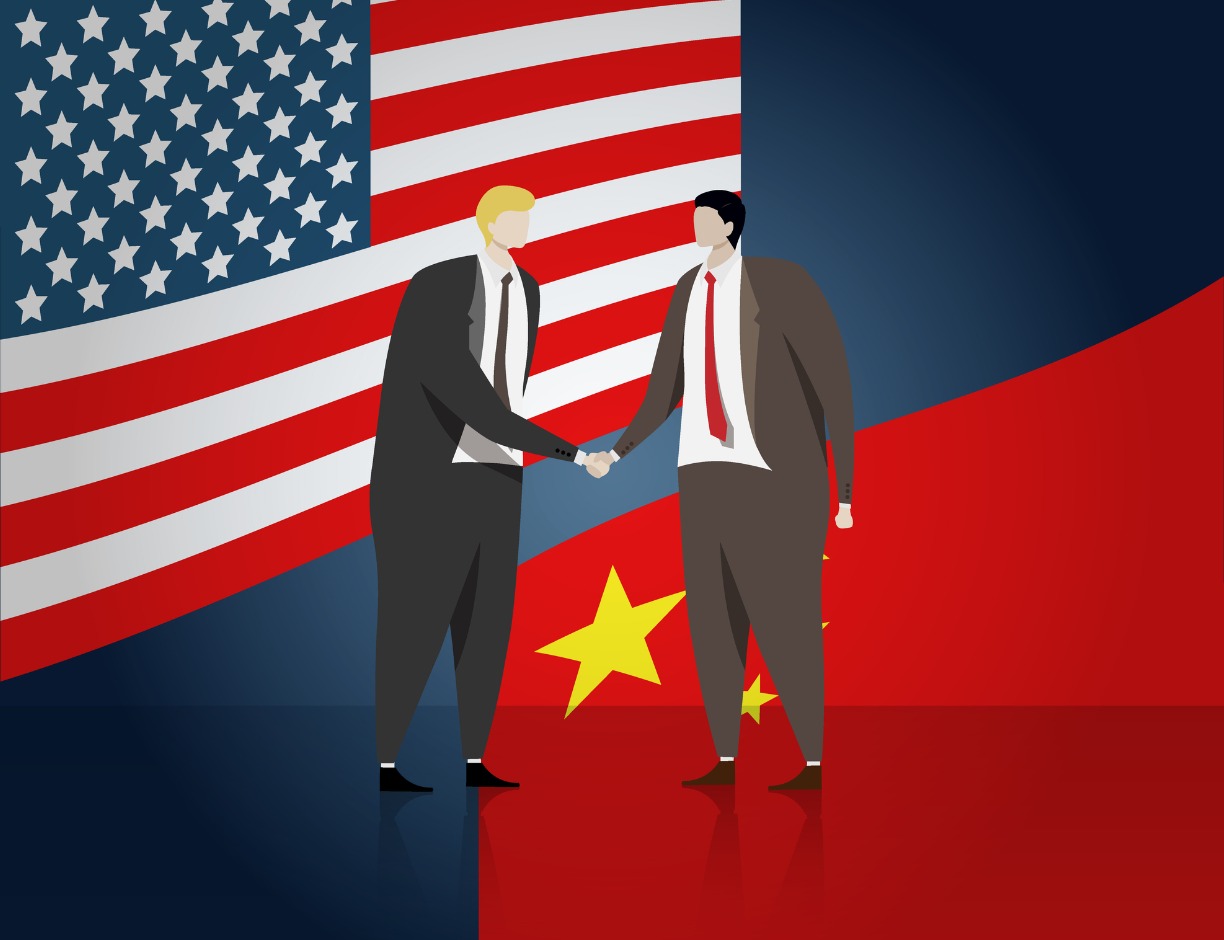
China just extended an olive branch – helping to send markets to higher highs.
All after announcing it’ll halve tariffs on hundreds of U.S, goods worth nearly $75 billion from 10% to 5%. Some goods will see tariffs drop to 2.5% — all taking effect on February 14, 2020.
According to China’s Ministry of Finance, the move was made in order to “advance the healthy and stable development of China-U.S. trade,” as quoted by CNBC. Reportedly, this was timed in conjunction with the U.S. cutting tariffs on $120 billion of Chinese goods — from 15% to 7.5%.
China also noted that additional adjustments will now depend on how well trade issues evolve with the U.S. There’s hope all tariffs can be eliminated on both sides.
It May be a Sign China is Ready to Move Beyond Phase One Deal
“Who knows the exact motivations, I mean that’s quite plausible, that they’re under (economic) pressure. But I think the development is very welcome because you know, that language suggests that there is a bit of an olive branch here. And a bit of a desire to move forward beyond phase-one and possibly take on phase two,” said Kingsley Jones, chief investment officer at Jevons Global, as quoted by CNBC.
“I think that would be good … if we can get these tariff barriers lowered, and get a normalization of relations that also includes some negotiation about those other sticking points, you know the IP and so on. Then I think that’s very positive,” he added.
Despite this news, the U.S. is still leaving tariffs in place on $250 billion worth of Chinese products. However, that could change as we near a potential phase-two deal.
“Just as in this deal there were certain rollbacks, in phase two there will be additional rollbacks,” he told CNBC. “It’s really just a question of — and we’ve said before — phase two may be 2A, 2B, 2C. We’ll see,” says Treasury Secretary Steven Mnuchin, as also quoted by CNBC. “The first step is really focusing on enforcement, but this gives China a big incentive to get back to the table and agree to the additional issues that are still unresolved.”