The U.S. cannabis industry added $1.3 billion in new legal sales in 2024, yet it lost more than 15,000 full-time jobs.
That’s the contradiction at the center of the 2025 Cannabis Jobs Report, released Tuesday by cannabis staffing firm Vangst in partnership with Whitney Economics. The annual analysis tracks job growth, revenue trends and workforce dynamics across every regulated state market.
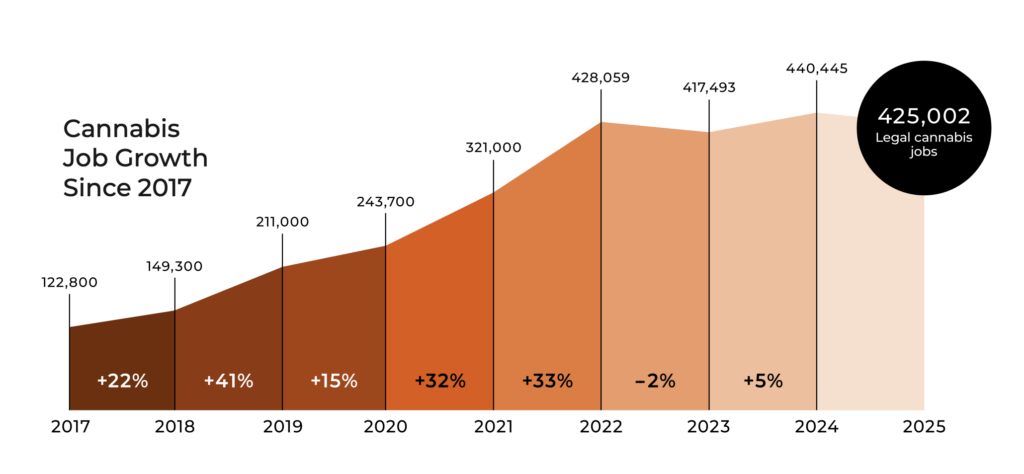
According to the report, the U.S. cannabis sector now supports 425,002 full-time equivalent (FTE) jobs, a 3.4% decline from 2023. This drop came despite $30.1 billion in legal retail sales, a 4.5% increase year-over-year.
“The cannabis industry has shifted from a phase of hypergrowth to one of operational discipline,” said Karson Humiston, CEO of Vangst. “Despite a slight decline in jobs, cannabis remains one of the nation’s leading employment sectors.”
A Flatline In Jobs, But A Jump In Sales
This marks the first notable employment contraction since the post-pandemic boom. Between 2017 and 2023, the industry added hundreds of thousands of new roles, but 2024 brought headwinds like tax pressure, oversupply and regulatory bottlenecks.
Cannabis Job Growth Since 2017
While overall sales rose, employers shifted toward leaner staffing models to preserve margins. Many moved away from full-time hires and instead adopted temp-to-hire or seasonal strategies, especially in cultivation and processing.
State-By-State Shake-Up
Legal cannabis continues to be a major economic driver, especially in states that recently launched or expanded adult-use programs.
Top 5 states by cannabis job growth in 2024:
State
Job Growth
% Change
New York
+8,450
+209%
Mississippi
+532
+103%
Ohio
+2,496
+34%
New Jersey
+2,763
+23%
West Virginia
+606
+73%
Conversely, several mature markets saw steep job losses:
State
Job Losses
% Change
Arizona
-10,749
-52%
Illinois
-7,466
-25%
Maine
-3,848
-51%
Colorado
-2,021
-9%
Michigan
-1,746
-4%
States with Job Gains vs. Job Losses
In Illinois, where the effective sales tax rate on cannabis is 36.25%, consumers continued to cross state lines for cheaper options. That tax pressure, combined with rising competition from hemp-derived THC and the illicit market, capped legal participation and limited hiring.
Strategic Staffing Replaces Expansion
Just 27.3% of cannabis businesses were profitable in 2024, according to Whitney Economics. Another 40% broke even, prompting many companies to restructure.
Instead of growing headcount, companies prioritized:
Short-term or seasonal labor
Cross-functional teams
Operational efficiency over scale
“The industry is maturing, shifting from rapid expansion to smart, strategic growth,” said Beau Whitney, chief economist at Whitney Economics.
States Lead While Federal Reform Stalls
A potential DEA reclassification of cannabis to Schedule III sparked optimism in early 2024. But a postponed hearing and election-year gridlock stalled progress.
With no major federal changes expected in 2025, state-level activity remains the primary driver. New York is projected to nearly double its retail sales this year, while Ohio’s adult-use rollout continues. Maryland, despite a recent tax hike from 9% to 12%, is forecast for further growth.
Meanwhile, California, Illinois and Washington continue to face structural challenges, including high taxes and sluggish consumer participation.
Forecast: $34 Billion In Sales In 2025
Vangst and Whitney project legal cannabis sales will reach $34 billion by the end of 2025, a 13.1% increase over last year. Whether job numbers rebound will depend on market stability, consumer migration to legal channels and tax or compliance relief.
“What we’re witnessing is not a slowdown, but a strategic reset,” said Whitney. “The industry is adapting, adjusting and preparing for its next chapter.”
During a captivating session at the Benzinga Cannabis Capital Conference, Alexa Alianiello, head of U.S. sales and partnerships at X (formerly Twitter), shed light on the unique relationship between the platform and its cannabis-engaged audience.
“Cannabis users are X users. But don’t just take my word for it… A recent study from GWI on smoking behavior states that X is the number-one platform for recreational cannabis consumers,” Alianiello said, emphasizing the platform’s prominence among recreational cannabis consumers.
The data she referred to indicates that X enthusiasts are also 25% more inclined to engage with cannabis recreationally than those not on the platform.
To provide a more nuanced understanding of this demographic, Alianiello shared findings from a proprietary survey conducted by X’s research team. “We actually found that 25% of X users who consume cannabis use it daily.”
Alianiello further elaborated on how cannabis users utilize X as a primary source for industry news, brand discovery and engaging in community discussions. The platform boasts a staggering twenty million posts on cannabis, contributed by four million unique voices. “You have people who are talking about it a lot,” Alianiello pointed out, underscoring the vibrant and active cannabis conversations happening on X.
Catch Alianiello at the upcoming Benzinga Cannabis Capital Conference this April 16 and 17 in Hollywood, Florida. Don’t miss the networking and learning opportunity of the year! Connect directly with industry leaders and key decision-makers, hear and learn from insiders with massive knowledge of the space and anticipate policy shifts that could greatly affect your business. Get your discounted tickets here now or apply to exhibit to get the most out of this event.
Through Alianiello’s insights, it becomes clear that X is not just a platform for social interaction but a critical ecosystem for cannabis culture and commerce. This intersection of cannabis consumers and digital communities offers brands unprecedented opportunities to engage with their audience in meaningful ways. As X continues to foster these connections, the insights shared by Alianiello at the conference underscore the platform’s significant role in the evolving landscape of cannabis consumption and discussion.
This content was partially produced with the help of AI tools and was reviewed and published by Benzinga editors.