After two decades of negotiations, it’s happening…
As the U.S. struggles in solidifying international trade agreements, it appears that the EU has been taking notes and making some long-awaited decisions.
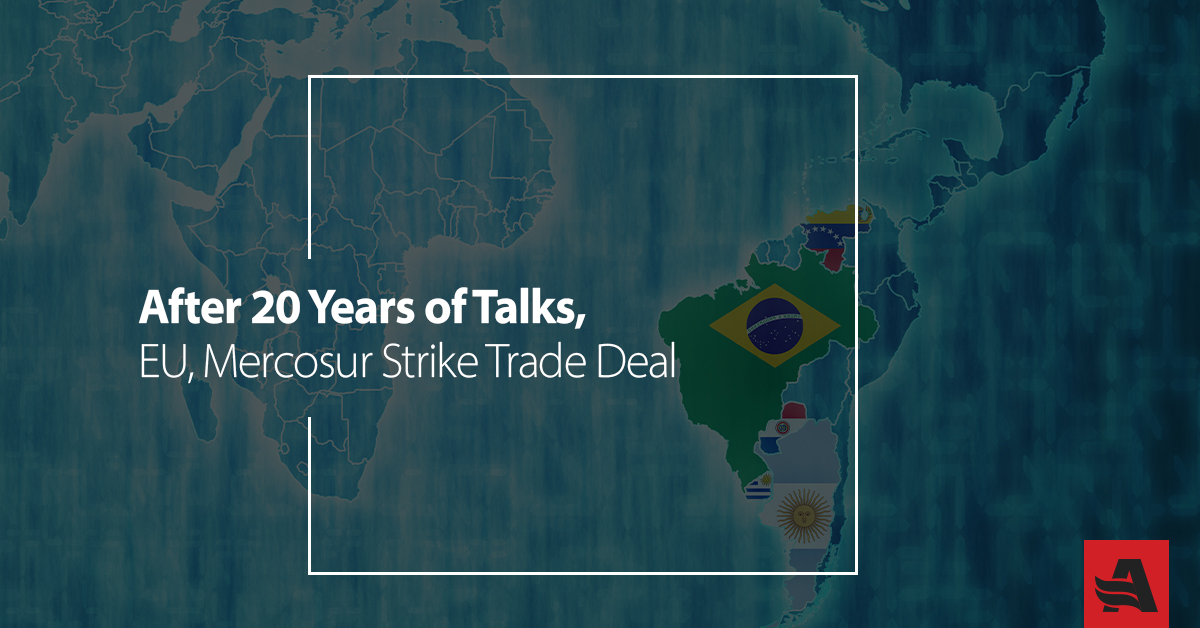
After 20 years, the EU and Mercosur have finally formed an agreement regarding trade talks that have commenced between the two since 1999. In fact, the final agreement made on June 28, 2019, marks the exact 20th anniversary.
Mercosur, aka Southern Common Market, is the fifth-largest international economy and one of the world’s largest economic blocs. It currently consists of Argentina, Brazil, Paraguay, and Uruguay. Venezuela is also a member, but was suspended in 2016 for failing to meet the basic standards.
Mercosur’s biggest exports are transport equipment, chemical and pharmaceutical products, and machinery. Their biggest exports to Europe include agricultural products: beverages, tobacco, vegetable products, meat, and animal products. In 2018, 20% of Mercosur’s trade went to the European Union.
Tensions & International Trade Talks
After U.S. President Donald Trump’s election in 2016, the trade talks between the EU and Mercosur accelerated, and EU and U.S. trade talks froze. However, since Trump’s election, the EU has solidified trade agreements with Japan, Mexico, and Canada.
The final deal between the EU and Mercosur aims to cut and/or remove all trade tariffs between each economic bloc. As stated on BBC, the agreement is based on making products cheaper for consumers while boosting exports for companies on both sides.
Reported by Reuters on June 29, French President Emmanuel Macron stated that the agreement meets French demands. At the 2019 Osaka Summit, he shook hands with Jean-Claude Juncker (President of the European Commission) alongside Germany’s Chancellor Angela Merkel, and Spain’s Prime Minister Pedro Sanchez.
Although tensions have cooled, and agreements have been made, not all reactions are happy.
Greenpeace is up in arms because the likely growth of trade between the two parties will inevitably create a higher demand for Latin American agricultural products which could be a disaster for the environment on both sides of the Atlantic. Greenpeace stated that the trade deal will lead to further destruction of the Amazon rainforests and attacks on indigenous peoples.
Final & Upcoming Agreements
In retrospect, the EU is now Mercosur’s biggest investment and trade partner.
The EU has inferred that their next objective is to increase their access to South American firms to make more industrial products and vehicles, plus to develop an increase in exports of beef, poultry, farm products, and sugar.
How long could it take for the free-trade deal to kick in? According to Brazilian President Jair Bolsonaro, possibly up to three years.
So when it comes to making new deals, this is only the beginning.