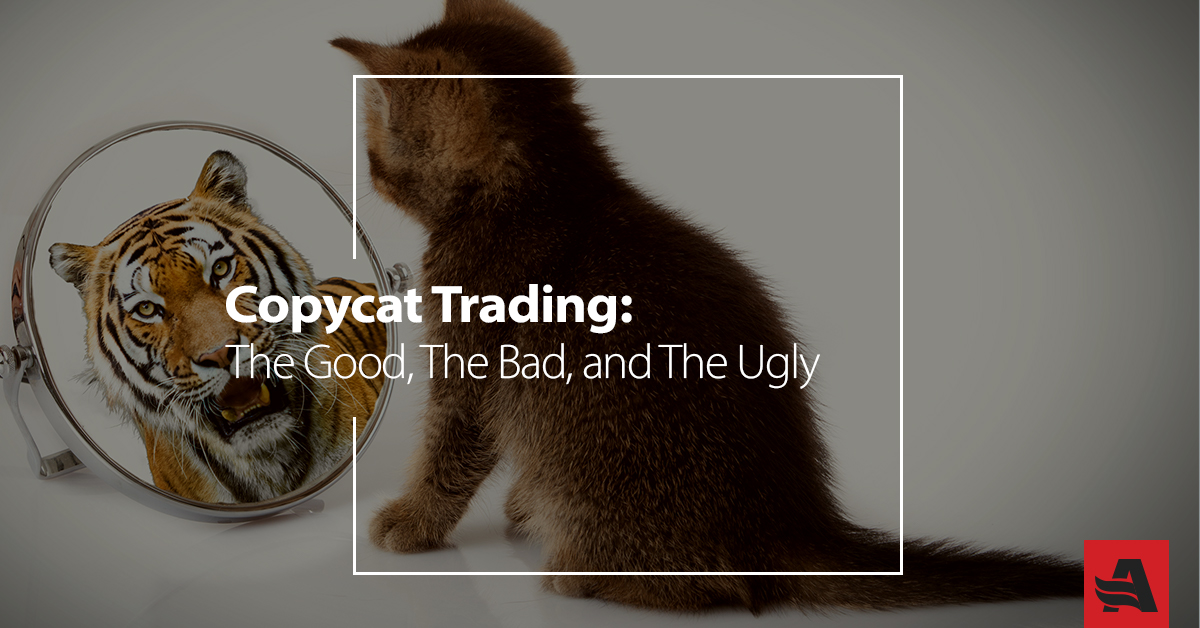
When I talk to students about copycat trading, I’m quick to point out that there are different kinds of ‘copycat’ strategies.
Some people want to actually piggyback on every single trade that somebody else makes. That ‘strategy’ (if you can call it that) is kinda doomed to disappoint, because of lag time and a slew of other factors.
But if you learn to copy someone’s overall style and principles instead … that can have value.
So I teach my Trading Challenge students the downside to a ‘copycat’ scenario: You’re still operating blindly as someone’s follower. You could say you’re trading according to what you see this person doing.
Think that will make you a more self-sufficient trader? Probably not.
The upside of copycatting? Maybe instead of just trying to follow every trade, you look deeply at WHY this ‘guru’ makes certain trades — then you make your own trades based on the same principles.
It’s like Mr. Miyagi training young Daniel for karate: wax on, wax off. It’s an action that leads to a general result. You don’t have someone tell you what to trade … you have somebody tell you how to trade.
Look, some people like the idea of copying someone. You can learn a lot from a mentor. It’s great to learn from someone — I teach people all the time. But the idea of having somebody do it for you just doesn’t apply.
Who Can You Copy?
Let’s go with the word ‘emulate’ instead of copy. If you want to emulate somebody, you usually find someone you respect and whose philosophy seems solid.
You’ll see this principle in play in my Trading Challenge, my contributions to StocksToTrade, and my videos. Because having a good philosophy is super important in trading!
You’ll hear me say that your work has to have meaning. There has to be an idea behind it, not just ‘get rich quick.’
If I’m working on the Save the Reef project or building the Trading Challenge, I’m thinking about my own guiding philosophy as well as how trading really works, practically. That’s a big part of how I got from a regular middle-class childhood to a jet-setting financial career.**
So here’s the part about who you should NOT copy.
There are those high-power hedge fund guys who lurk in the corners of Manhattan.
Don’t bother with them.
Listen, those aren’t the guys to blindly follow or imitate. They have piles of money at their fingertips — other people’s money. You don’t.
Plus, they tend to be light on philosophy and heavy on leveraging money in a purely tactical way. That doesn’t help you, because again, you’re not one of them. You don’t need to be one of them!
Okay … so who’s worth copying?
Here’s what I think: You should ‘copy’ someone you vibe with. Someone who’s transparent in all of their trades. I’m talking full disclosure — wins and losses.
Look for someone whose strategies and tactics are in line with how you want to approach the market and trade.
And I would consider their philosophy too (big surprise, right?). How do you feel about this person’s approach the market, each trade, or the people they mentor? Heck, how do you feel about how this person relates to the planet?
And finally, look for someone with a solid track record (c’mon, don’t waste your time following newbies) and who’s found success.
photo ID: 582335989 created by Constantin Stanciu – shutterstock.com
One Great Technique
Now, let’s talk about the types of things that I tell my students in terms of technique. You need an arsenal of weapons, like buy-and-hold, day trading, short selling, swing trading … you get the idea.
How about another?
Okay, look, the fishing comparison is hugely cliché, right? But it’s still a great analogy, because a fish is an asset, and you’re trying to hook that asset.
I want to talk about a technique that’s worth copying.
Let’s talk about cutting losses.
Cutting losses is critically important, and I talk about it all the time. The idea is that you get out of bad trades quickly, both to protect your account and so that you can go on to the next trade.
I won’t totally dive down the rabbit hole here, but this is basically how it works…
You get into a trade that you think is amazing. But then it doesn’t go as you planned or thought. But now you’re already in it. You think maybe if you hang on, things will turn around.
Don’t do it! Get out of that trade! This almost always becomes a disaster. Do it enough and it can obliterate your account. I tell my students to quickly cut losses and move on. It starts to become almost mechanical.
So, back to the fishing analogy … It’s like learning a great cast: a snap of the wrist and a great lie for the line where you stand a better chance of getting a fish. See where I’m going with this?
There are many other examples of copying technique, but this is a good example because it’s both simple and effective. Actually, it’s not simple, but it’s a relatively straightforward concept.
Applying it is the problem. This is where there’s an art to trading and where you can’t really teach everything. You’ll either get really good at cutting losses … or you won’t.
But you can learn from people who give you these general principles and even more technical strategy, and then you can continue to learn on your own.
Okay, here are a few more fundamental components of a greater technique and strategy.
Photo by AlexLMX shutterstock_413482558
1. Volatility
Volatility in the stock market means higher risk … but it can also come with higher rewards. So you have to embrace that volatility and be smart about it. Okay, Zen master, what does that mean?
Careful, grasshopper … careful. You have to be prepared for every single trade.
2. Patterns
I often talk about mastering patterns, then applying that knowledge.
Nothing is exactly cyclical. History doesn’t always repeat itself, but you can often find patterns. So learn to spot patterns.
And when you learn a pattern well, you can apply your principals intelligently. If you only kinda learn a pattern, well, you’re looking down the barrel of some pretty ugly risk.
But again, when it comes to copying, you can copy what someone else has done only to a certain extent. You’ll have to blaze your own trail at some point.
3. Catalysts
No, this isn’t a chemistry lesson. Don your economic hats instead. There’s almost always a catalyst for stock movement.
This one is really interesting because you can contrast it with what they call ‘insider trading.’ What’s insider trading? Well, it’s using inside information to make a trade. Clear as mud. Not ethical.
With catalysts, you’re looking for public information that everyone can access so no one can remotely accuse you of insider trading. You can be the lily-pure trader whose hands are washed of all blame. And you can still make money … if you study hard, work your butt off, and dedicate yourself to trading smarter.
Awesome, right?
Image by Cifotart — shutterstock 594485654
4. Using Available Tools
You can also use a stock screener to your advantage.
For example, you can use one that I helped build at StockstoTrade.
Again, this is a tool that can help you scan, research, and understand what you think will happen in the stock market and in your planned trades.
There’s a lot of complexity to this, but you could say in a nutshell that you’re just looking for raw data for analysis and to make insights or to collect intel to make your own plays … or digging for mushrooms in a pile of crap!
Want to be a self-sufficient trader? If you’re truly dedicated to your trading education, join my Trading Challenge. I’ll teach you the basics, show you how I trade, and help you learn to face the markets on your own.
How do you copycat trade? What strategies do you like to copy? Leave a comment and tell me what you’ve learned in the process!