By Devik Jain and Shreyashi Sanyal
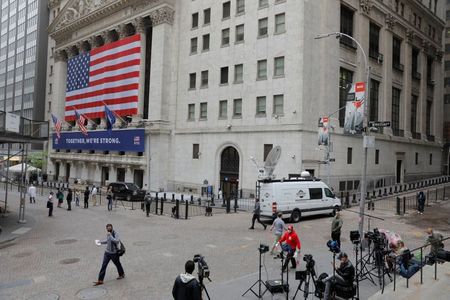
(Reuters) – Wall Street’s main indexes hit their lowest in nearly seven weeks on Monday as concerns about fresh coronavirus-driven lockdowns and a stalemate in Congress over more fiscal stimulus raised fears about another hit to the domestic economy.
All the major S&P indexes were down, with energy <.SPNY> leading declines as oil prices slid on the possible return of Libyan production and rising coronavirus cases.
The CBOE Market Volatility index <.VIX>, a measure of investor anxiety, shot up to its highest level in nearly two weeks.
Wall Street has tumbled in the past three weeks as investors dumped heavyweight technology-related stocks following a stunning rally that returned the S&P 500 and the Nasdaq to record highs.
Another round of business restrictions will threaten a nascent recovery in the wider economy and add further pressure on equity markets, analysts said. The first round of lockdowns in March had led the S&P 500 <.SPX> to suffer its worst monthly decline since the global financial crisis.
In contrast to last week’s trend, declines were led by value-oriented sectors such as industrials <.SPLRCI> and financials <.SPSY> as opposed to technology stocks <.SPLRCT>.
Analysts said the passing of U.S. Supreme Court Justice Ruth Bader Ginsburg also decreases the chances of another fiscal stimulus package to help lift the domestic economy from a deep recession.
Tom Martin, senior portfolio manager at GLOBALT Investments in Atlanta, said finding a replacement for Justice Ginsburg is going to take up the time and energy of Congress.
“So there’s going to be very little bandwidth for putting in a new fiscal bill with this new development.”
Congress has for weeks remained deadlocked over the size and shape of a fifth coronavirus-response bill, on top of the approximately $3 trillion already enacted into law.
The passing of Justice Ginsburg could also lead to a tie vote when the Supreme Court hears the challenge to the constitutionality of the Affordable Care Act (ACA) in November, Brokerage Mizuho said.
Healthcare provider Universal Health Services <UHS.N>, which is expected to have the greatest exposure to the reform, fell 11.9%.
At 11:39 a.m. ET the Dow Jones Industrial Average <.DJI> was down 892.05 points, or 3.23%, at 26,765.37, the S&P 500 <.SPX> was down 83.06 points, or 2.50%, at 3,236.41 and the Nasdaq Composite <.IXIC> was down 211.02 points, or 1.96%, at 10,582.27.
JPMorgan Chase & Co <JPM.N> and Bank of New York Mellon Corp <BK.N> fell 4.4% and 4.9%, respectively, on reports that several global banks moved large sums of allegedly illicit funds over nearly two decades despite red flags about the origins of the money.
The S&P banking subindex <.SPXBK> lost 4.3%.
Nikola Corp <NKLA.O> crashed 20.3% after its founder Trevor Milton stepped down as executive chairman following a public squabble with a short-seller over allegations of nepotism and fraud.
General Motors Co <GM.N>, which took an 11% stake in Nikola for about $2 billion earlier this month, slipped 6.7%.
Airline, hotel and cruise companies tracked declines in their European peers as the UK signalled the possibility of a second national lockdown. [.EU]
Declining issues outnumbered advancers for a 10.22-to-1 ratio on the NYSE and for a 6.86-to-1 ratio on the Nasdaq. The S&P index recorded one new 52-week high and one new low, while the Nasdaq recorded 11 new highs and 43 new lows.
(Reporting by Devik Jain and Shreyashi Sanyal in Bengaluru; Editing by Sagarika Jaisinghani and Anil D’Silva)

The post Wall Street near seven-week low on virus fears, stimulus fog appeared first on Morningology.